
The Pillar’s Edgar Beltran is joining Pope Leo on his historic Peruvian homecoming trip. You can follow along with Edgar here, with dispatches that will be updated as his trip continues.
—
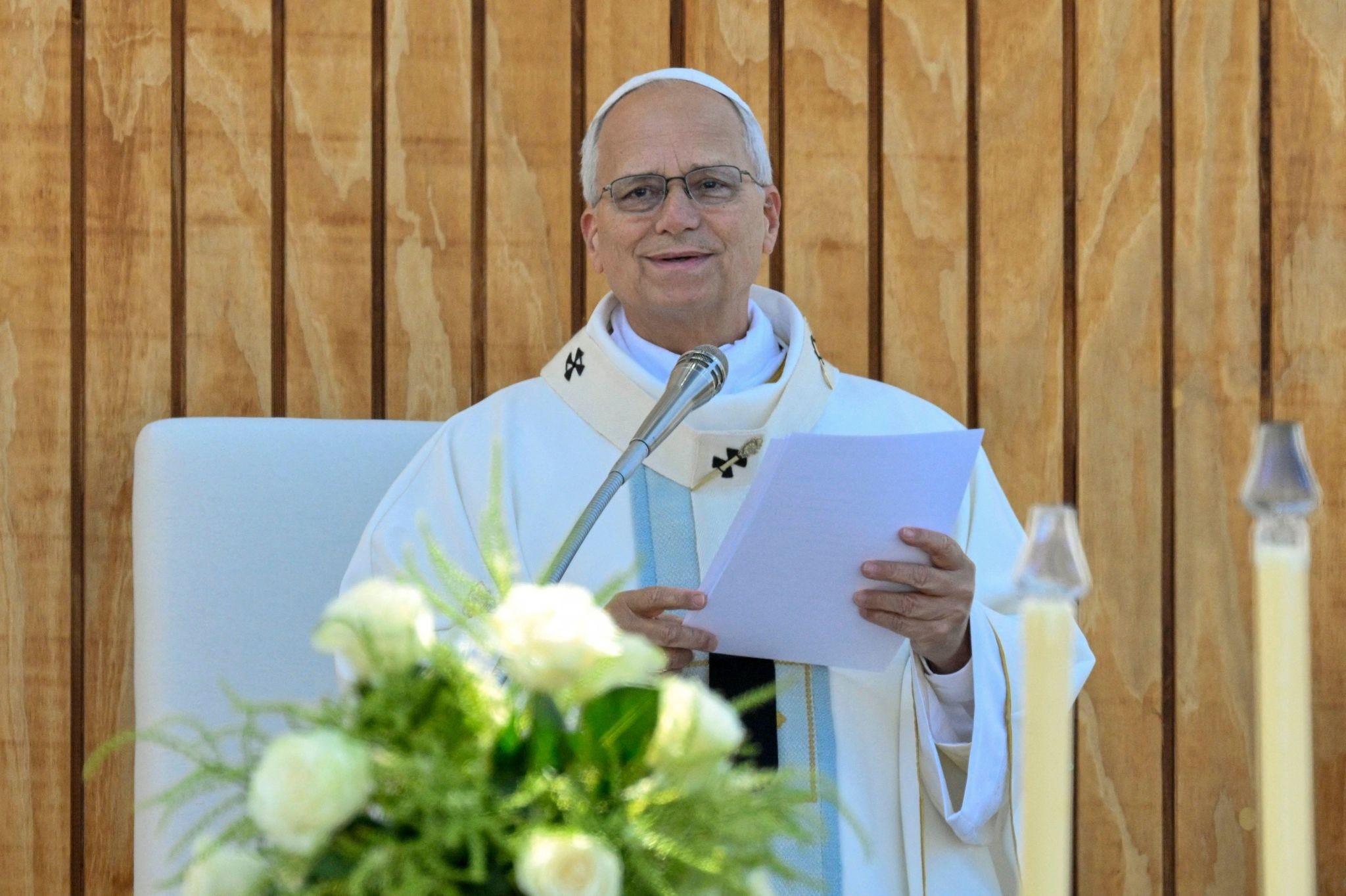
Elevated by grace
The pope celebrated the last Mass of his apostolic trip to Peru on Nov 16 in the Las Palmas airfield in Lima.
His homily Monday was a homage to Saint Toribio de Mogrovejo, recalling that the saint “insisted that priests learn Quechua and fought for the ordination of Indigenous people and mestizos, whom many members of the clergy still held in contempt.”
With the homily coming after all the pope’s speeches and homilies throughout the trip, it has been widely taken as a capstone homily: It seemed to show the pope’s desire for the Church in Latin America.
The pope said that Saint Toribio “wanted Indigenous people to evangelize their own relatives, friends and neighbors. Indeed, he wanted them to choose to lay aside their ancestral beliefs freely, without coercion.”
“He was firmly convinced that gentleness was the only way to proclaim the “true religion,” as Bartholomew de Las Casas had taught,” the pope said.
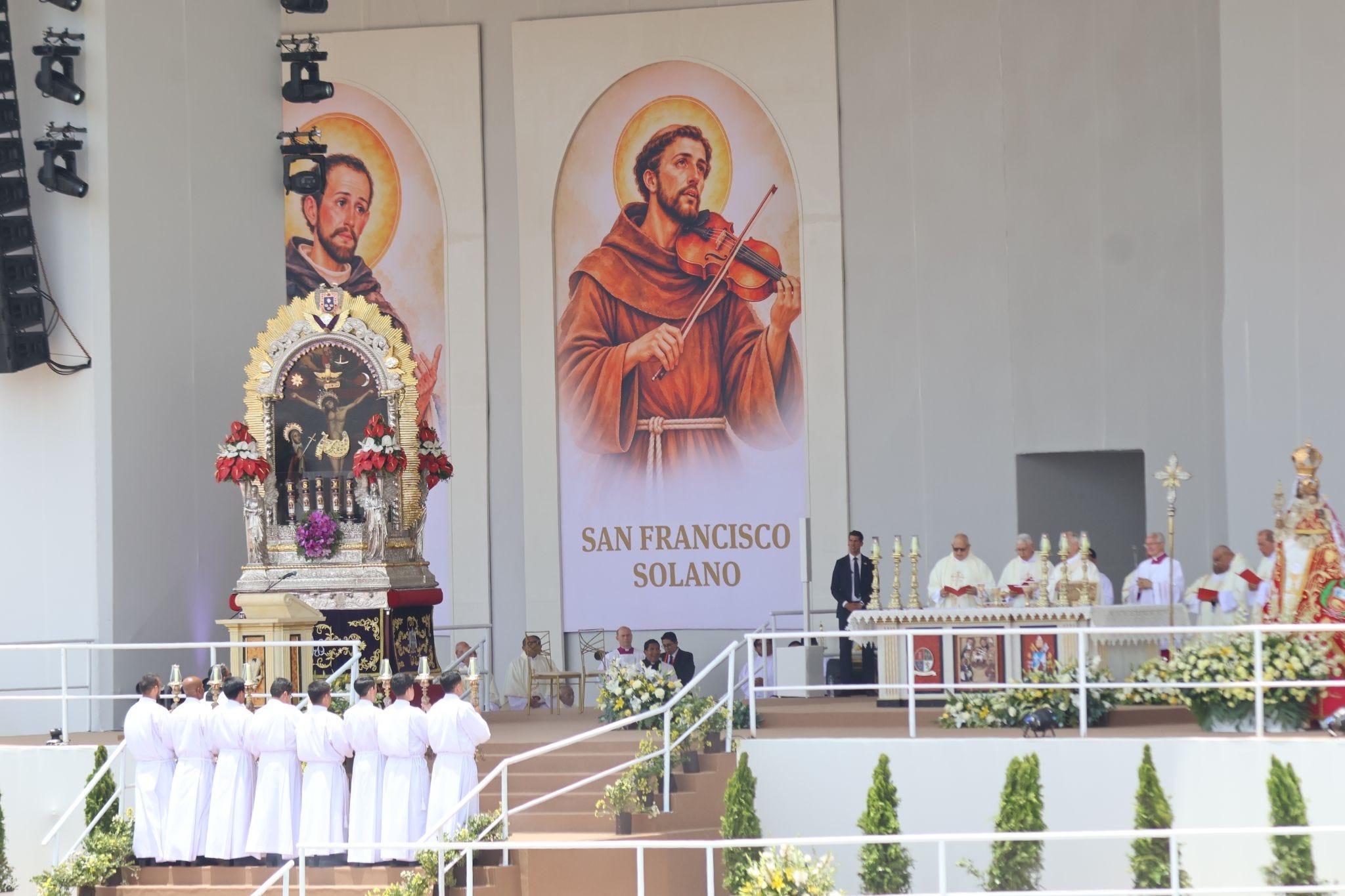
It was a homage not only to Saint Toribio, but to all missionaries who evangelized these lands – despite historical attempts to erase or diminish their work in the continent, both from the radical left and the liberal right, calling the Church to be rooted in the sacraments to evangelize the world and serve the poor and the dispossessed.
“The only ones who cannot wait are the poor. By excluding no one and welcoming everyone, Saint Turibius took particular care of the most neglected,” the pope said in his homily.
“I too wish to confirm you in faith and charity, and assure you that I will always carry you with me. Yes, the Peruvian people are my people too!” the pope said to a thunderous applause.
“By opening our hearts to God we can live out the fundamental relationship that enables every human being to reflect the divine image. Through our bond with the Trinity, our hearts are healed and elevated by grace; and we can then open ourselves to our brothers and sisters in order to heal, love and serve them with the goodness of the Lord, he added.
If you haven’t read any of the pope’s homilies or addresses in the trip, just go to today’s homily. You won’t be disappointed.
Chaos in Lima
The Lima leg of Pope Leo’s trip to South America has been criticized for disorganization, alleged politicization of events, and the exclusion of priests from the events in Lima without much explanation.
The events in Lima were organized by a team appointed by Cardinal Carlos Castillo Mattasoglio, who has come under fire for his doctrinally dubious statements, and alleged financial mismanagement and cover-up of sexual misconduct and abuse cases in the Archdiocese of Lima.
Papal masses in Argentina were record-breaking events, with the masses in Buenos Aires and Luján now among the five largest papal masses in history.
Moreover, the Mass in Chiclayo drew a crowd of almost a million people, while the city of Chiclayo only has 600,000 inhabitants and the whole diocese serves 1.3 million.
Therefore, many expected that the Mass in Lima would be record-breaking, considering that it’s the country’s capital, much easier to reach than Chiclayo, and has one of the largest metropolitan areas in Latin America, with over 11 million inhabitants, even more than cities like Chicago or Dallas.
Most estimates indicate that the crowd was around 1.5 million people, which is a significant draw but many thought that the crowd could have been much larger with better organization.
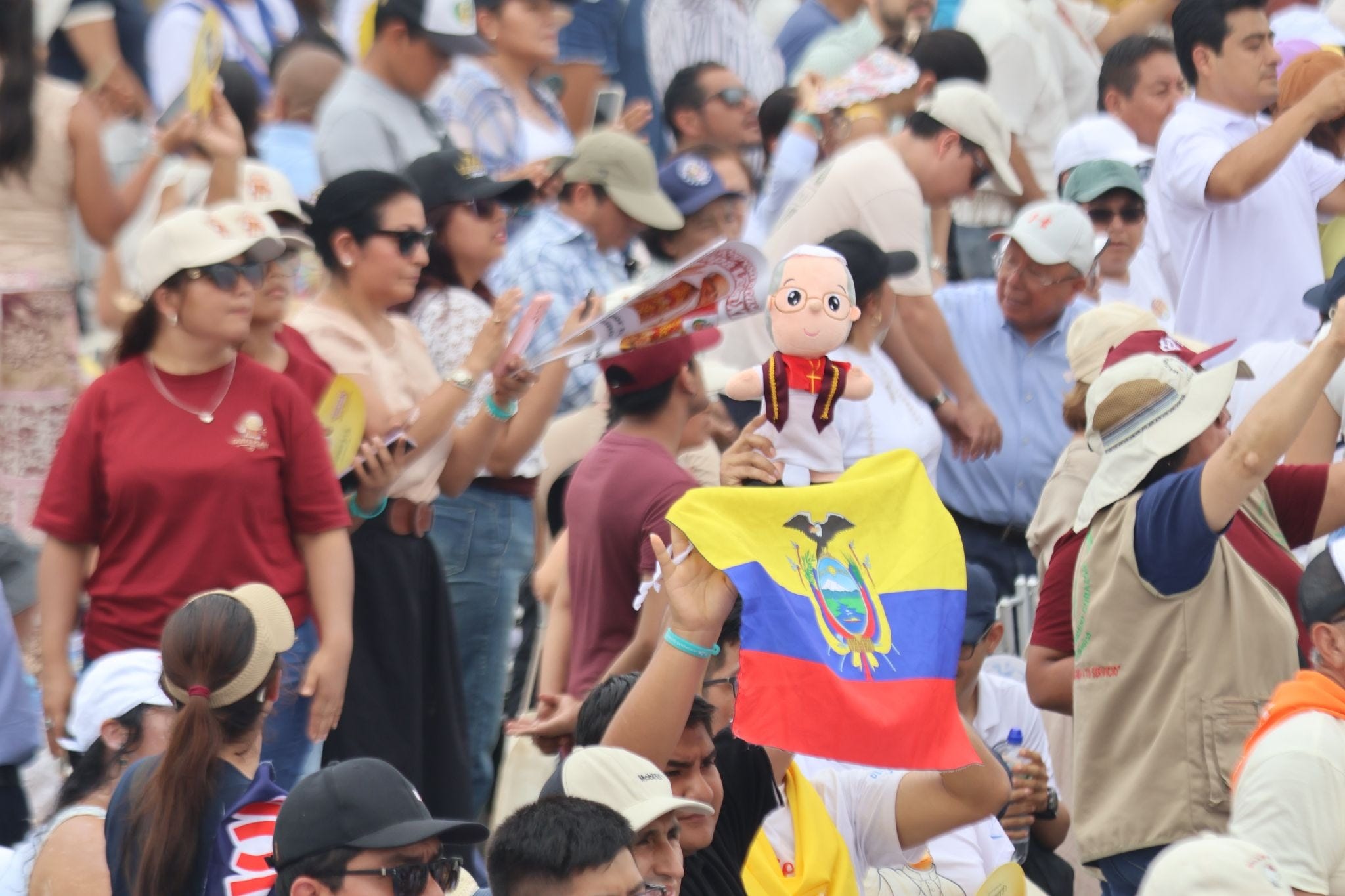
For example, several videos circulated on social media showing people leaving as the Mass started because the sound and the screens were failing so they couldn’t follow the Mass.
Several sources in the Archdiocese of Lima blamed the fact that the crowd was less than expected on the fact that the organizers decided to use electronic tickets for the Mass, instead of paper tickets or just allowing free access to the Mass.
“We’re not a country with a lot of tech literacy, a lot of older people don’t have phones, don’t have emails, don’t even know how to use a computer, so a lot of people didn’t register when told they had to do it online or tried and failed,” a source told The Pillar.
“And also, a lot of people tried to register but never got the confirmation email, so the system wasn’t working well either,” the source added.
The same situation occurred in the prayer vigil with the youth on Nov. 12. For most of the event, several free spaces could be seen in the broadcast, both in the pitch and in the stands.
A source close to the organization told The Pillar that access to tickets was severely limited, with most of Lima’s suffragan sees receiving only 100 tickets for their whole diocese.
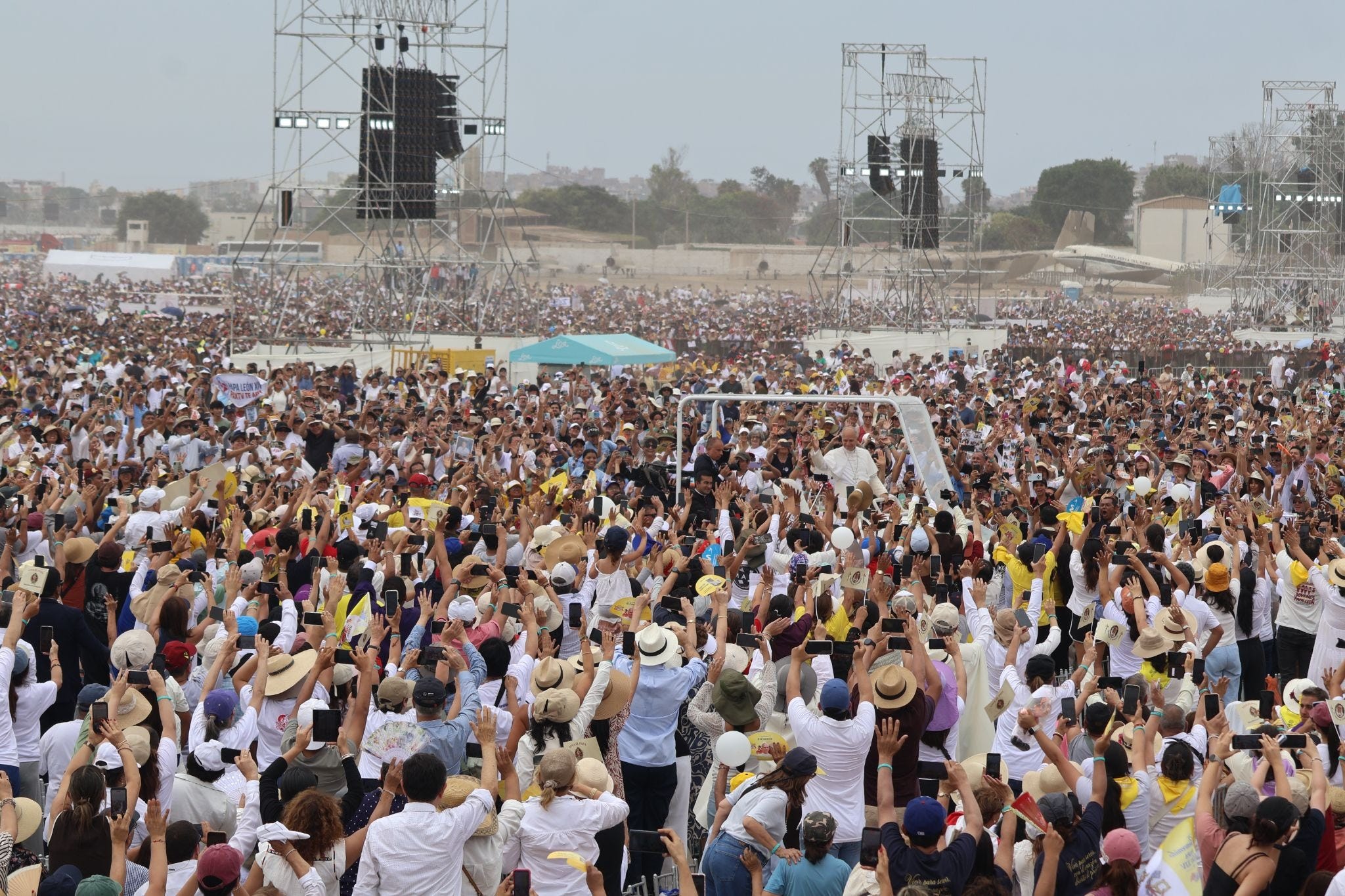
In the end, the organizers opened the doors to thousands of people without tickets to fill up the event, and by the time the pope gave his speech the stadium was mostly full.
However, the main criticism of the vigil was Cardinal Castillo’s speech.
The original version of his address sent to journalists was only seven lines long but Castillo went off script, referring to two young people killed during protests in Peru in 2021 as “martyrs,”in a comment that was widely panned on Peruvian media as an attempt to politicize the event, while several priests and diocesan officials in Lima and other dioceses told The Pillar that the comments were found divisive and “unnecessary” by many in the Peruvian Church.
Castillo was also criticized for allegedly banning several Lima priests from participating in the papal activities in the city.
Two different priests told The Pillar that they were told only parish pastors and vicars were allowed to partake in the meeting with the clergy and religious in the Cathedral of Lima, therefore excluding chaplains and priests without any pastoral assignment.
However, one parish vicar told The Pillar he was also excluded, while a parish priest told The Pillar one of his parish’s vicars was also excluded from the event. Some were excluded from today’s Mass for the same reason.
Castillo has been criticized in the past for allegedly leaving several priests in his diocese without a pastoral assignment despite there being no complaints of misconduct, no sanctions, and no investigation pending against them.
In fact, all excluded priests that spoke with The Pillar seemed to believe they were being excluded for a combination of factors somewhat connected to one another: that they’re perceived as theologically too conservative for the cardinal’s liking, that they worked closely with Castillo’s conservative predecessor, Cardinal Juan Luis Cipriani, or that they’re perceived – rightfully or otherwise – to be connected to the now-dissolved movement Sodalitium Christianae Vitae.
South America’s Top 40
Many readers have been pleasantly surprised with the music used in the trip and about Latin American and Spanish Catholic music in general, as it now seems to be in vogue after ‘Alma Misionera’ has become the unofficial anthem of Pope Leo’s pontificate.
Several of you have asked me to compile a list of Catholic music in Spanish.
A couple of small clarifications before the list. I’m not making a list of personal preferences, but the ones that are widely popular in Latin America. Also, I’m Venezuelan. I’ve been to Mass extensively in Colombia and Spain. So perhaps there are some hymns who are very popular in Mexico, the Dominican Republic or Ecuador that I don’t know of. Feel free to post recommendations in the comments.
I’m also omitting songs that are commonly used but have doctrinally ambiguous lyrics or were originally written by Protestants. I have nothing against our separate brethren, but we’re talking about Catholic songs. So, no ‘Aunque no te pueda ver’ – ironically used during communion in many parishes – or ‘El Alfarero.’
Some of these songs originated in Spain. For simplicity’s sake, I’m just calling them Latin American, as we’re talking about songs that are popular in Latin America. If they stole our gold, we can steal their songs.
Lastly, this is not an exhaustive list. I’m admittedly not a musician, much less a liturgical musician, despite my wife’s insistence that I should join a choir.
With you, The Pillar’s Latin American contemporary liturgical music playlist.
Alma misionera
The absolute anthem of the pope’s trip, with images of Leo singing it from the top of his lungs with fireworks exploding around him in Luján.
The song originated in Argentina in the 80s, quickly becoming popular in Argentina and neighboring Uruguay, where a Mexican priest who was on mission in Uruguay heard it in a parish and then became the first one to record it, after which it became widely popular throughout the region.
Easy to sing, easy to arrange in a more traditional manner, and appropriate lyrics.
Vida en abundancia
Somewhat unknown before the trip and relatively new compared to most songs on this list, people have gotten to know it during the Argentinian leg of the trip. Again, easy to sing and arrange, and beautiful biblically inspired lyrics --- and I have to thank my wife’s Marian Congregation back in Venezuela for introducing me to this song when it wasn’t still that well known.
Pescador de hombres
By far, the most recognizable Catholic hymn in Spanish. Some say it’s Latin America’s ‘On Eagle’s Wings.’ I wouldn’t go that far. It’s a little annoying. But it’s an annoying classic.
I used to hate it, mostly because it was everywhere, so using it at Mass seemed to betray a severe lack of imagination. But I heard it at Mass yesterday after three years without going to Mass in Latin America and I realized I’ve missed it. It’s too cheesy for some, but as the choir in Pucallpa showed, it can be interpreted beautifully.
It has also become somewhat controversial as of late, after its composer, Cesáreo Gabaráin was posthumously accused of abuse in 2021, and it has been banned in some dioceses in the US, despite the fact that the Archdiocese of Madrid said it couldn’t corroborate the accusations and closed its investigation. Still, I’d say that unlike a certain Slovenian priest, people don’t think of Gabaráin or his abuse when they listen to ‘Pescador de Hombres.’ In fact, they probably haven’t a clue of who that man is. Make of that why you will.
Siervo por amor
The absolute GOAT of contemporary Spanish Catholic hymns. I’m sorry. It’s in a completely different league. The difference in quality between ‘Siervo por Amor’ and other contemporary hymns is about the same between a professional MLB player and me.
Unfortunately, most recorded versions of the song don’t do it justice and it just calls to Heaven for a good organ version.
Cerca de ti, Señor
The Spanish version of ‘Nearer my God to thee,’ and, unfortunately, one of few preconciliar hymns to still be in common use in Latin American parishes. Fantastic song, especially as interpreted by Hermanas de la Cruz de Sevila.
Himno de los adoradores
The official anthem of the 1911 Eucharistic Congress, held in Madrid. A Corpus Christi staple. Much like ‘Cerca de ti, Señor,’ one of the few preconciliar hymns to still be in common use in Latin American parishes. And much like it too, beautifully interpreted by Hermanas de la Cruz de Sevila.
Alabaré
Perhaps not the most liturgically appropriate as it invites not-so-liturgical dancing, but an absolute banger. I can’t add anything else.
Estamos de fiesta con Jesús
I think I might be breaking my rule of no Protestant songs. But I can’t help it. Liturgically inappropriate for the same reasons as ‘Alabaré,’ but you can still dance to it in your car. Or your house. Or at a party. Or anywhere.
It also became a meme due to this video.
Mi Dios está vivo
Best known as “Hay que nacer del agua.”
I’ll tell you a secret about this song: Growing up I knew a dance that was supposed to accompany it. More on that to come.
Hakuna
Hakuna is not a song, but a group and a growing Catholic movement originated in Spain. It’s by far the most recognizable Catholic music group in the world. Most of their music is intentionally not liturgical (although they do have some liturgical songs, like their own Kyrie), but to be used in the Holy Hours they organize throughout the world and from which the movement has grown or just as Catholic pop music to be played in Spotify or in a concert.
By far, my favorite Hakuna song is ‘Arde,’ sung from the perspective of Saint Joseph, but others such as ‘Sencillamente,’ ‘Huracán,’ and ‘Un Segundo,’ have become instant classics.
Qué alegría cuando me dijeron
The most common entrance hymns in Latin America. Catchy, simple, and Scripture-based.
Madre / Santa María del Camino
Every Latin American kid is taught these two Marian songs in catechesis. They’re admittedly children’s songs, so it’s slightly bothersome when they’re played as closing hymns at Mass. But if your child is learning Spanish and you want to teach him Catholic songs, it’s perhaps the best way to start. Can’t go wrong with Our Lady.
Misa criolla
The Gloria of the Misa Criolla was sung during the pope’s closing Mass in Lima. It’s not common at all in Venezuela, but it’s widely considered a masterpiece in the Andean region and Argentina. I’ve been awe-struck every time I hear it. It’s majestic.
-
Fray Richard
Fray Richard is not a song but a person. Fray Richard – in Latin America many friars go by ‘Fray’ instead of ‘Father’ even after ordination – was my parish priest for many years back home. I’ve spoken briefly about him before.
His Masses were an hour and a half long or more. They started late. They were interrupted by several spontaneous mini-homilies he gave throughout the Mass, right after the entrance, before the start of the Eucharistic prayer or after communion.
Fray Richard was also a Catholic reggaeton singer. With music videos, albums and all.
As a lukewarm Catholic teenager, I found his Masses deeply annoying. I wanted a 45-minute Mass with a forgettable homily, as long as I could leave the place pronto.
When I started taking my faith more seriously, I stopped attending his parish.
But I never stopped appreciating the man. Fray Richard grew up dirt poor in Panama. He learned to steal as a child. Several of his siblings and friends ended up killed in gang wars or in prison, and he was on the same path, until somehow, he found himself in the hands of Mercedarian priests, known for their work as prison chaplains and among the poor.
He became a Mercedarian himself. He underwent a radical metanoia as he said often in his homilies.
He went on to serve as a prison chaplain in Panama, ministering to many of those on both sides of the gang wars that killed friends and family. There, he started recording Catholic reggaeton videos, sometimes even with the inmates he served as a chaplain.
He was eventually sent to Venezuela, where he served in my parish, which was right by a crime-riddled poor neighborhood.
And there, he ministered with a perennial smile to all with the same love, rich and poor, criminals, single mothers, addicts, and those affected by migration and the crisis in the country and saving hundreds of souls from crime, despair, and sin.
I’m not half the man he is, but I can now see the immaturity of my thinking when I was young, and why hundreds came to see him preach on Sundays or celebrate a Holy Hour on Thursdays. It was difficult to find a seat in Mass in his church unless you arrived about 15 or 20 minutes early.
His liturgies might’ve been rather cheesy and long, but this man pointed his parishioners towards the suffering, poor, but loving Christ.
And ‘Yo creo en el amor,’ ‘Hoy Señor yo quiero,’ and ‘Limpia mi mente’ are absolute bangers. Just don’t use them as communion hymns.
Msgr. Edgard’s church
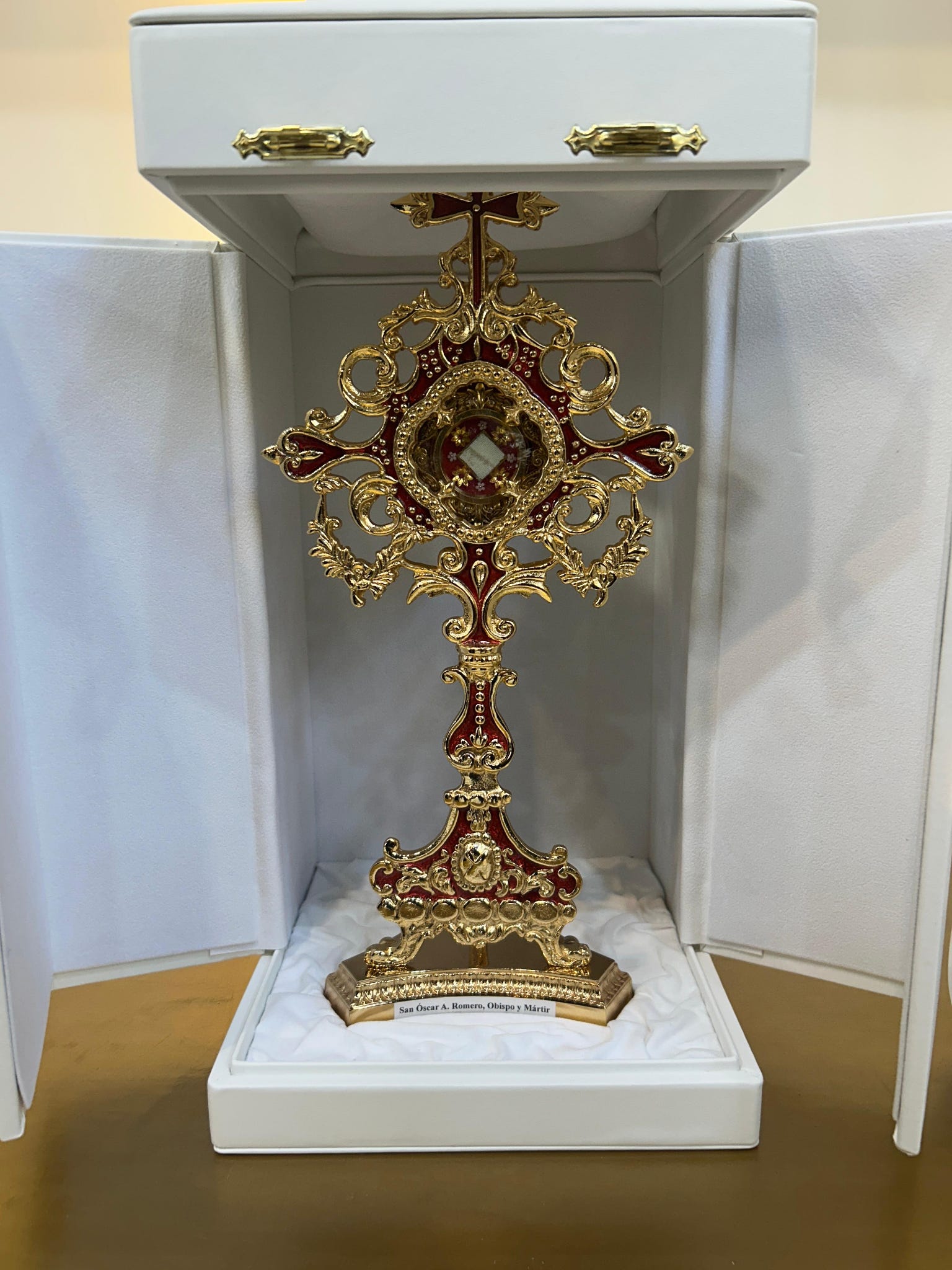
Pope Leo on Friday visited the childhood parish of his priest secretary. And the pope had a lot do with a renewal at St. Oscar Romero chapel.
Narrow is the way to Santa Cruz
The road to Santa Cruz de Succhabamba is made for saints and madmen. I’m sure I’m not the former; I hope I’m not the latter.
For his part, Pope Leo will visit Santa Cruz on Saturday without taking the road; he’ll arrive by helicopter from Chiclayo, the city where the pope was bishop.
But my journey to Santa Cruz began early Thursday morning.
We got in a 15-seat van soon after the sun came up. The drive usually takes around three-and-a-half hours from Chiclayo.
“I reserved the passenger seat for you,” my guide said with a knowing smile. “That way you’ll enjoy the view better.”
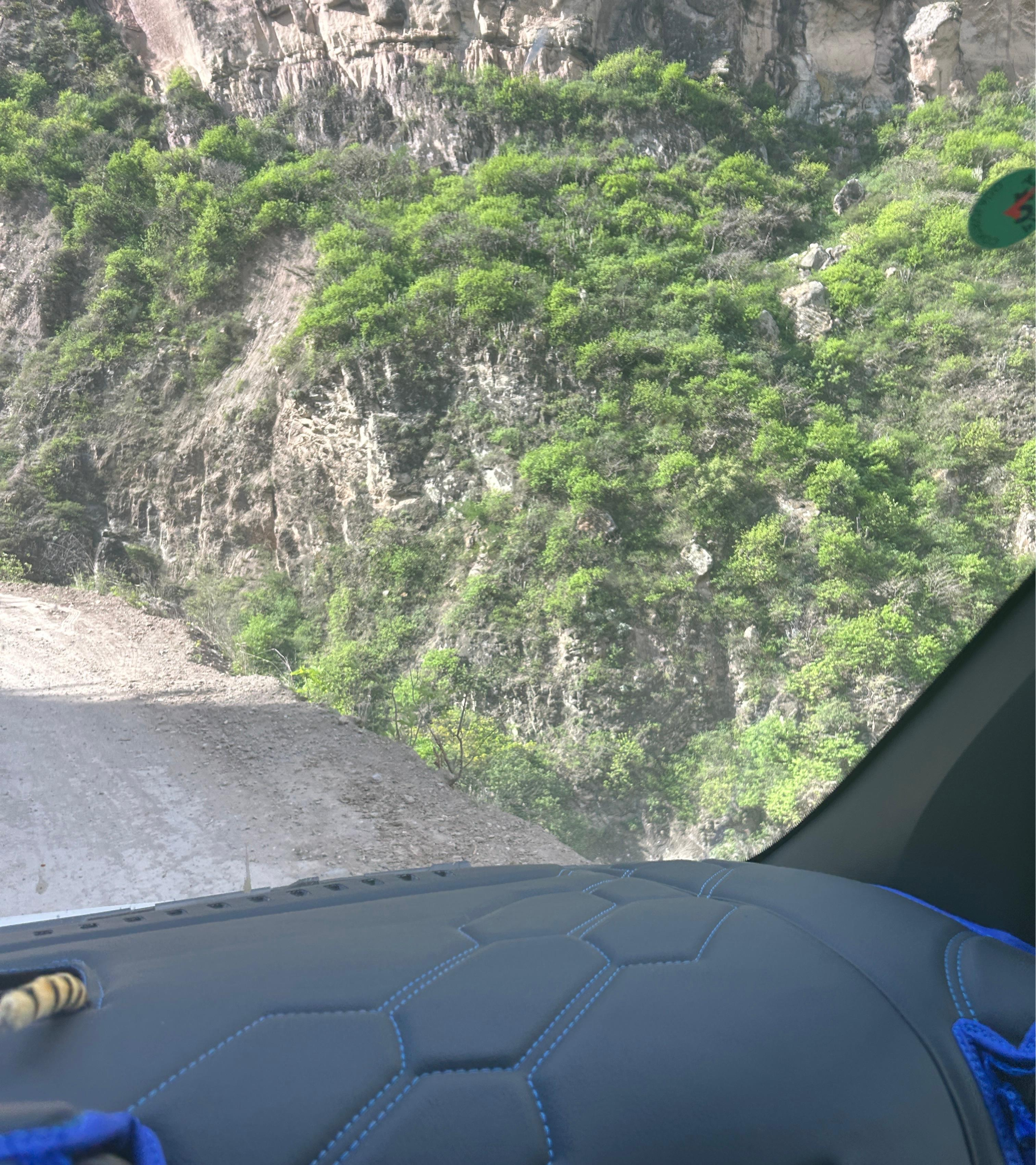
The scenery was beautiful. The few pictures I was able to take through the dirty windshield don’t do justice to the breathtaking green mountains and the rocky river flowing along the road.
I had been warned about the road, though.
Bishop Jesus Moliné, the pope’s predecessor as Bishop of Chiclayo, told me that the roads once were all unpaved and narrower, so buses had to drive with two wheels up the on mountain slope, going diagonally across the road—or sometimes with one wheel literally hanging in the air—in order to get through.
“I’ve gone through mountain roads before, how bad could it be?” I asked myself as the trip started. And, at first, I didn’t think much of it. There was no guardrail, but the road was mostly paved and it didn’t seem like it would be too bad.
I was wrong. Very wrong.
The van started zig-zagging through the road as it went up in the mountains. Every time I think to myself that it’s actually not that bad, it gets worse.
The road gets narrower and the curves are endless, so you can’t see if there are cars coming from the opposite direction. As we traversed curves, our driver honked furiously, hoping that any cars coming from the opposite side would hit the brakes before we crashed into them.
The driver ate coca leaves like chips, while he blasted Peruvian cumbia music on the radio, despite the early hour. I just prayed it would help him stay alert.
When he was the local bishop in this region, Pope Leo liked to drive himself to Santa Cruz.
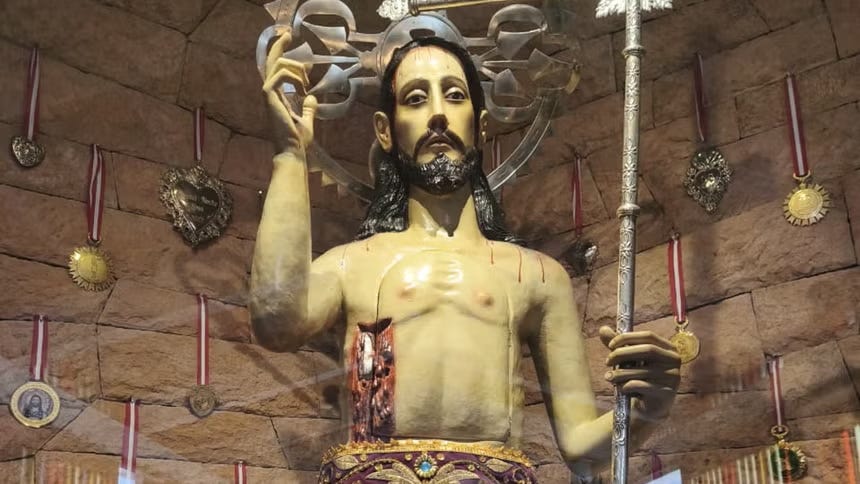
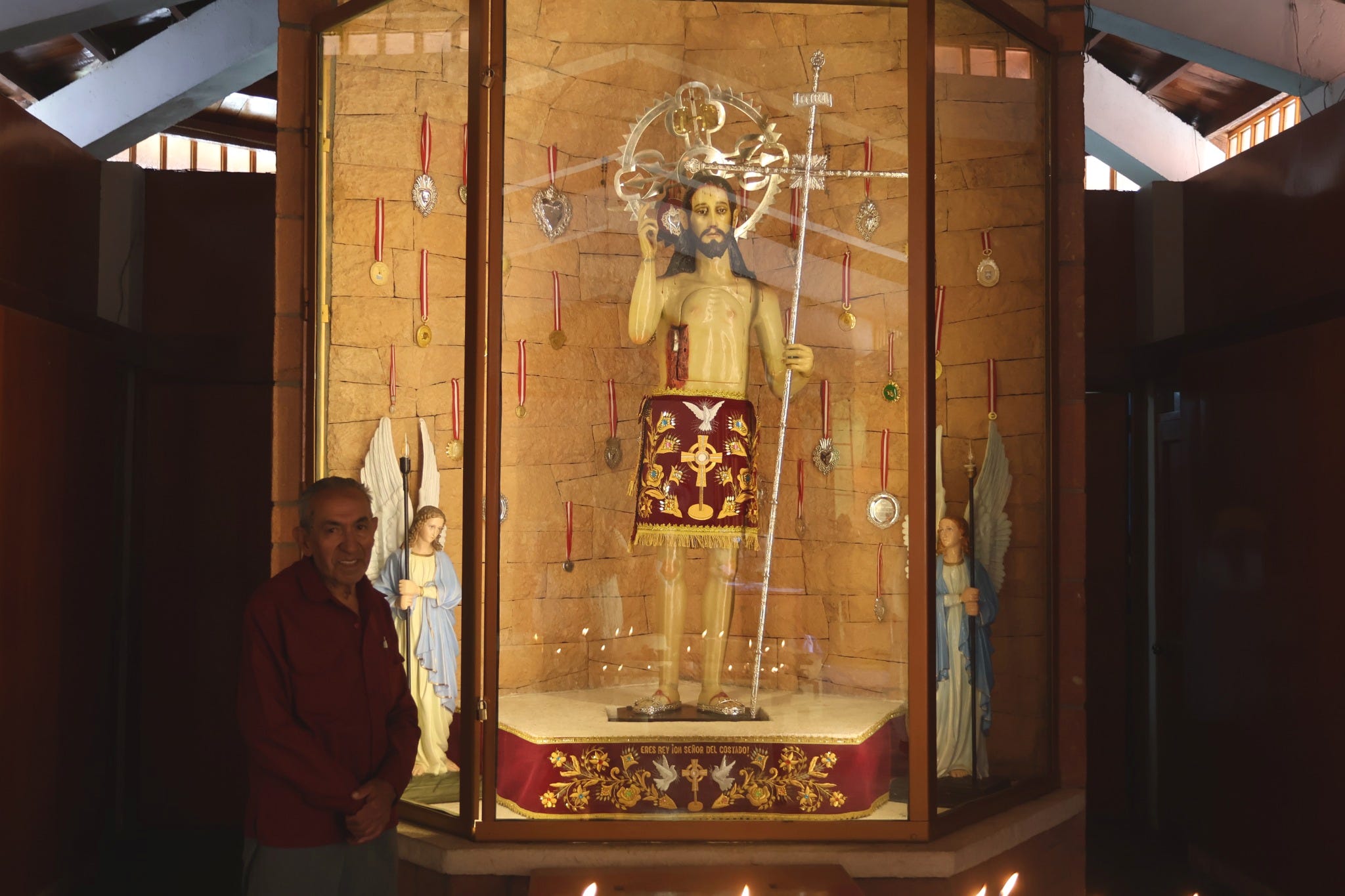
He did so several times a year, as he came to the town each year for the feast day of the “Lord of the Side,” a colonial statue of the Resurrected Christ with a bloodied side, which is still venerated in Santa Cruz.
The pope also came for confirmations, and whenever he felt like going up the ‘sierra’ to enjoy the weather.
When he went to Santa Cruz, Msgr. Robert, as they called the future Leo, liked to stay for a few days.
He really loved the town, people say. And the town loved him. In fact, Santa Cruz seems to draw the bishops of Chiclayo, with its temperate weather and colonial architecture, filled with houses made of rock and wooden balconies. After retirement, Bishop Moliné volunteered to come for confirmations every time he could and sometimes stayed in the town for over a week, hiking in the nearby mountains, as the good Aragonese he is.
On our journey, the road continued getting worse as we climbed through the mountains.Parts were missing. Signs warning drivers not to speed appeared everywhere. Some parts of the road had been overflown by the nearby river. The passenger sitting by my side covered her face in the worst curves.
I tried to get some sleep, but the van’s gear stick kept hitting my knee every time the driver changed gears—which was pretty much all the time.
There was work on the road everywhere, because the road was falling to pieces the higher we got into the mountain. As we passed, laborers have to slip into narrow spaces along the road, so we could make way.
But somehow, political ads drawn into the slope appeared every now and then. The higher we got, the older they were.
The cumbia kept blaring. I happened to get nauseous just as a crooner described his intimate relationship with beer. I’ll probably relate Peruvian cumbia to nausea for the rest of my life.
The van felt like it was drifting to its right. It seemed impossible that the passenger-side wheels were still on the ground while the driver made his way on the narrower parts of the road.
I cursed my editor.
“I can’t believe I’m doing this for JD Flynn,” I thought to myself. “It profit a man nothing to give his soul for the whole world… but for [horrible person] JD Flynn, Edgar?”
At some point, I saw 15 feet of railing to my right. It was the only guardrail in hours of driving through the mountains. It felt like a bad joke. Perhaps it was an encouragement to trust in divine providence. Maybe if I trusted the Lord, I thought, I wouldn’t feel sick.
I tried to get it together.
“Hundreds of people come and go every day without an issue,” I thought to myself. I asked my guide if a lot of people die driving in these mountains.
“Not many,” he replied tersely. I was not reassured by his reply.
I pray every day that the pope might be a saint, but I’m slightly more certain that he might be a madman, if he actually enjoyed driving all the way to Santa Cruz several times a year.
Later I mentioned this to Fr. Marco, one of the priests serving in Santa Cruz, and he laughingly said: “No, he’s not a madman, he’s a missionary. He loves his people and wants to be with them.”
Once I arrived in Santa Cruz, I could see why so many from Chiclayo visit the town, and why seemed to fall in love with it.
The narrow cobblestone streets are dotted with children playing in the streets, while some of the houses around the town square still retain their colonial aesthetic. It reminded me of the many Andean towns I visited in Venezuela as a child with my parents.
The smell of stew drifted out from the nearby restaurants into the streets, carried by the breeze. After a couple of days of heat in Chiclayo – and after foolishly booking a hotel without air conditioning – I was quite thankful for a respite.
I asked Fr. Wilder, another priest in Santa Cruz, if he was excited about the pope visiting the town.
“Oh yes, I never thought the pope would come, I would never have imagined he’d come here,” he said.
And Fr. Wilder told me I should talk to the parish priest, who is conveniently called Fr. Wildor.
Both Fr. Wilder and Fr. Wildor are relatively young and were ordained by then-Bishop Prevost. Young people in town joke they’re like Nintendo characters Mario and Wario, although I didn’t dare ask which was which.
I eventually saw Fr. Wildor. In a helicopter. doing a reconnaissance flight with the Peruvian Air Force. So we didn’t get to talk much.
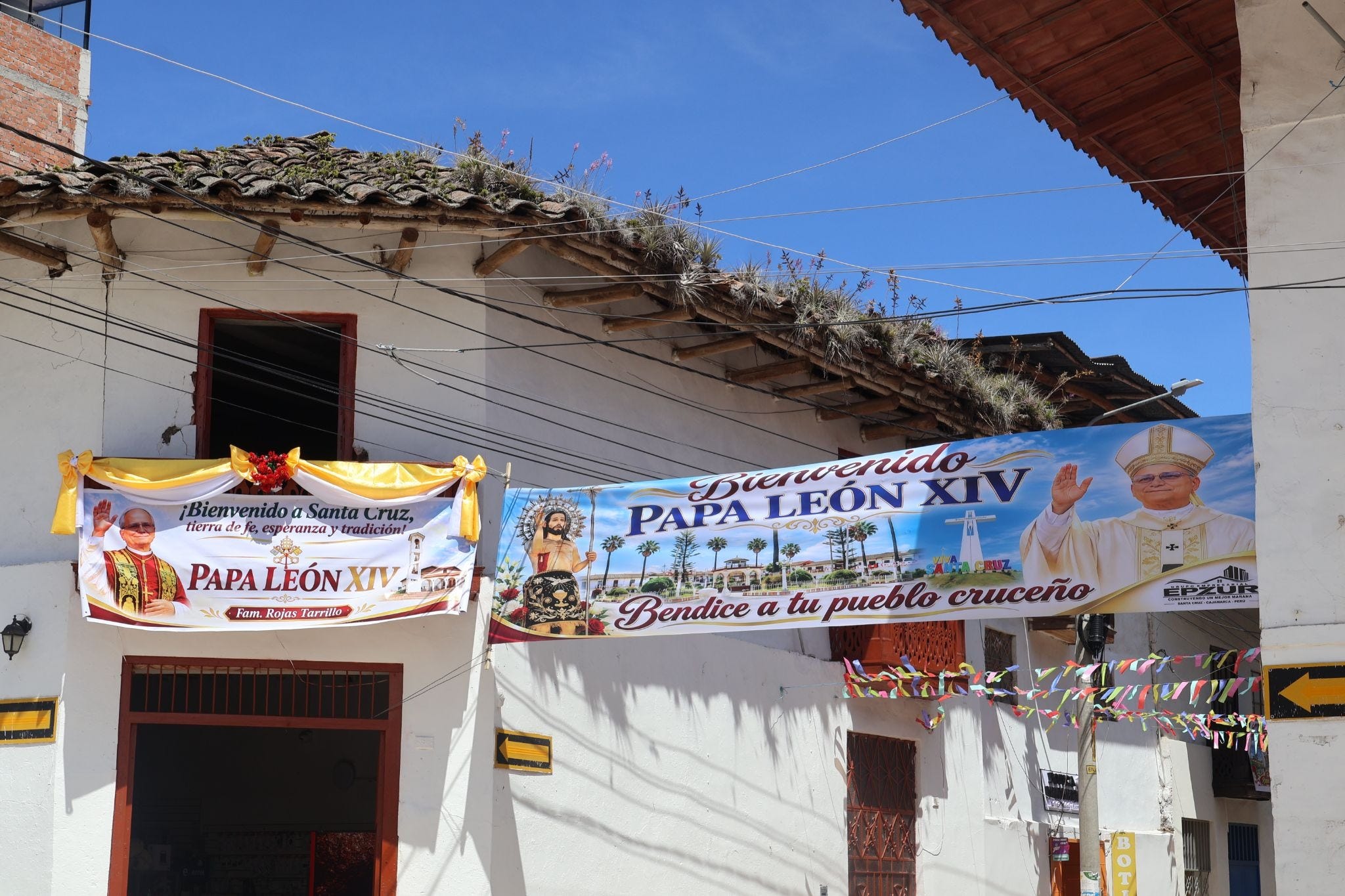
The pope will arrive in Santa Cruz in a helicopter on Saturday. During his visit to Santa Cruz, he’ll meet with the elderly and the sick in the town’s parish church.
While I didn’t get Fr. Wildor’s take, I did talk with Fr. Marco — maybe he’s the Luigi to their Mario and Wario.
“I knew he was coming,” Fr. Marco told me. “He loves this town way too much. People said it was too complicated to come here, that it was not possible logistically, but I always told them: ‘If the pope wants to come, he’ll make it happen, he’ll come in a helicopter if he needs to.’”
Manuel Calderón, a parishioner everyone in town knows as Don Jico, agreed.
“He loves this town so much I thought he’d move the episcopal see to Santa Cruz,” Don Jico told The Pillar.
The parish church of Santa Cruz was built by American missionaries from the Diocese of Bridgeport, CT, in 1968. With that as a base, five priests serve more than 150 nearby communities.
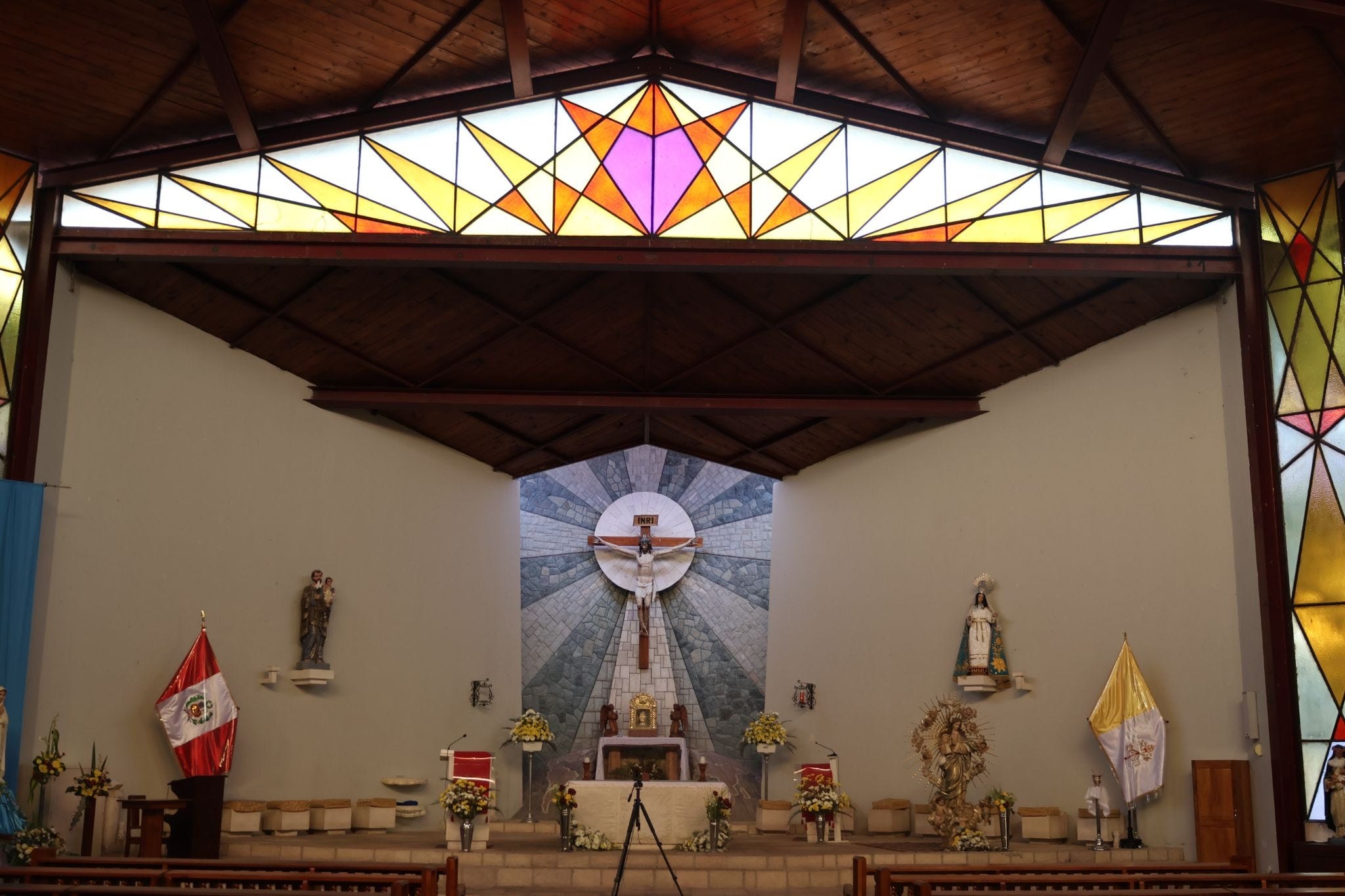
“We go monthly to the biggest towns, but we only manage to go to the smaller towns during the feast of their patron saint, and some don’t even have a chapel in town, so we celebrate Mass in the town square, or someone’s house,” Fr. Antero, who was the parish priest of Santa Cruz for a decade, told The Pillar.
“It’s very busy, it’s beautiful. But it’s tough,” he added.
Bishop Prevost made it a point to visit some of the more far-flung communities within the parish’s territory, the priests told me.
“We went to very small towns with him, and he came to confirm the young men and women of the communities, even if there were only five or six of them, he rarely gave delegations for us to celebrate the sacrament of confirmation, [because] he wanted to come personally,” Fr. Antero said.
“It’s part of his missionary spirit of bringing the Gospel far and wide, to the peripheries, of understanding that even those in the smallest towns deserve to listen to the Word of God and to meet their bishop,” Fr. Marco told The Pillar.
“He was very close to us, very open. He was one of us, another ‘cruceño’,” Don Jico told The Pillar. “He was able to talk with everyone, people from all walks of life, and make himself dear to all.”
Don Jico said he cried the day the pope was elected.
“I live close to the parish, when my son and I see the news, we ran to the church, and Fr. Antero who was the parish priest, opened pthe door] and I embraced him and started crying, and he told me: ‘Calm down, we already have our pope.’”
“Never in my life would’ve imagined that I’d meet a pope so closely. Those days were full of celebration throughout the diocese and throughout the province.”
Don Jico was among a group of parishioners from Santa Cruz to have a private audience with the pope in February. He brought a small image of the Señor del Costado to the pontiff.
“We had visited him too when he was a cardinal in 2024, and he promised he’d come in September 2025, which for obvious reasons, he couldn’t do. But he’s coming now as a pope, which is even better,” Don Jico told The Pillar.
“When the pope has an audience, you know he usually greets them, gives his speech, they take a group photo and he goes. But in our case, when he came in, he said he hadn’t prepared a speech because he just wanted to converse with us. And when the time of the picture came, he took a picture individually, with each and one of us. And we were more than 70 in total,” he added.
Chiclayo’s bishops
Pope Leo is not the only historically significant bishop from the Diocese of Chiclayo.
Here’s a look at the rich history of bishops in a diocese that’s only 70 years old.
—
Leo and Latin pop music
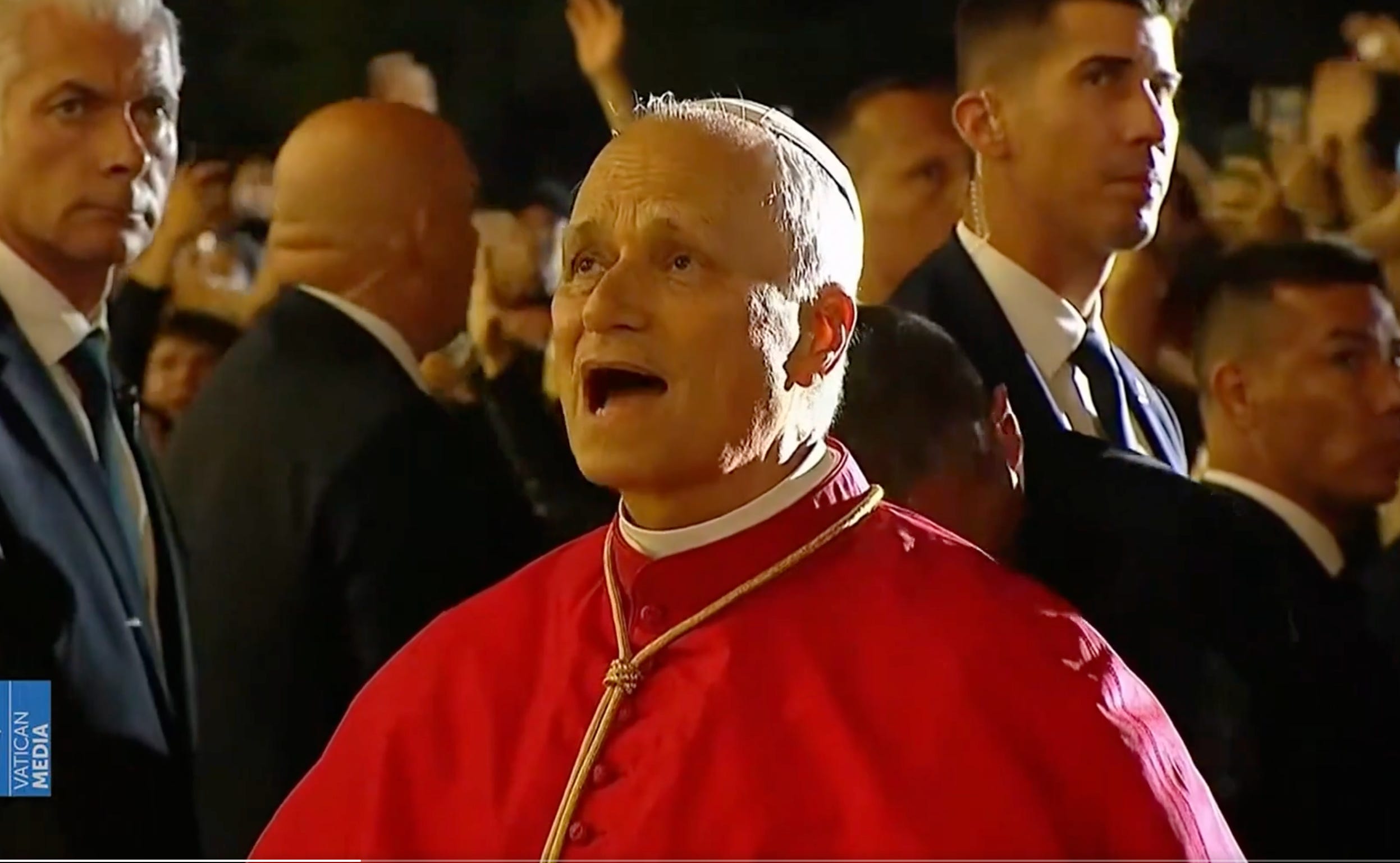
Clips of Pope Leo singing to Latin American contemporary hymns during his trip to Argentina have gone viral on social media. Unsurprisingly, the pope knows these hymns as well as your average Latin American parish priest, because that’s what he was for almost half his ordained ministry.
As a South American myself, it’s almost unbelievable to see a pope singing “Alma Misionera” from the top of his lungs. Even though the Church had a South American pope in Francis, he wasn’t much of a singer.
Admittedly, I have a complicated relationship with Latin American liturgical pop hymns. I think most are well-intended. But I grew up in a dual environment: a parish in which merengue, salsa, bachata and reggaeton were considered suitable liturgical musical genres, and a Catholic school that made me develop a much more traditional sensibility, and led me to somewhat repudiate the first.
At the same time, my former parish priest – a Catholic reggaeton singer – is one of the holiest men I’ve ever met, a man who has saved hundreds or thousands from lives of drug, crime, addiction, and sin. It would be rather ridiculous of me to judge him for his liturgical taste.
Hymns like “Alma Misionera,” “Vida en Abundancia,” and “Pescadores de Hombres,” are not in the same league as liturgical reggaeton. They’re not Gregorian chant either, but they can suitably be used in a liturgy and even accompanied exclusively by organ. And I haven’t met a single person who actually hates these songs. Some may say so publicly but they end up finding themselves singing along anyway.
I was one of those types for some time.
While they’re not the epitome of liturgical music, that was the music I grew up with, and, in many ways, the liturgical music which taught me how to pray. People may think of these hymns as too emotional – ironically, the same people who cry at Mozart’s requiem at a traditional liturgy, as God knows I’ve done too – but I don’t think it can hurt the sensibility or the faith of a young person to ask the Lord to “send us where men need your Word,” or to affirm that the Lord “makes all things anew, and comes to bring us abundant life,” as these songs claim.
I sang and listened to these hymns in my school choir, in adoration as a young man in Venezuela, and now as I write this dispatch.
They may not align perfectly with my liturgical sensibility, and some are admittedly cheesy or outright inappropriate. A long, synodal conversation on liturgical music in Latin America, and guidance from bishops and the Holy See, is much needed.
But I can only rejoice at seeing the pope joining two million young people in telling the Lord “I am up to whatever You ask of me, it matters not what it may be, just call me to serve You,” in one of the most secularized countries in Latin America.
Edgar, this take on the Pope and liturgical sensibilities, it is so refreshing. What a great antidote to the liturgy wars. Praying that we see some healing in those wars under this pontificate.
“I can’t believe I’m doing this for JD Flynn,” I thought to myself. “It profit a man nothing to give his soul for the whole world… but for [horrible person] JD Flynn, Edgar?"
🤣🤣