
February marks the 950th anniversary of one of history’s most famous papal excommunications. Toward the end of the month in 1076, Pope St. Gregory VII excommunicated Henry IV, the King of Germany, Italy, and Burgundy. That penalty set off a chain of events which led, the following year, to an iconic episode––usually characterized as the same king’s kneeling penitently before the same pope, at Matilda of Tuscany’s castle at Canossa, and begging forgiveness for disregarding papal authority.
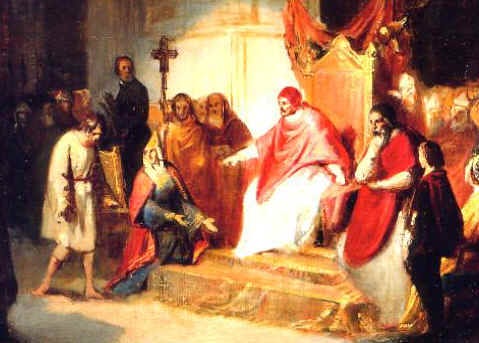
When Catholics learn about these events (if at all!) in school, they are at times given caricatures of them and even of St. Gregory himself. The 11th century pope is at times described as standing up, exceptionally heroically, to a militarily powerful Holy Roman Emperor—and standing up for the principle that clerical authority always precedes lay authority in ecclesiastical affairs. He is also at times identified with the idea that any involvement by “the State” in the appointment of bishops and other clergymen to their sacred offices is a violation of the sovereignty or rightful autonomy of “the Church.”
The real circumstances 950 years ago were far more complicated than many brief summaries of the events allow. The 11th century was, to paraphrase Andrew Willard Jones, a time before Church and State as we think about and cleanly separate them today. It was a time, too, long before Church authorities spoke––as they have done especially since Vatican II—of the munus regendi, or duty of governing the Church, as tied strictly to the sacrament of holy orders.
The saga of Gregory and Henry can be said to be underway as early as 1056, when Gregory, a Benedictine monk in his 40s, was known as Hildebrand of Sovana and as an advisor to Pope Victor II on various matters. In the meantime, Henry IV was only five years old. Already King of the Romans (King of Germany) since he was three, he succeeded that year to the thrones of Italy and Burgundy, making him the likeliest ruler that the pope would next set apart from others, in a special liturgical rite with a sacral anointing, as Holy Roman Emperor.
Young Henry inherited longstanding political tensions between his empire and Rome as well as ecclesiastical institutions and territories that were plagued by clerical and monastic corruption––despite the many salutary effects of the great Cluniac monastic reform effort and the broader ecclesial reform movement that some of his predecessors had done much to advance, at times against the wishes of individual popes.
Early during Henry’s reign — or rather during the imperial regency of his mother, Queen Agnes of Poitou — the party in Rome favoring the Cluniac reform began pushing for the papacy’s independence from the empire and to push for papal elections and bishops’ appointments without imperial authorization. This was ironic, because the popes that had most advanced the reform in Rome were generally chosen (and backed with the threat of arms) by the young king’s predecessors, such as his father Henry III. His mother, Agnes, had just in this period worked with then Cardinal Hildebrand (the future Gregory VII) to depose Antipope Benedict X, the choice of some anti-reform Italian nobles.
Indeed, from the time of Pope Alexander II’s election in 1061, the increasingly anti-imperial reform party in Rome aligned itself with some of the same powerful Italian families that had previously been a stumbling block to reform. One of the cardinals in that movement, Humbert of Silva Candida, even began to argue — in an unprecedented way — that churchmen needed to be freed completely from any control by secular or lay authorities, and that practices such as lay investiture, or royal ceremonies for giving bishops and abbots their symbols and powers of ecclesiastical office, had to stop.
Again ironically, this was inconsistent with the way the Cluniac reform itself, which had influenced Candida and others in his movement, had achieved some of its considerable success in Rome and in other parts of Christendom.
Matters came to a new and interesting head some years later when Gregory VII took the papal throne in 1073. By that point, Henry IV was 22 years old and already in conflict with reformers in Rome who opposed how he wished to maintain control over the selection of bishops and abbots, and of other matters in Church affairs — just as his father and other Holy Roman Emperors before him had done, often in ways conducive to moral reform and spiritual renewal.