
Fabrizia Raguso has known Father Marko Rupnik for more than 30 years, and has come forward publicly to allege the priest spiritually and psychologically abused her.
Raguso moved to Portugal as a sister of the Loyola Community in 2000, and though she left the order in 2021 she continues to live in the Portuguese city of Braga.
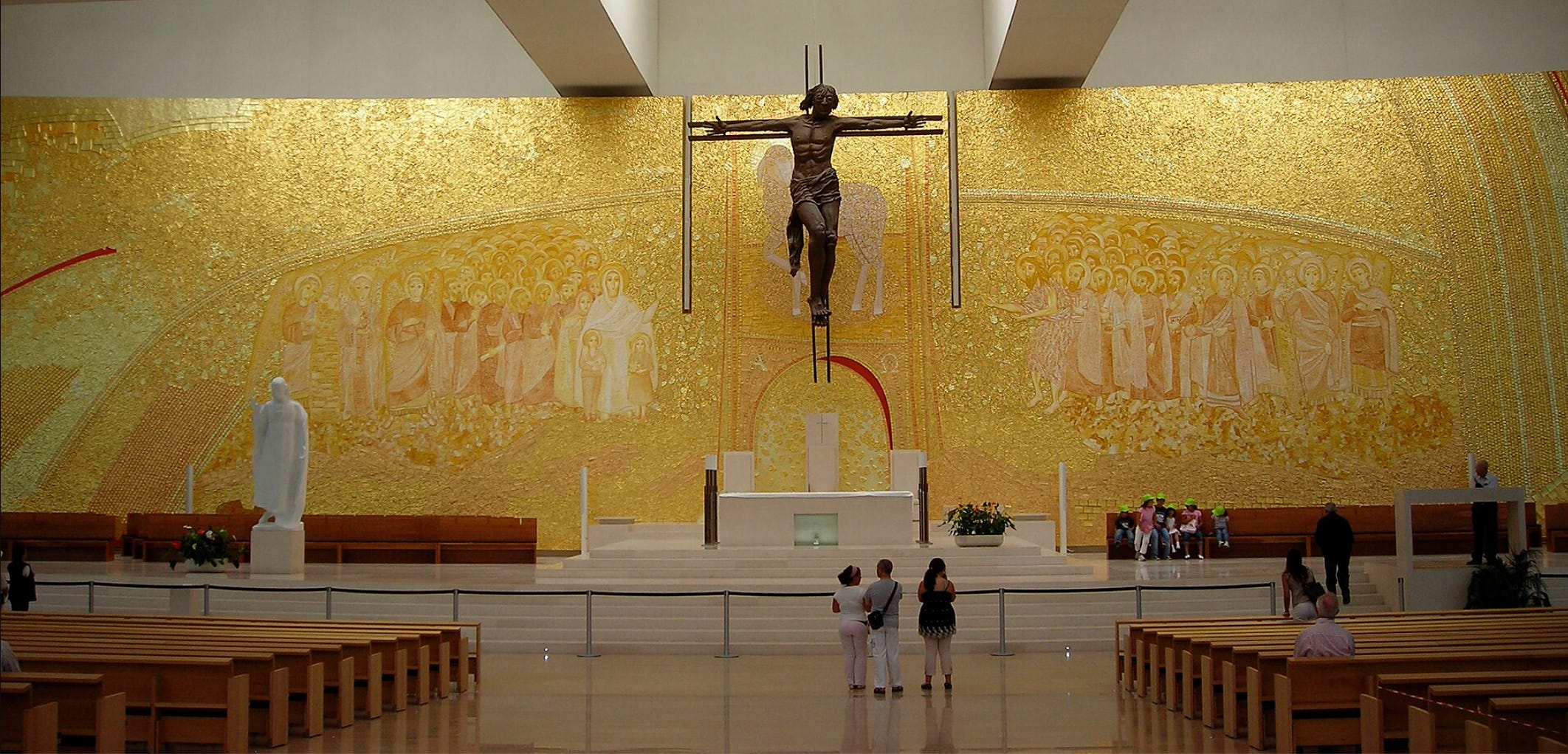
Raguso believes the Shrine of Fátima must undergo a process of discernment regarding what to do with the 500 square-meter mosaic inside the Basilica of the Most Holy Trinity. But as the question is deliberated, Raguso says she has not been contacted by Portuguese ecclesiastical authorities to share her experiences as a victim.
Rupnik is currently being subjected to a canonical trial at the Vatican, accused of abusing dozens of women sexually, spiritually and psychologically.
This interview was conducted in Portuguese and has been edited for length and clarity.
What was your relationship with Father Marko Rupnik?
In March 1990, I had just finished my degree in psychology and was doing a postgraduate degree in family therapy in Rome. At the same time, I was very active in the youth sector of Catholic Action and was collaborating with the movement’s national center. Fr. Rupnik was invited to run a workshop for young people in the movement.
Through that experience, he discovered the world of Catholic Action’s national youth ministry in Italy and became very interested in integrating himself into this world. He stayed in touch with one of the leaders of our sector, and from there arose the opportunity for me to do spiritual exercises under his direction.
By October, 1999, I had already made the decision to enter religious life. In August of the following year, I left for Slovenia to enter the novitiate of the Loyola Community.
Looking back, and with my experience as a psychologist, I see that the spiritual exercises were—for me and for many other people in Slovenia and Italy—a space he used to direct and structure people’s lives according to his own will, with great force.
Marko Rupnik has been accused by dozens of women of sexual, psychological, and spiritual abuse. But you are one of the few who has come forward publicly.
There are six of us who have come out publicly, in different ways. We hadn’t had contact with each other for many years, because the other five had already left the community at different stages, and we have very distinct personal stories regarding our relationship with him and the abuse within the community.
Even after his 1993 departure [from the Loyola community in Slovenia], a process of psychological-spiritual abuse began—in this case, on the part of his former friend and co-founder of the community itself, Ivanka Hosta.
You say you suffered psychological and spiritual abuse. But do you personally know people who were also victims of sexual abuse?
From the Loyola Community, I know all of them, because there were never many of us and we had the opportunity to know each other closely. In some cases, we even lived together for some time within the community.
So you have no doubt that the abuse happened?
These are proven facts. We have accounts from people accusing him in different contexts. There are about 30 people, and they do not all come from the Loyola Community. Many have no connection to one another and didn’t know each other, but they testify to abuse, including during the time the works were being constructed and assembled, as in the case of Sister Samuelle, [ed. note: an artist who described the work environment with Rupnik as one of sexual coercion and psychological and spiritual manipulation].
In what way did the abuse you suffered affect your faith life?
In my case, I can say that I had not the merit, but undoubtedly the grace to maintain a deep connection with what my experience of faith had been up until the age of 30, which means until I entered the Loyola Community. Specifically, everything that had been my experience of faith and my ecclesial experience within Catholic Action. That was a lifeline for me from a psychological standpoint, but also a spiritual one.
There has been a major debate about what to do with Rupnik’s works. The Ssrine of Lourdes chose to remove the mosaics, but Fátima chose to keep them, and in Brazil, the Shrine of Our Lady of Aparecida just unveiled new mosaics, after the abuse came to light. Defenders of the works say it is necessary to distinguish between the art and the creator.
In this case, and keeping in mind that some abuse occurred within the context of artistic creation, is it possible to make that distinction?
Any experience, and especially any work of art, needs to be contextualized. Looking at events from other eras using present-day parameters is completely incongruous. But we also cannot do the opposite: looking at the present through the parameters, vision, sensitivity, or socio-cultural context of the 16th or 15th century. Today, we look at things with 21st-century sensitivity, with a critical, theological, and also ethical consciousness specific to our time.
The example usually cited in these discussions is Caravaggio, who was a murderer but continues to be recognized as a great artist. But works like “The Conversion of Saint Paul” were not designed for prayer. Of course, whoever commissioned those works might have desired a certain evangelization, but we know those times were primarily marked by the desire to affirm the temporal power of the Church.
Rupnik, on the other hand, adopted the style of Eastern Christian iconography. Byzantine art is a way of proposing the Gospel through images, and therefore, before these works, we are invited to pray. Rupnik himself confirms this reading of his art as having an evangelizing function. That is why the way we understand these works today is clearly much more compromising.
You have been in Portugal for 26 years. Have you ever entered the Basilica of the Most Holy Trinity in Fátima?
Yes, though with great difficulty. And also other places, such as the Church of Saint Pio in San Giovanni Rotondo, which is very close to my place of birth and has 54 mosaics by Rupnik. The experience of standing before these mosaics brings a feeling of inner invasion. Because of the insistent use of gold and harsh colors; the size of the figures; the unsettling feeling caused by their black, bottomless eyes; and also, in some cases, by their bodily postures. These bodies give us a feeling, as I said, of invasiveness. We do not feel welcomed as we should, as we do before the authentic art of Byzantine icons, which allow us to enter into a spirit of deep prayer.
In the case of Fátima specifically, due to the sheer size of the mosaic itself and the way it is constructed, the feeling I personally have always had is one of feeling trapped, invaded—not an experience of contemplation.
These aspects you mention are primarily aesthetic. But this must also be informed by your personal story…
Evidently, yes.
The Bishop of Lourdes, in France, ordered the existing mosaics at the shrine to be covered, and has now stated that in doing so he was following the guidance of Pope Leo XIV and that they will be removed or covered permanently. What do you think of this decision?
This process of discernment—regardless of how the decisions are ultimately made—seems to me a serious way of positioning oneself not only in relation to the past, but also to the present and the future. What we want is for people to acknowledge this extremely painful, extremely invasive history, given the number of people who have been involved and the length of time it has gone on.
Discernment is timely, and I do not believe that the decisions made in this spirit can be associated—as many denounce—with the phenomenon of “cancel culture.”
Unlike the Shrine of Lourdes, the Shrine of Fátima said it does not intend to cover or remove the mosaic. What are your thoughts on that?
In this situation, I consider the Portuguese Church’s position to be one of non-transparent silence, which is a common position.
The Church is quite divided on this issue, and that is also demonstrated through this silence, which ends up being complicit, or not entirely liberating, because it ignores the impact it will have and the constant need we have to take a stand. From an ethical point of view, as the Word of God itself teaches us, we cannot be lukewarm.
Have you ever been contacted by anyone from the shrine, or from the Portuguese hierarchy, to share your opinion as a victim regarding what should be done with the mosaic?
The only official interactions I have had in Portugal were with the Archbishop of Braga, mainly due to the need to clarify my pastoral responsibilities after I left the Loyola Community. No other figure with ecclesial responsibility in Portugal has contacted me. I am always available, but there has been no sign whatsoever.
And do you know if any other victim was contacted by the shrine?
As far as I know, on the part of the Fátima Shrine, no.
Some suggest that keeping the mosaic could be a demonstration of respect for the team that assembled and helped develop it, who are not to blame for the abuse and may even include victims. What do you think of that argument?
It seems very weak to me. My position might seem fundamentalist, but it is based on accounts from people who collaborated on the works, and personal accounts that have not come to light publicly, but which I know personally. Having this slightly broader knowledge, I consider that argument inconsistent.
There is also the option of keeping the mosaic, but leaving some kind of memorial or plaque associated with it, describing what happened.
That is one of the possibilities. It is important that there be a process of discernment and understanding that takes into account the motivations that led to the commissioning of the work, the people who contributed financially to its execution, and also the spiritual consequences for people who find it difficult to be in these churches.
I was involved in a case like that for another worship space. It is not public yet, so I cannot reveal more than this, but it was a discernment experience that lasted several months and that reached certain conclusions, although our role was solely advisory. But this is a necessary process. It’s better than just following the latest emotional fad.