A ‘real experience of being college’: Cardinal Czerny on the consistory
"We were really in collegiality, and that was a great experience."
Pope Leo XIV held the first extraordinary consistory of his pontificate last week.
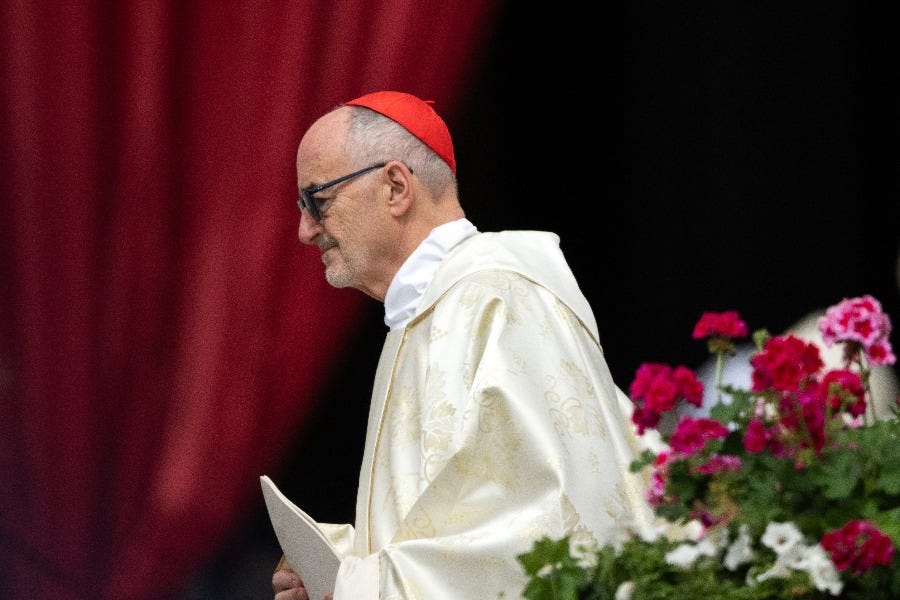
Although there was some confusion about the event’s rules and disappointment that the liturgy was not a main discussion topic, the general consensus seemed to be that the consistory was a positive experience.
Pope Leo has announced his intention to hold another brief consistory in June this year, followed by annual consistories that each last three to four days.
The Pillar spoke with Cardinal Michael Czerny, S.J., about his experience at last week’s consistory.
After a career spanning Canada, El Salvador, Africa, and Rome, and after founding the African Jesuit AIDS Network, Czerny — who refers to himself as a Pillar reader in a good way — started working at the Pontifical Council for Justice and Peace in 2010.
In 2016, he became the undersecretary of the migrants and refugees section of the Dicastery for Promoting Integral Human Development. Pope Francis named Czerny a cardinal in 2019 and prefect of the dicastery in 2022.
This interview has been edited for clarity and length.
First, what’s your general view of the consistory?
Broadly speaking, it was an excellent experience. Maybe you could say that it was an experience of the College of Cardinals as a college. Usually we meet on occasions, like an ordinary consistory, but you basically just say hello and goodbye. Whereas this time we were really in collegiality, and that was a great experience.
There were some cardinals who were slightly confused about the methodology, as most of the meetings took place in small groups – similar to the Synod on Synodality – rather than plenary sessions.
Do you think the experience was positive?
I can honestly say that I didn’t hear cardinals complain. Perhaps some were wondering what was happening at the very beginning, but as soon as it got underway, it really was smooth sailing. Whether the cardinals were, you might say, “graduates” of the Synod on Synodality in 2023 and 2024, or whether it was their first time, people just got to work.
At the beginning of the consistory, it was announced that the cardinals had to pick two discussion topics. Some cardinals didn’t like that much, because they had wanted to discuss other subjects – liturgy and the reform of the curia.
How do you think that was handled in the discussions? How did that work?
Honestly, maybe it’s just by chance, but I didn’t hear anyone say, “Oh, I’m sorry we didn’t treat liturgy.” As soon as we got together and as soon as we realized that the first thing we would do is spend the whole afternoon in discussion, we realized we were already at work, people immediately switched and got underway. All three sessions were good.
It turned out to be a very healthy exercise. It turned out to be a good way to get going and it came up with an interesting result.
How do you feel about non-voting and curial cardinals being in different groups than cardinals who are diocesan bishops?
Wouldn’t it be more synodal or collegial to mix them?
I think it’s realistic. The Holy Father needs to hear primarily from those who are in active service. And his opportunities and chances of hearing from the older ones or from those in the curia are much higher than from a bishop in a diocese.
My impression is that everybody understood that, because why were we there? We were there to advise the Holy Father. So anything which could help him to get the advice from the college was appropriate.
Some cardinals described the discussions on evangelization as being largely about going back to basics.
Would you agree with that view?
I wouldn’t say so much going back to basics as renewed focus, renewed orientation. We’re flooded with a thousand problems, whether we’re in a diocese or in a dicastery, and it’s very normal to get lost in the problems. So, to spend a half day on evangelization and to appreciate the different contexts in which we live our Christian vocation to evangelize…
I think it was very good to have this shared understanding that evangelization means that each one, according to their calling in the Church, brings the Gospel to every corner of the universe. I think there’s a shared appreciation for the challenges and a shared conviction of “this is what we’re supposed to do.”
One of the biggest challenges of the Synod on Synodality was defining what ‘synodality’ is and how to put it in practice.
Did you see that perhaps the cardinals are closer to a common understanding of what synodality means and how to practice it?
No, but I would say they’re much closer to a common appreciation. To appreciate doesn’t necessarily mean to be able to give the clearest of definitions.
So, ‘I know it when I see it?’
More than that, it’s “I know it when I do it.” If you just see it, you don’t get it. You have to do it. So there was that side in the discussion asking us to be clearer, and another, obviously stronger side that said that we should keep going.
An important insight that another cardinal shared with me is also to read what happened as a message. On the second day, we talked about synodality in the morning. And in the afternoon, we talked about evangelization.
The more synodal the Church is, the more the Church will evangelize. Synodality is not so much an end in itself, although it’s a great value, but it’s a means to enable the Church to bring the Gospel to the whole world, to every corner, to every creature, as St. Mark says.
Did you get the feeling that cardinals were interested in discussing the liturgy and the reform of the curia, or that the pope perhaps wants to take these topics to the next consistory?
Since we didn’t discuss them, it would be pure speculation to say what our attitude toward them was. But what was the question the pope presented to us? The question wasn’t which topic is more important or which is of greater value. The question was, in a sense, what should come first? What needs to be on the agenda during the coming year or two so that these other topics and many other topics can be faced well?
So it was a question of sequence. I don’t want to use the word “priority,” because that gives the idea that indeed one is more important than the other, but that’s not the case. Doing something first doesn’t mean that what you do later is less important. It might be just the opposite, but you have to do A before you get to C or to F.
Many people speak of ‘liturgy wars’ in the Church. Is the pope’s decision to engage in this debate intended to bring peace to the situation?
And is it likely to result in greater flexibility for those with more traditional liturgical preferences?
That’s beyond my pay scale. I can’t speculate about how he intends to approach the situation. But I can’t imagine a pope who wouldn’t want to bring peace to the Church. I think every pope since St. Peter would want that.
The only concrete announcement coming out of the consistory was that the pope intends to hold another consistory in June, and after that one longer consistory each year, precisely because some people got the feeling that they needed to deepen the discussions.
What was the general impression of the college in gaining a significant role in advising the pope?
Given the great experience we had, it seemed very natural. We’ve had a good beginning, and you usually don’t say “we’ve had a good beginning, so we will never do it again.” No, we’ve had a very good beginning and we’ll continue.
I think that announcing another session this year, and then regular sessions from now on, is a way of affirming what we had already experienced. The day and a half were so good that it would have been strange if it were not repeated, if we had waited another 10 years for another consistory.
The fact that the pope announced it right away was very encouraging. In a sense, it was a very concrete expression of his appreciation. If it hadn’t met his goal, which was to seek and get the advice of it, I don’t know that he would have said: “Well, let’s do it again.”
But it did what it was supposed to do, and it gave us the real experience of being college, beyond wearing the same habit or belonging to the same calling in the Church.
Another way of explaining it or describing the experience is to go back to the three key words of the Synod on Synodality: communion, participation, and mission. It’s not always easy to understand why they’re in that order, but I would say that in the day and a half, we lived in that order. We experienced the community, we participated, and we renewed our sense of mission.
But wasn’t it, in a way, the elephant in the room that this experience in the College of Cardinals wasn’t common under Francis?
No, just the opposite. Everybody said, thought, or felt that without Francis, this could not have happened.
It wasn’t an elephant at all. It was much more the appreciation for God’s providence and the infinite wisdom of the Holy Spirit.
As I said earlier, it’s important that things happen in a good order. And if you do X before you do W, even if both of them are good, they’re in the wrong order, it’s not going to work well.

“Being College…”
So, you mean, LARPing Animal House?
"Everyone said, thought, or felt" clearly does not include Cardinal Zen in "Everyone"...