African bishops demand investigation, security boost after bishop’s killing
"The State has a solemn responsibility to ensure that all citizens can practice their faith freely and safely."
The Catholic bishops of Africa have demanded a thorough investigation into the killing of a Mozambique bishop over the weekend, and are calling for increased protection for pastoral workers in the region.
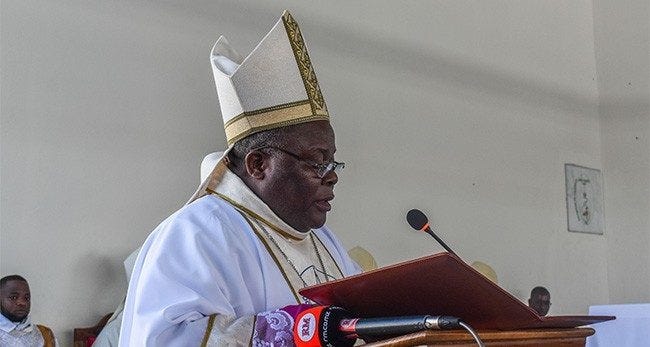
Investigators have yet to determine who killed Bishop Osório Citoro Afonso of Quelimane. The bishop was found dead in his residence Saturday morning. He had been shot in the chest.
“We vehemently and unreservedly condemn this barbaric crime,” said the Symposium of Episcopal Conferences of Africa and Madagascar (SECAM) in a statement after the bishop was killed.
“No religious leader, regardless of their faith or denomination, should be a target of violence. Those who dedicate their lives to serving God and promoting reconciliation, solidarity, education, charity, and the common good deserve protection and respect, not persecution and death.”
The statement, signed by Cardinal Fridolin Ambongo of the Democratic Republic of the Congo, called for “an immediate, thorough, transparent, and independent investigation into this crime” and demanded justice for those responsible for the “heinous act.”
It stressed that the attack on the bishop was also “an assault on the fundamental values of peace, justice, human dignity, and religious freedom – essential principles for the well-being and development of any society.”
The statement urged the government to increase security measures for religious and humanitarian works, as well as places of worship following the attack on the bishop.
“Religious freedom is a fundamental human right and a pillar of any democratic and peaceful society,” it said. “The State has a solemn responsibility to ensure that all citizens can practice their faith freely and safely, without fear of intimidation, violence, or persecution.”
The attack which left Bishop Osório dead is still shrouded in mystery. The authorities have said that the attackers scaled the walls of the bishop’s residence and shot him in the chest with a modernized Kalashnikov, or AK-M. But the identity and motive of the attackers remain unknown.
Pope Leo has also expressed “deep sorrow” over the bishop’s killing.
A message from the Holy See Press Office on Sunday said the pope is “united in prayer with the people of the diocese and of Mozambique at this time of confusion, that the Lord may grant them comfort, that He may keep every man and woman in His love and restrain the hand of the violent.”
Mozambique has faced years of difficulty, largely due to a violent jihadist insurgency in the far-northern district of Cabo Delgado.
Though mostly Christian overall, the former Portuguese colony of Mozambique has a Muslim majority in the north. Different religious communities coexisted peacefully for centuries before the insurgency began in 2017.
At first the jihadists, who claimed allegiance to the Islamic State, mostly focused their attacks on military and government infrastructure. In recent years, however, they have begun to specifically target Christians and Christian buildings as well.
Around 300 Christians have been killed since the attacks began, with many beheaded. In 2022, Italian nun Sister Maria de Coppi was shot in the head and killed during an attack on the educational compound where she worked.
Quelimane, which is located in the province of Zambezia, in the northern half of the country, is predominantly Christian, though it has a significant and historic Muslim community as well.
However, Quelimane has not seen religiously motivated violence. The area has taken in thousands of internally displaced people from the regions most affected by the violence.
Before his death, Bishop Osório Afonso had been a vocal advocate for peace in the country.
The day before he was killed, he took part in an interreligious initiative, visiting a local mosque and addressing those gathered, asking that religion not be a source of division.
“In our African and Mozambican culture, we are used to living together. We go to the market together; we visit hospitals together. We don’t have a hospital for Muslims and another for Christians. May religion never divide us, but rather be a source of unity,” he said.
“Let us all pray for peace and well-being in Mozambique, for justice in Mozambique. Our God asks us to be humble and to recognize that we are all brothers,” he concluded.
The province of Zambezia has also seen an increase in organized crime over recent years. With the insurgency in the north, the drug, illegal fishing, and timber cartels have moved further south, to the Zambezian coastline.
Politically, Mozambique recently emerged from a period of extreme tension, following 2024 presidential elections that were marked by terrible violence, with opposition candidate Venâncio Mondlane accusing the ruling party of ballot fraud. Dozens of protestors were killed in the aftermath, and two of Mondlane’s closest aides were ambushed and shot dead by unknown gunmen in the capital, Maputo.
Though the country recognizes the separation of Church and State, there is a history of government interference in the life of the Church.
The former bishop of Pemba, in the country’s north, resigned from office in 2021, citing safety concerns. He later stated that the threats which had led Pope Francis to accept his resignation and send him back to his native Brazil had come from the government, and not from the jihadists.
Though Bishop Osório Afonso had stayed clear of partisan politics, he frequently criticized the government’s inability to bring peace and stability to the area.
Bishop Osório Afonso was 54 years old at the time of his death. He was known as a promising and gifted young bishop. After joining the Consolata missionaries, he studied in Maputo, then in Kinshasa, before travelling to Rome and then doing further studies in Jerusalem.
He was appointed auxiliary bishop of Maputo in 2023, with Pope Leo moving him to Quelimane in July 2025.


Is there a link to the SECAM statement quoted in the article?