
A Vatican archbishop underlined the urgency of ending the Ukraine war Tuesday, following a meeting with Russia’s foreign minister in Moscow.
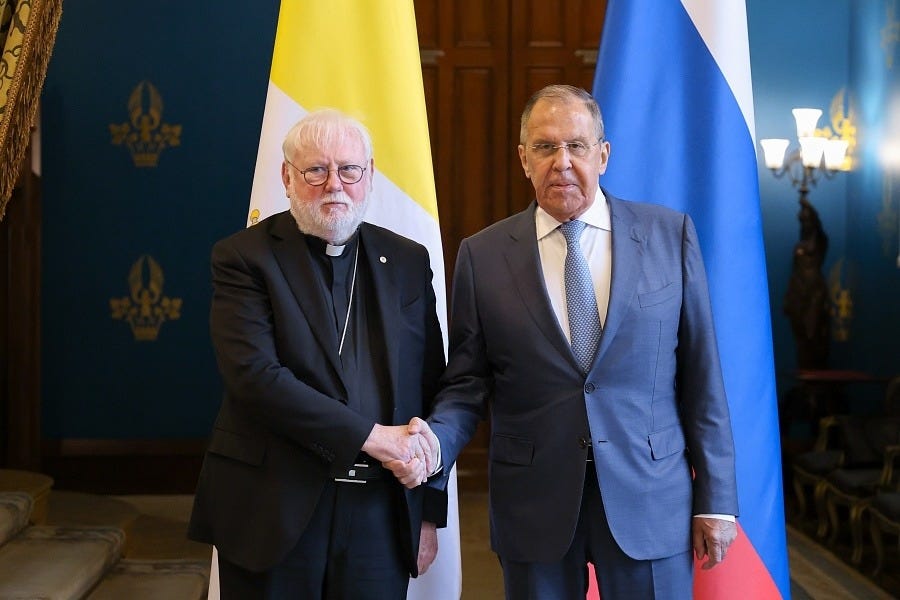
Addressing the media after the Aug. 25 meeting with Sergey Lavrov, Archbishop Paul Richard Gallagher noted that the conflict continued to expand more than four years after Russia’s full-scale invasion of Ukraine, harming millions of people both materially and psychologically.
Gallagher, the Vatican’s Secretary for Relations with States, said: “Let us be clear, this war must end.”
“For this reason, during our exchange, I reiterated the appeal of His Holiness, Pope Leo XIV, to end hostilities and to begin authentic negotiations with the support of the international community,” he continued.
“The position of the Holy See remains clear: the conflict cannot be resolved by military means. It is essential to create the conditions for a serious political and diplomatic process.”
Gallagher went on: “Engaging in authentic dialogue implies recognition of the fact that the longer the conflict continues, the more difficult it will be to arrive at an adequate resolution, while the sufferings of the population continue to increase.”
“The Holy See urges both parties to demonstrate openness and goodwill, so that such dialogue can become a reality as soon as possible.”
The archbishop, who visited Ukraine July 17-20, called for respect for international law, steps toward de-escalation, and further humanitarian gestures.
He said: “The most important issue, however, remains the need to achieve peace. Every day that the war continues creates new victims, exacerbates the divergences between the peoples involved, and renders future reconciliation ever more difficult.”
“It is, therefore, urgent and necessary to end and to look beyond the conflict in order to ensure that the future memory of past wrongs does not become a prison, nor that present sufferings become a legacy of hatred.”
“The Holy See will continue to provide its own spiritual, diplomatic, and humanitarian support by contributing to and offering a space for dialogue, while patiently listening and assisting concretely in charitable and humanitarian efforts. Indeed, we offer our good offices in any way that can help, in the hope that the much-desired peace can be achieved as soon as possible.”
“This is my sincere desire for the people of the Russian Federation, for the Ukrainian people, and for all those who continue to suffer on account of this tragic war.”
Gallagher, a 72-year-old English archbishop who has served as the Vatican’s equivalent of a foreign minister since 2014, spoke after Lavrov, who noted that the two men last met in Moscow in November 2021, before the launch of full-scale hostilities in Ukraine.
In his comments to the media, Lavrov said that despite geopolitical upheaval since their last meeting, relations between Russia and the Holy See continued to be marked by “trust, friendship, and pragmatism.”
He expressed gratitude for the Holy See’s “balanced position on the situation in and around Ukraine.”
“We reaffirmed our high assessment of the Vatican’s active involvement in resolving a number of acute humanitarian issues arising from the conflict in Ukraine, as well as our mutual commitment to continuing bilateral cooperation in this area, including on the extremely sensitive ‘children’s dossier,’” he said, referring to the thousands of Ukrainian children forcibly relocated to Russia after the full-scale invasion in February 2022.
Lavrov accused Ukraine of being responsible for the deaths of civilians, including children, amid drone attacks against Russia. He also claimed that the country had banned the Russian language. He said he expected the Vatican to raise the topics in its contacts with Ukrainian officials.
Ukraine says its drone attacks are aimed at military targets and infrastructure that sustains Russia’s invasion. It accuses Russia of deliberately killing Ukrainian civilians and engaging in a “human safari” in several front-line cities. Ukraine has curtailed the use of Russian in official contexts but the language continues to be used in everyday life.
Lavrov also suggested that Ukrainian authorities were seeking the “destruction” of the Ukrainian Orthodox Church of the Moscow Patriarchate. He said the Foreign Ministry would share a copy of its latest report on the status of the UOC-MP with the Vatican.
The Ukrainian government argues that it is not seeking to suppress the UOC-MP but to prevent it being used as a tool of influence by the Russian state.
Lavrov said that he and Gallagher had also discussed “trends in the field of artificial intelligence, including its military applications,” and that issues surrounding AI could become another area for dialogue with the Vatican.
Lavrov stressed that Russia was willing to resume a more structured, regular dialogue with the Holy See at working levels below that of foreign minister, as well as targeted consultations between the two parties on specific issues at the expert level.
“I believe this was a very useful conversation,” he commented.
Archbishop Gallagher arrived in Russia Aug. 24, on one of the most sensitive diplomatic missions of his tenure as Vatican Secretary for Relations with States.
On the morning of Aug. 25, he took part in a wreath-laying ceremony at the Tomb of the Unknown Soldier near the Kremlin.
After his encounter with Lavrov, Gallagher was expected to meet with Metropolitan Anthony of Volokolamsk, who chairs the Moscow Patriarchate’s Department for External Church Relations, which oversees the Russian Orthodox Church’s ecumenical ties.
The Ukraine war has created significant tensions between the Vatican and the Moscow Patriarchate, as well as between the Moscow Patriarchate and autonomous Eastern Orthodox Churches aligned with the Ecumenical Patriarchate of Constantinople.
Gallagher is scheduled to meet Aug. 26 with Yuri Ushakov, an aide to President Vladimir Putin on foreign policy and a prominent figure in negotiations aimed at ending the Ukraine war.
Gallagher will spend Aug. 27, the final day of his Russia visit, with the local Catholic community.
The archbishop indicated that he had raised concerns about restrictions on Catholic life in Russia during his meeting with Lavrov. Gallagher said that the discussions touched on “the pastoral care of the faithful, the ministerial activities of priests and religious communities, and the conducting of charitable and humanitarian initiatives.”
There are thought to be fewer than 1 million baptized Catholics in Russia, where the majority of the more than 140 million total population are Eastern Orthodox Christians.
The war needs to end justly for the victims, not just end.