An Indian cathedral at the heart of the Syro-Malabar liturgy dispute celebrated a Holy Qurbana entirely facing the people Sunday, after parishioners agreed to allow it alongside the Eastern Church’s new uniform Eucharistic liturgy.
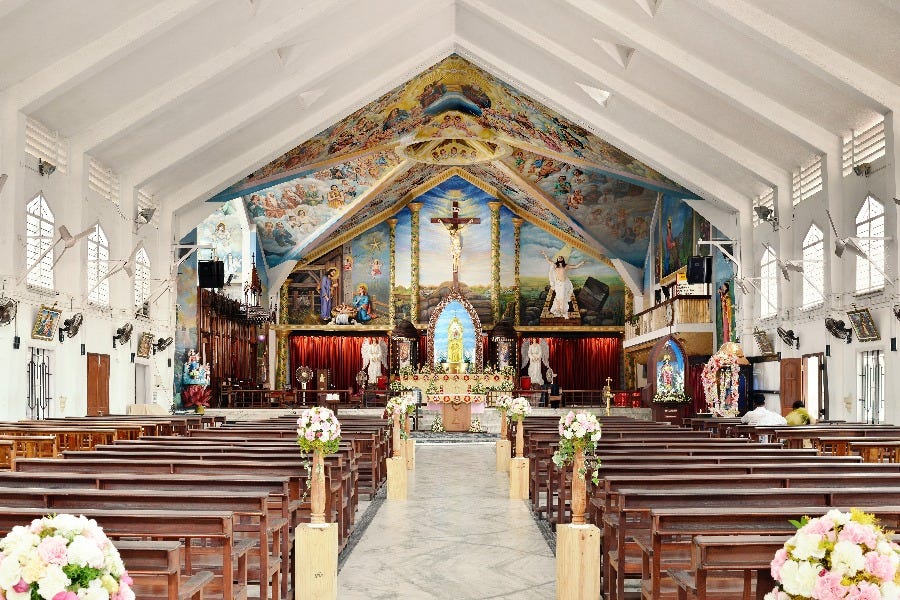
The agreement marks another step in the healing of a decades-long rift between Syro-Malabar Catholics who favor the Holy Qurbana celebrated facing the people throughout and proponents of the uniform mode, in which the priest faces the altar during the Liturgy of the Eucharist.
Supporters of Holy Qurbana facing the people throughout argue that it is more in keeping with the liturgical reform that followed the Second Vatican Council, while advocates of the uniform mode say it is faithful to the Syro-Malabar Church’s ancient roots while also accommodating later reforms.
The Aug. 30 Eucharistic liturgy facing the people was celebrated at St. Mary’s Cathedral Basilica in Ernakulam, in the southern state of Kerala, almost four years after clashes between supporters and opponents of the new uniform liturgy led to the cathedral’s closure.
The closure highlighted the intensity of the liturgical dispute within the Syro-Malabar Church, the second-largest of the 23 Eastern Catholic Churches in full communion with Rome after the Ukrainian Greek Catholic Church. The cathedral serves the Archeparchy of Ernakulam-Angamaly, the most populous of the Syro-Malabar Church’s 35 eparchies and the seat of its major archbishop, or head.
The vast majority of clergy and lay people in the archeparchy resisted a Vatican-backed effort to end celebrations of the Holy Qurbana facing the people throughout and impose the uniform mode throughout the Syro-Malabar Church.
St. Mary’s Cathedral Basilica was the site of a notorious incident in December 2022, when advocates of the uniform mode stormed the sanctuary while priests were celebrating a Eucharistic liturgy facing the people throughout, pushing the portable altar and knocking sacred vessels to the ground.
The cathedral’s closure was challenged in civil courts. In March 2024, a local court ordered the reopening of the cathedral for sacraments other than the Holy Qurbana.
Following an agreement reached in June 2025, the archeparchy’s priests were permitted to continue celebrating the Holy Qurbana in their preferred style, provided that at least one uniform liturgy was offered in each parish on Sundays and holy days of obligation.
In December 2025, a public Holy Qurbana was celebrated for the first time in three years, in the form facing the people throughout. Supporters of the uniform liturgy then occupied the cathedral, further disrupting the parish’s liturgical life and prompting the archeparchy to seek police intervention from the Kerala High Court.
In March 2026, the High Court referred the dispute for mediation to a retired judge.
In an Aug. 22 document setting out the terms agreed by parishioners, cathedral administrator Fr. Thomas Mangattu noted that legal appeals had failed to achieve a resolution.
The document said the uniform liturgy would be celebrated on Sundays and holy days of obligation at 5 p.m., while setting out several specific instances where the liturgy would instead face the congregation throughout.
The text noted that parishioners had agreed to withdraw court cases filed against fellow parish members as soon as possible.
“If anyone acts in a way that insults or disrupts the offering of the Holy Qurbana at the basilica, action shall be taken against them in accordance with the Church’s canon law,” it said.
In an Aug. 28 letter, the Major Archiepiscopal Curia, the archeparchy’s central administrative office, acknowledged receiving the text of the agreement. The body said it had no objection to the offering of the Holy Qurbana on Aug. 30, but stressed that the agreement’s terms only applied to the cathedral.
Although the agreement appears to have defused the liturgical dispute at the cathedral, other grievances in the Ernakulam-Angamaly archeparchy remain unresolved.
Clergy aligned with the Archdiocesan Protection Committee, a body opposed to the uniform mode, insist the authorities have failed to achieve a just resolution of the so-called “land scam” scandal, which rocked the archeparchy in 2017.
The scandal centered on real estate transactions that lost the archeparchy a reported $10 million and led to legal proceedings. The controversy triggered what became known as the “Ernakulam priests’ revolt,” in which clergy demanded the removal of the then Syro-Malabar Major Archbishop, Cardinal George Alencherry, who rejected allegations of wrongdoing.
Clergy affiliated with the Archdiocesan Protection Committee also argue that the archeparchy needs a new auxiliary bishop drawn from the archeparchy’s ranks, to provide day-to-day leadership while the current Major Archbishop Raphael Thattil attends the needs of the entire Syro-Malabar Church.
While Thattil oversees the archeparchy, he is assisted by Archbishop Joseph Pamplany, who was named Vicar of the Major Archbishop for Ernakulam-Angamaly in January 2025, while remaining the Archbishop of Tellicherry.
At an Aug. 28 meeting, members of the Archdiocesan Protection Committee criticized the Synod of Bishops for not appointing a new auxiliary for the Ernakulam-Angamaly archeparchy at their Aug. 17-28 assembly at Mount St. Thomas in Kakkanad.
The priests said they were especially disappointed because the Synod named an auxiliary bishop for the Archeparchy of Kottayam, which is also based in Kerala but has slightly fewer members than the Ernakulam-Angamaly archeparchy.
Committee members also reportedly accused the Synod of Bishops of disobeying a Vatican restitution order linked to the land scam scandal.
In comments reported by the New Indian Express, Archdiocesan Protection Committee spokesman Fr. Jose Valikodath said clergy hoped that Pope Leo XIV would direct the Synod of Bishops to name an auxiliary for Ernakulam-Angamaly.
“The Ernakulam-Angamaly archeparchy is the second largest in India and the first in Syro-Malabar Church. However, it remains an orphan without its own bishop,” he commented.
