What is the Augustinian approach to Lent?
"For Augustine, Lent is more than just about giving up food."
For many Catholics, the season of Lent may be associated with giving things up – 40 days of refraining from something enjoyable, like chocolate, coffee, or alcohol.
For St. Augustine, though, Lent was a time for the renewal of the person, to recognize the restlessness of the human heart, and to allow God to expand one’s heart and capacity for love.
What exactly does that mean, and how do Augustinians approach Lent? And will Pope Leo be giving up gelato this year?
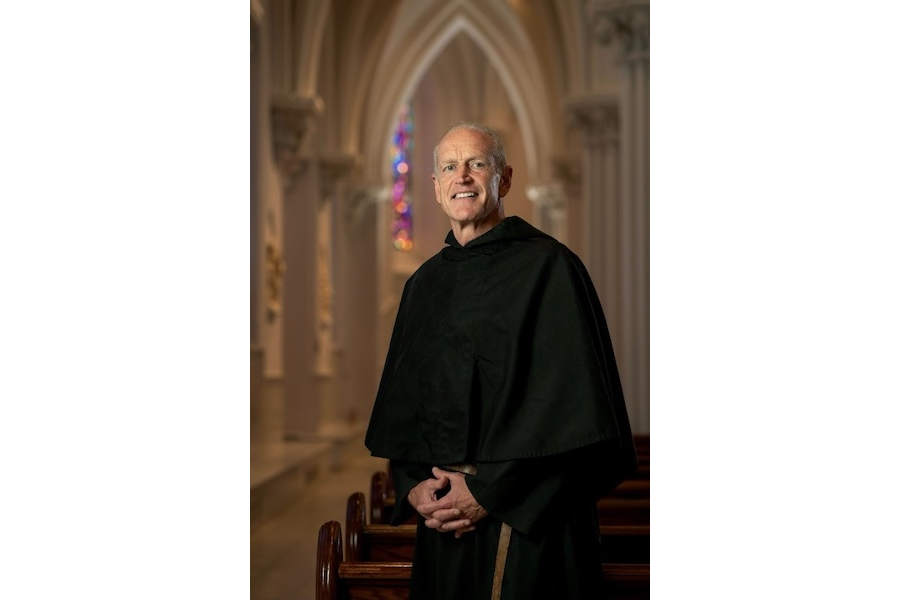
To find out, The Pillar spoke with Father Rober Hagan, OSA, the prior-provincial of the Province of St. Thomas of Villanova.
And, since Hagan is also the chaplain of the Villanova men’s basketball team, we also asked about the overlap between Lent and the upcoming March Madness college basketball tournament.
The following interview has been edited for length and clarity.
What does St. Augustine teach about Lent?
Lent is a wonderful opportunity for renewal of mind, body, and spirit. As Augustinians, we commit ourselves to the rule of St. Augustine, which is a series of guidelines to live a disciplined life around prayer, community, moderation, and the common good. As Augustinians, we, like everyone else, need to renew those commitments, to refresh them, to not take them for granted.
Augustine has a lot to say about spiritual discipline and the need to move beyond the physical. He has a homily where he talks about how the times are tough and the times are burdensome, yet how they never really hurt anyone. Those who are hurt are human beings and those who hurt them are also human beings. So change human beings, and the times will be changed.
We have an opportunity in our Lenten practices to hopefully grow a little bit closer to the Lord and to one another.
For Augustine, Lent is more than just about giving up food. We do deprive ourselves by fasting, but then we add to ourselves by being generous and giving to others. So it is a twofold approach.
Lent gives us an opportunity to “die to ourselves,” to not cling to the things of the world, and to open ourselves up to the grace and the presence of God all around us.
It’s an opportunity to really allow God to expand our hearts. Our capacity for the divine is the only thing about us that’s infinite. Everything else is finite – our health, our time on this earth, our strength. But when we allow God to expand our minds and our hearts to receive God’s grace, that can really be transforming. And Augustine would say, that’s how the world is transformed.
So what would an Augustinian approach to Lent look like?
An Augustinian Lent is accepting the fact that we have restless hearts and then understanding that all the pursuit of worldly pleasure is not going to satisfy or fulfill that restless heart. Then we must turn or return to the direction of the Lord, through prayer, through scripture, through service to others, and understanding that our heart.
As Augustine said, our hearts are restless until they rest in you.
And then the cherry on top is when you find that peace, when you find that forgiveness, when you find the joy that comes from reconciliation, one begins to understand why Jesus is on the cross, then go share that joy with the world.
Do you have any practical advice on how to live that out?
Yes, it is to participate in a very underappreciated practice in our faith, and that’s the sacrament of reconciliation.
Go to confession. I do, Augustinians do, the pope does. Maybe the last time you went was 15 years ago, maybe you went and you had a bad experience, give it another try and allow yourself to experience the grace that comes from knowing that you are forgiven, that you can leave the past in the past, and step into a bright future.
Do you have any favorite Lenten traditions in your community?
We are not going to reinvent the wheel here, but what we’re asking for is a renewed commitment to community prayer.
It is this renewed opportunity and appreciation for Eucharistic adoration.
Everybody should just go, spend some time in front of the Blessed Sacrament, and allow your cares, your anxieties to sit on that altar, and really allow yourself to experience the presence of the one who came into this world to show us how to live, to show us how to accept suffering and even death, and to show us how to love one another, and to understand that with every cross, whatever cross it is that you’re carrying, there’s resurrection.
This year will be Pope Leo XIV’s first Lent as pope. As a fellow Augustinian, do you have any insight into what the first Augustinian pope might be reflecting on for the next 40 days?
Well, last week he gave a homily reflecting on Lent, and it discussed a lot of the things that we’re talking about here, like calling upon the faithful to fast and to remember what Augustine said, that fasting is more than just refraining from food. And it was Leo who called us just last week to use disarming language, to fast from words that wound.
For Leo, he invites us to put the mystery of God back into the center of our lives. What an opportunity that presents for us in Lent. Pope Leo has spoken much about the need for us to be a synodal Church, one that listens. For Leo, there would be a great importance to listening to God, listening to the Spirit who speaks to us through much of the noise in the world, and listening to one another.
And in particular for Leo this Lent, I believe that he is calling us to listen to the poor. He has a great affinity and affection and love for the poor, and for listening to the cry of the poor. That is a voice that cries out in the desert and is not often heeded.
Another thing he will be asking us to work on as we move through Lent, is to order our appetites. We are hungry, but what are we hungry for?
That’s a wonderful reflection for us — what is it that satisfies my hunger? It is a prayer that we say every day when we say the Our Father, “this day, our daily bread.” What is it that truly feeds us? It’s not the coffee and the chocolate.
Father, in addition to your role as prior-provincial, you are the chaplain of Villanova’s basketball team.
How do you spiritually guide your team as they journey through Lent and March Madness at the same time?
I’ve been reflecting on that exact question for the past day as I’m currently at Xavier University in Cincinnati for a game. At two o’clock, I will address the team where I have an opportunity to read a passage from scripture and then reflect on what that means for us — How is the Spirit speaking to us as we head into March Madness?
There is no greater centering activity for a team than to adopt the spiritual values that Lent offers us, which is to be unselfish, to be concerned for the common good, to let go of a past mistake, and move into the present. These are all values that make for good living. They are also good values that make for a good team.
Today, I will remind the guys that today is Fat Tuesday, tomorrow is Ash Wednesday. So, we stand at a fork in the road where the world offers us the opportunity to fill up, to get mine, and to pursue my pleasure. Or we can understand that we are all just passing through this world, that we are dust and unto dust, we shall return.
That we are on this earth for a finite period of time and to spend our time, not filling ourselves up, but giving ourselves away.
That message applies to Lent, but it also applies to a team, to March Madness. It would apply to a corporation. It would apply to a school. Why wouldn’t we adopt this type of values-based spiritual living to every endeavor that we find ourselves in?
Before you go, would you be interested in doing a quick Lenten question speed round?
Sure, it sounds like fun.
Great, here we go. What is your favorite Friday fish dish?
Easy. Tuna salad on rye.
Do you have a favorite Lenten devotion?
This is going to sound funny coming from a priest, but I think I adopt more attention to the rosary during Lent. It is something that you should be doing all the time, but I like to say the rosary more often during Lent.
Muskrat isn’t considered a meat by the Church, it’s considered fish. Would you eat muskrat on a Friday in Lent?
I am adventurous when it comes to food, so I would try it if somebody told me it was prepared well.
The Final Four basketball game falls on Holy Saturday, what happens if Villanova makes the Final Four, and Easter Vigil Mass coincides?
That’s happened before. I’ve been doing this for 20 years. We’ve played on Holy Saturday, and we’ll do a Mass for the whole community, for our fans. We’ve done Palm Sunday Mass with our whole team and community and fans.
When we won the national championship, we played the Sweet Sixteen on Holy Thursday and the whole team washed each other’s feet. It was a very powerful team exercise.
Wherever we find ourselves in the liturgical calendar, we will adopt and incorporate into where we are with the team.
While we’re on the subject of basketball – since the pope is a Villanova alum, do you think Villanova has a better chance at winning the tournament this year?
Well, I hope he’s praying for us. But I think God has bigger concerns than who wins the NCAA tournament.
Finally, do you have a favorite Lenten book to read, or that you would recommend?
That’s a good question, The Imitation of Christ is a time-tested classic. I think it speaks to a lot of the things that we discussed. It just gets back to the basics.


