Archdiocese of Caracas denies arranging meeting to extort political prisoner's family
The archbishop of Caracas has been accused of maintaining a close relationship with the Venezuelan regime.
The Archdiocese of Caracas has denied allegations that it brokered a meeting with regime officials in order to blackmail the daughter of the opposition candidate in the 2024 presidential election.
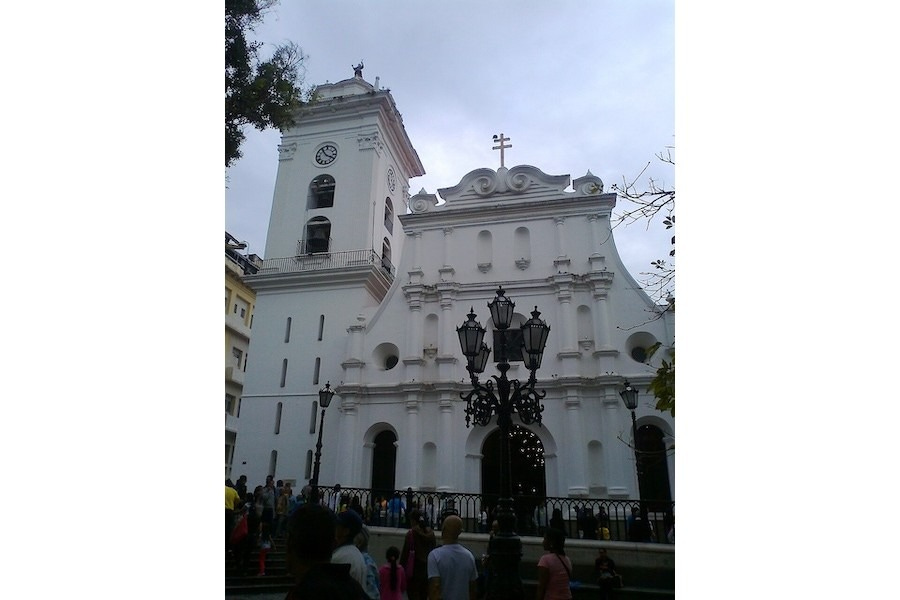
“At no time has any ‘extortion’ or pressure been exerted in the archdiocese on the families of detainees or on anyone else,” said Archbishop Raúl Biord in a Jan. 20 statement.
Mariana González de Tudares, the daughter of opposition presidential candidate Edmundo González, said that she was at a meeting coordinated by the Archdiocese of Caracas in which regime officials asked her to convince her father to give up his political aspirations in exchange for the release of her husband, Rafael Tudares, who last year was sentenced to 30 years in prison for conspiracy.
Biord has been accused repeatedly in the last year and a half of maintaining a close relationship with the Venezuelan regime.
On Jan. 20, Mariana González published a statement in which she claimed to be “the victim of three episodes of extortion, perpetrated by individuals linked to the authorities of this country, individuals linked to the Church, and individuals who claimed to represent important organizations.”
The extortion took place in diocesan offices, and Church officials were present, she said. She did not name the Church officials, nor did she say when the alleged extortion took place. However, she said there were eyewitnesses in all three instances.
González said she was told directly that she should push her father to resign from his leadership role with the opposition in order for her husband to be released.
González’s husband, Rafael Tudares, was arrested a year ago. Since Tudares was not himself involved in public political activism, human rights organizations believe the arrest was a means of pressuring his father-in-law, Edmundo González, to back off from his political work with the opposition.
Tudares was sentenced to 30 years in prison on charges of terrorism and conspiracy. His wife called the conviction “an absolute violation of due process, the presumption of innocence, and the right to defense.”
González said she was only allowed to visit her husband in prison for the first time last week. She said she and her attorney never had access to his case file.
“This constitutes a pattern of coercion and indirect persecution against a civilian family, using deprivation of liberty as a mechanism for political and personal pressure, and even taking advantage of institutional and diplomatic spaces that should be neutral and protect rights,” she said.
“Being Edmundo González Urrutia’s son-in-law is not a crime.”
The archdiocesan statement denied involvement in any acts of extortion.
The statement said that throughout Venezuelan history, the Church has had the “mission of interceding to achieve the access to justice or the release of political prisoners. We understand the pain of Mrs. Mariana González de Tudares and support her request to free her husband.”
“We have helped numerous family members of political prisoners, whom we’ve accompanied pastorally, with no other interest than their good,” the statement added.
Since his election as Archbishop of Caracas in 2024, Biord has come under fire for what critics describe as complacency in dealing with the Venezuelan government.
Biord’s appointment was viewed within the country as a compromise, to avoid the prospect of a stalemate over a more outspoken candidate. A concordat between Venezuela and the Holy See gives the Venezuelan government unusual influence over episcopal nominations, limiting the Vatican’s ability to appoint bishops.
“He’s the best we could do, considering the circumstances,” a Vatican source told The Pillar back when he was appointed.
Another Vatican official told The Pillar that Biord was chosen to prevent the Venezuelan government from vetoing the appointment and to avoid a stalemate like the one that saw Cardinal Baltazar Porras serve as apostolic administrator of Caracas for nearly five years before the Venezuelan regime finally allowed his appointment as archbishop.
Porras, Biord’s immediate predecessor as archbishop of Caracas, has been the leading episcopal voice in criticizing the regime in Venezuela, which led to the Venezuelan regime to ban him from leaving the country and cancelling his passport in December 2025.
“Biord took the economic support [away] from Porras and his right to live in a home designated to the archbishop emeritus, which is why Porras lives in a parish in Caracas,” a source in the archdiocese told The Pillar.
“Biord has dedicated himself to the calumny of his predecessor. He keeps an open relationship with Maduro’s son and María Eugenia Mosquera, the president of Vale TV, a government-controlled TV station,” the source added.
“Biord has ordered a ‘zero politics’ line in pastoral work, namely, no complaints, no campaigns that show the awful situation in the country. This is why you don’t see anymore priests with the families of political prisoners outside of political prisons,” the source said.
The archbishop was criticized recently for celebrating a Mass on Jan. 6 in which a member of the congregation prayed during the general intercessions for the “immediate release of our constitutional president [Nicolás Maduro] and the first combatant of the Bolivarian Republic of Venezuela [Cilia Flores].” Biord can be seen in video of the Mass giving the customary response, “We ask you this, O Lord.”
While the Mass is held annually to pray for the beginning of the sports year in Venezuela, it is traditionally attended by senior government officials and government supporters. Last year, the Mass was attended by now-interim president Delcy Rodríguez, and this year the mayor of Caracas was in the pews.
In August 2024, Biord met publicly with Maduro – something his predecessor never did outside of official occasions – alongside the former dictator’s son, Nicolás Jr., who serves as the government’s liaison for religious matters. Biord could be seen smiling in pictures of the meeting, prompting further allegations of cooperating with the regime.
Several Vatican and Caracas sources told The Pillar that a handful of Venezuelan priests have met with Vatican officials to discuss Biord’s behavior and apparent mistreatment of his predecessor.
“Many dicasteries are well aware of what’s happening with Biord, and they’re not happy about it. One of the things that has been brought up is how he’s left Cardinal Porras almost on the street,” an archdiocesan source told The Pillar.
“Biord was brought to Caracas because he was a young bishop in a diocese that hasn’t had a long-term project in a while and because he wouldn’t be vetoed by the Venezuelan government. But he’s proven not to be up to the task and not to understand the prophetic dimension of his ministry,” a Vatican official added.


Appalling.
Throw the bu- I mean Bishop out.