The Catholic Church in the German state of Saxony-Anhalt is urging voters to shun the Alternative for Germany party when they head to the ballot box Sept. 6.
With polls suggesting the AfD could secure its first outright majority at the state level, the Diocese of Magdeburg has launched an initiative urging citizens to “vote consciously” in the upcoming election.
The Bewusst Wählen! initiative, spearheaded by the local Bishop Gerhard Feige, is appealing to the more than 2 million residents of the eastern state to prioritize charity, dialogue, human dignity, and solidarity when they cast their votes.
The diocese believes that the Church itself could face dire consequences if the AfD, which seeks to curb immigration, wins enough votes to lead the state government in Saxony-Anhalt. This is because the party’s manifesto, released in July, promises to overhaul Church funding mechanisms if the AfD secures power.
The AfD’s manifesto targets the two important aspects of the financial relationship between the state and Germany’s largest religious bodies, including the Catholic Church and the Protestant Church in Germany.
The manifesto says the government of Saxony-Anhalt pays more than 40 million euros (around $46.6 million) annually in taxpayers’ money in the form of state payments (Staatsleistungen) that were instituted as compensation for historical seizures of Church property, especially during the secularization of 1803.
The manifesto says the AfD would keep the overall amount of funding unchanged, but make the money available to all Christian communities in proportion to their membership. The party would insist funds are spent only on clergy salaries and building maintenance, with a requirement that churches provide evidence of how the money is spent.
The AfD’s proposed changes to the Staatsleistungen in Saxony-Anhalt are milder than in its draft governing program in January. The draft called for the immediate abolition of the state payments without compensation, a proposal that raised major constitutional questions and was dropped from the July manifesto.
The second funding mechanism that the manifesto addresses is the church tax (Kirchensteuer). In Germany, religious communities that are corporations under public law have a right to levy taxes on their members. Every person in Germany who is officially registered as a Catholic and liable to pay income tax is required to pay church tax equivalent to 8-9% of their income tax liability, depending on the region in which they live. The state collects the sum on the Church’s behalf, usually directly from employees’ paychecks, while claiming a percentage of the total revenue.
The AfD in Saxony-Anhalt argues that the Catholic Church and the Protestant Church in Germany, which both benefit from the church tax arrangement, enjoy an undue privilege. The party says it will work at a federal level to end the state’s role in church tax collection, with the aim of requiring Catholic and Protestant communities to collect their own membership dues.
Although the final manifesto dropped the January draft’s proposal to abolish Staatsleistungen entirely, Bishop Feige has continued to argue that the AfD’s financial plans pose a threat to the Diocese of Magdeburg, which is considered among the poorest in Germany.
But recently Feige has focused less on the financial proposals and more on what he believes to be the racial (völkisch) nationalism at the heart of the party’s campaign in Saxony-Anhalt.
The German bishops unanimously issued a statement in 2024 declaring that Catholics could not vote for the AfD as it had undergone “several waves of radicalization” and was now “dominated by a racial-nationalist attitude.”
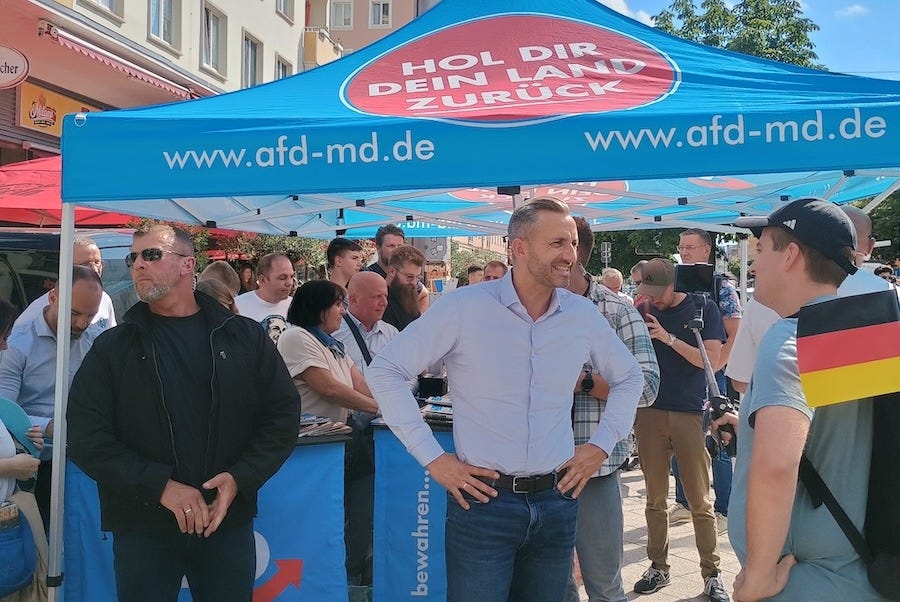
In an interview with dw.com published Aug. 26, Feige criticized the AfD’s election posters, which include slogans such as “Deport from minute one,” “Save your country,” and “Take your country back.”
“What is that if not racial nationalism?” he commented.
Feige, who has submitted his resignation as Bishop of Magdeburg to the pope ahead of his 75th birthday in November, also took issue with a call in the AfD’s manifesto for the German flag to be flown at every school and for the singing of the national anthem to be made a regular feature at school events.
“That existed during the Nazi era; the GDR [Communist East Germany] adopted it. And now it is supposed to come back? I consider that impossible,” he said.
Flags are currently flying outside the Catholic Cathedral of St. Sebastian in Magdeburg promoting the diocese’s “vote consciously” initiative.
According to the latest polls, the AfD is leading by a significant margin in Saxony-Anhalt. An Infratest dimap poll recently put the AfD in the lead with 41%, followed by the Christian Democratic Union, the party of Chancellor Friedrich Merz, at 24%.
To secure an outright majority, the AfD needs to gain 49 out of the 97 seats in Saxony-Anhalt’s state parliament. The party must win up to 50% of votes, unless smaller parties fail to cross the 5% threshold, bringing down the percentage necessary to achieve an outright majority to as low as 44%.
If the AfD comes first but does not secure an outright majority, it is unlikely to govern the state because other parties have said they will not enter a coalition with the AfD, a policy known as the firewall (Brandmauer). The firewall is the reason why the AfD has so far failed to take power in any German state, despite topping the poll in neighboring Thuringia in 2024.
Ulrich Siegmund, the AfD’s lead candidate in Saxony-Anhalt, has earned significant media attention since being described as “Germany’s most dangerous man” by the magazine Der Spiegel. The 35-year-old was raised a Catholic, but reportedly formally left the Church in 2017.
More than 1,000 Catholics in Saxony-Anhalt formally renounced their membership in 2025, the latest year for which figures are available, leaving only 61,300 registered Catholics in the state.
Siegmund has said that he carries Catholic values “in the heart.” He reportedly has a portrait in his office of Otto von Bismarck, who led the 19th-century Kulturkampf against the Catholic Church.
Bishop Feige has voiced fears that an AfD victory in Saxony-Anhalt could also affect Germany at a federal level.
“If the AfD forms a majority government here, it will be a pilot project. Saxony-Anhalt will then serve as a stepping stone to federal politics,” he told dw.com.

I’d love more info on why the AfD are the Nazis reincarnated apart from flying flags and singing the National anthem (the bishop seems to be saying it’s a sin to be patriotic if you’re German and while I do have a knee jerk reaction to Germans being enthused I can acknowledge that’s totally unfair to project on modern Germany lol) or wanting to fix the church tax situation (which you’ll never convince me isn’t simony so please don’t start with the church nationalizing history lesson etc etc ).
American media (excepting the pillar of course) can ONLY project our very rigid American political binary on other places and is thus not reliable. Previous pillar coverage had referenced that apart from AfD, post WWII all political parties in Germany have been center or left of center and anything right of center doesn’t really exist. But right of center doesn’t jump to literal nazi. So I just feel like I can’t get a handle of reality over there.
Ok non Church reality. Pillar coverage of German church is A+++ 😁
President Trump and Vice President Vance have both supported the AfD and various of its candidates. Why wouldn't they?