The Bishops’ Conference of the Philippines urged Catholics Monday not to visit the Shrine of Our Lady of Naju in South Korea.
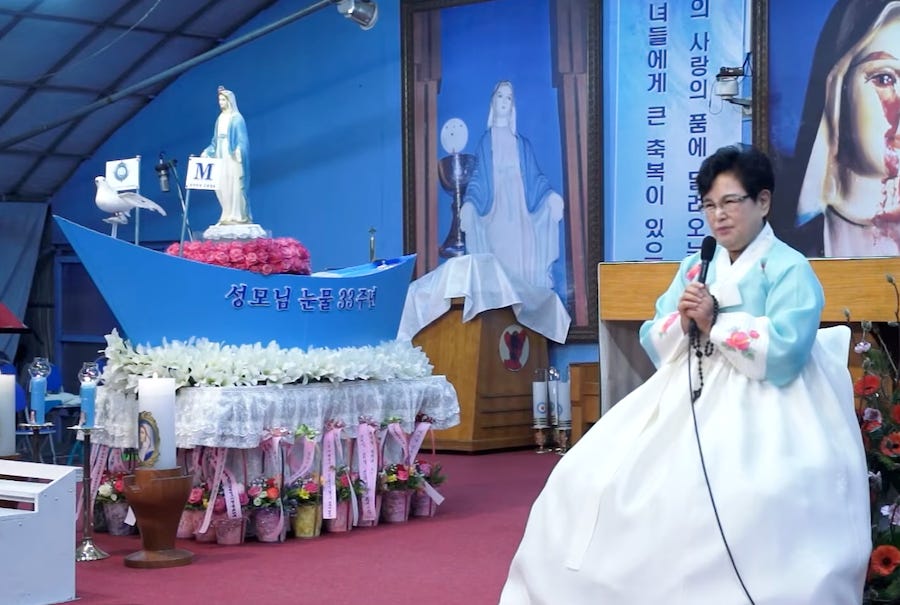
Philippines bishops’ conference president Archbishop Gilbert Garcera noted in a July 13 statement that South Korea’s Gwangju archdiocese had issued a negative judgment on the events at Naju, following a discernment process in communion with the Vatican’s Dicastery for the Doctrine of the Faith.
“We address diocesan pilgrimage organizers, parish leaders, travel agencies, as well as Filipino pilgrims and devotees, urging them to refrain from organizing, promoting, or participating in pilgrimages to Naju,” Garcera wrote.
“Instead, we encourage the faithful to make pilgrimages to approved Marian shrines in the Philippines and throughout the world, where authentic Marian devotion is fostered in full communion with the Church.”
The statement appears to be the first instance of a national bishops’ conference publicly issuing its own formal pastoral guidance on the Naju site and telling Catholics not to organize, promote, or participate in pilgrimages there.
But the intervention follows a flurry of declarations about the phenomenon issued by archdioceses in Southeast Asia — an indication of growing concern at the shrine’s influence on clergy and laity.
What are the origins of the Naju shrine? How have bishops responded? And what’s likely to happen next?
The birth of the Naju shrine
Julia Youn Hong-Sun, known internationally as Julia Kim, was born on March 3, 1947, in Naju, a city in southwestern South Korea, according to the Naju shrine’s official biography, a devotional account that refers to her as “the little soul.”
Kim’s relatively well-off family was thrown into turmoil by the Korean War. According to the shrine’s account, Kim’s father died in the conflict, leaving her and her mother to fend for themselves.
In 1972, Kim married Julio Kim Man-bok, with whom she had two sons and two daughters. Her official biography says that she continued to work strenuously outside the home while managing a household of 15 people.
She was diagnosed with cancer, which doctors reportedly deemed untreatable, and by the summer of 1980 was preparing for death. That was when Kim, a Protestant, first visited a Catholic church.
The Naju shrine website says that Kim later heard what she believed to be the voice of Jesus, directing her to read the Bible. She opened it at Luke 8, and read the accounts of Jairus’s daughter and the woman with a hemorrhage. The site says that the moment she said “Amen” after reading the passages, her cancer disappeared.
Kim was baptized Catholic on Easter Sunday 1981. She opened a beauty salon, which she combined with an increasingly intense spiritual life.
A decisive event occurred on June 30, 1985, when Kim reported that a statue of the Virgin Mary she had enthroned in her house began to weep continuously.
Kim claimed that from July 18, 1985, onward she began to receive messages from Mary and Jesus. She also said that she received an abundance of “signs,” ranging from Eucharistic miracles to statues exuding fragrant oil. She reported that on Oct. 19, 1986, her statue of Mary began to emit tears of blood — an image used extensively in the shrine’s materials.
In 1987, Kim oversaw the construction of a building she called the Blessed Mother’s Chapel. The chapel was completely destroyed by fire in 2015, but later rebuilt. Today, the building houses various “signs,” including a Eucharistic host that allegedly descended miraculously when Archbishop Giovanni Bulaitis, the apostolic nuncio to South Korea, visited the site in 1994.
In 1992, Kim bought land on a nearby peak, which she named the Blessed Mother’s Mountain and where she claimed to have discovered a miraculous spring.
How have bishops responded?
The growing number of visitors to the Naju site in the 1990s attracted the attention of the local Archdiocese of Gwangju, which opened a formal investigation.
In 1998, the archdiocese issued its first pastoral notification. It said that Kim’s “messages of the Blessed Mother of Naju” appeared to borrow from other published works and did not constitute credible private revelations. It also concluded there was no evidence that the “signs” claimed by Kim were of supernatural origin.
Archbishop Victorinus Youn Kong-hi, the then-Archbishop of Gwangju, prohibited the publication of materials promoting the alleged visions, asked Kim to stop spreading the supposed Marian messages, and reaffirmed a ban on Masses at places associated with the purported visionary.
The archdiocese issued further pastoral guidance in 2001 and a second pastoral notification in 2005, emphasizing that the Naju phenomenon was not approved by the Church.
The archdiocese’s actions culminated in January 2008 with a decree imposing canonical penalties while reiterating that Catholics should not attend unauthorized liturgical celebrations at the site.
Archbishop Andreas Choi Chang-mou, who had succeeded Archbishop Youn at the helm of the Gwangju archdiocese in 2000, declared that “clergy, religious, or laity who preside over or attend the celebration of the sacraments or sacramentals, against my prohibition, at any alleged ‘oratory’ or the ‘hill of Our Lady in Naju’ incur a latae sententiae [automatic] excommunication.”
The decree did not appear to dent the popularity of the shrine, which increasingly attracted visitors from outside of South Korea. No annual visitor statistics are publicly available. But significant numbers of pilgrims appear to come from Japan, China, Hong Kong, Malaysia, Singapore, the Philippines, and Indonesia.
The then-Congregation for the Doctrine of the Faith reportedly confirmed in a letter dated April 23, 2008, that the Church’s official position on the Naju events was “non constat de supernaturalitate” (not established as supernatural).
Meanwhile, the Gwangju archdiocese continued to underline its opposition to the Naju site, with a third pastoral notification in 2011, published with the backing of the Vatican’s doctrinal office, and new guidelines in 2012, which noted that all members of the Catholic Bishops’ Conference of Korea supported the archdiocese’s position.
In 2013, the original weeping statue of the Virgin Mary was stolen from the Naju shrine and remains missing to this day.
In 2018, the Korean bishops’ conference wrote to the Federation of Asian Bishops’ Conferences, which encompasses 29 member territories, sharing its conclusion that the events at Naju had not been established as supernatural and urging priests and laity not to visit the site.
In 2018 Archbishop John Wong of Kota Kinabalu, Malaysia, issued a statement endorsing the Korean bishops’ stance.
The Archdiocese of Singapore issued a similar notice in 2022, which it underlined in 2025 with a notice warning Catholics that those who visit the site “incur an automatic (latae sententiae) excommunication.”
Malaysia’s Kuala Lumpur archdiocese also followed suit in 2025.
In February 2026, the Korean bishops’ conference’s standing committee reportedly decided to approach the Federation of Asian Bishops’ Conferences again, asking it to inform Catholics across the continent that the shrine operates without Church approval.
What’s next?
The Filipino bishops’ conference’s July 13 statement could mark the start of a new wave of warnings about the shrine by bishops across Asia.
That’s more likely if it was triggered by a request from the Federation of Asian Bishops’ Conferences, though this is unclear. Alternatively, the statement might be an isolated response to the phenomenon, driven by concerns about the number of Filipino lay people visiting the shrine.
The proliferation of declarations about the shrine across Asia suggests that Naju has gained a momentum that is difficult to counter with episcopal statements alone.
Asian bishops face the challenge of how to redirect Catholics’ Marian piety toward officially recognized shrines. There is no shortage of these, ranging from the Our Lady of Akita Shrine in Japan to Antipolo Cathedral in the Philippines to Our Lady of Good Health Church in Indonesia.
Julia Kim is now 79 years of age. She appears to be in good health, delivering vigorous addresses on the shrine’s slickly curated YouTube channel, dressed in a traditional Korean hanbok.
But her advanced age inevitably raises the question of what will become of the Naju movement after her death. Asia’s bishops may be hoping that the shrine’s appeal will begin to fade without the presence of its charismatic founder.

