
Austria’s largest Catholic women’s organization urged the country’s bishops Tuesday to open the role of bishops’ conference general secretary to lay people.
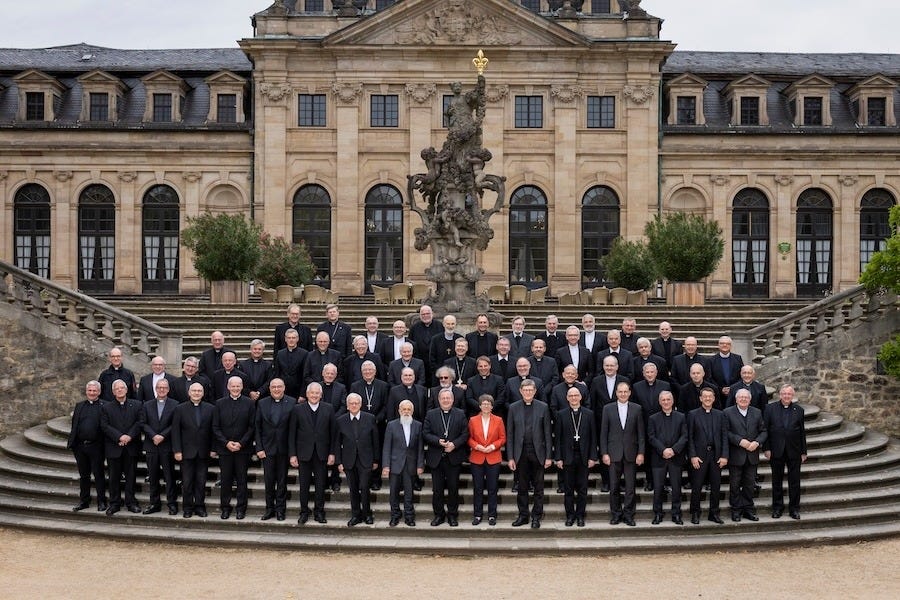
Caption: German bishops with bishops’ conference general secretary Beate Gilles, at the 2025 fall plenary assembly in Fulda. Credit: Deutsche Bischofskonferenz / Ralph Sondermann.
The Austrian Catholic Women’s Movement called Sept. 15 for the statutes of the Austrian bishops’ conference to be amended so the office holder is no longer required to be a priest or bishop.
Angelika Ritter-Grepl, the group’s chairwoman, said: “It is time for the bishops’ conference to amend its own statutes so that this important office can also be held by lay people — both women and men.”
The appeal was prompted by the announcement that Fr. Peter Schipka, the general secretary of the Austrian bishops’ conference since 2011, will step down in November. Schipka chose to resign two years before the expiration of his latest six-year term to serve as a professor of education.
The Austrian Catholic Women’s Movement noted that canon law does not require a bishops’ conference general secretary — who plays an administrative and coordinating role within a national bishops’ conference — to be a priest.
But the phenomenon of appointing lay people to the top administrative role in a bishops’ conference is relatively no — and has a historical connection to the Church in the United States.
Click here to open the map in a new window.
Sr. Anna Mirijam Kaschner, C.P.S., is widely regarded as the first woman to serve as general secretary of a bishops’ conference. She became general secretary of the Nordic bishops’ conference in 2009, a post she continues to hold.
Sr. Hermenegild Makoro, C.P.S., became the general secretary of the Southern African Catholic Bishops’ Conference in 2012, serving in the role until 2020.
The theologian Beate Gilles became the first woman who is not a religious to hold the post of general secretary of a bishops’ conference when she took up the role in Germany in 2021.
Other lay general secretaries in Europe include Bruno Spriet in Belgium, Luisa Campbell in Scotland, Davide Pesenti in Switzerland, and Anneke van der Kamp-van Saase in the Netherlands.
But the practice remains uncommon in many parts of Europe, where the general secretary is still a priest or bishop.
The U.S. bishops’ conference has never had a lay general secretary, although lay people have held senior executive positions within its general secretariat.
In fact, in 2000, the U.S. bishops’ conference asked the Congregation for Bishops if it was possible to install a woman religious — specifically a canon lawyer, Sr. Sharon Euart — as conference general secretary.
The congregation wrote back with a firm “no”, insisting the role had to be filled by a cleric. It is not clear when that insistence waned, but by 2009, such an installation had occurred for the Nordic episcopal conference.
—
The general secretary of the Austrian bishops’ conference is elected by the plenary assembly of bishops for a six-year term.
The bishops’ conference statutes currently state: “He need not be a bishop, but he must be a priest.” The statutes note that they can only be amended with the Holy See’s approval.
Schipka was first elected general secretary in March 2011 and was re-elected in November 2016 and November 2022.
Kathpress, the official Catholic news agency of the Austrian bishops’ conference, quoted Schipka as saying: “I have always greatly enjoyed this role. However, I have come to realize that it is not good — either for the office or for myself — for the two to become too closely intertwined over such a long period.”
Before he leaves the post, Schipka will take part in the Austrian bishops’ November plenary meeting in Salzburg.
The Austrian Catholic Women’s Movement argued that opening the position of general secretary to lay people would show the bishops’ commitment to synodality.
“Synodality that takes place only in roundtable discussions but never finds its way into structures and offices remains half-hearted. If the bishops’ conference wants to credibly follow the synodal path for itself, then the question of who should lead its general secretariat must be at the very top of the agenda,” the group said in a Sept. 15 press release.
It added: “In November, the plenary assembly of the bishops’ conference will meet in Salzburg, where the succession to Peter Schipka will also be on the agenda. We will actively bring this matter to the bishops’ attention and invite those in charge to engage in dialogue about opening up the office in a way that is in keeping with the times.”