Austrian Church offers new pathway for late vocations
Men aged 45-60 will be able to train for the priesthood while continuing to work in a secular profession.
The Catholic Church in Austria unveiled a new program Monday that will enable men aged 45 to 60 to train for the priesthood while continuing to work in a secular profession.
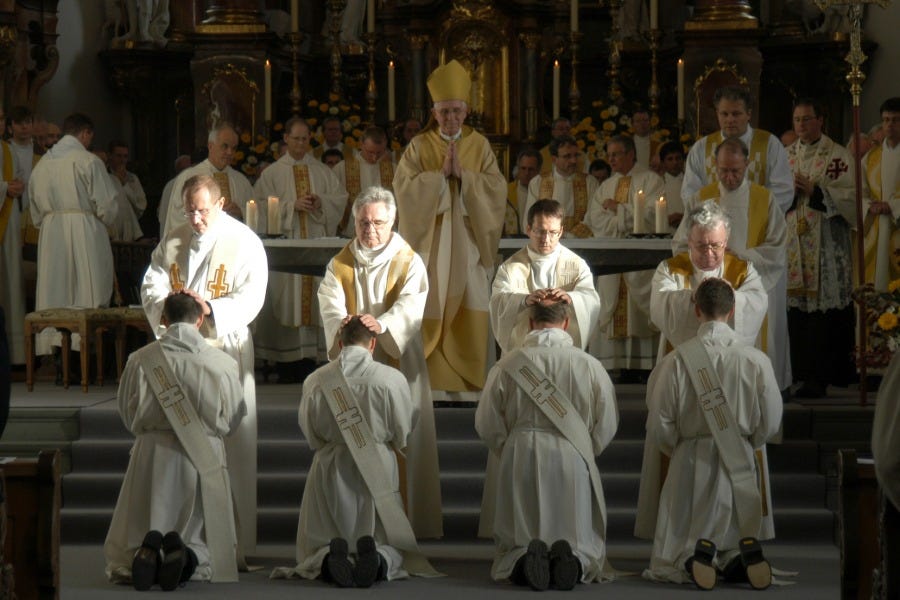
The Conference of Rectors of Austrian Seminaries announced the new program for dioceses Jan. 5, emphasizing that it will be individually tailored to each candidate, rather than taking a one-size-fits-all approach to late vocations.
The program — known as the Zweiten Weg für Spätberufene, or Second Pathway for Late Vocations — will permit candidates to pursue their theological studies on a flexible basis or via distance learning while they continue in their daily professions.
Candidates’ practical and spiritual training will take place at a seminary. But Austrian media reports did not specify whether candidates will also be required to live full-time in the seminary. The seminary-based training will be arranged around the candidate’s professional commitments.
In rare cases, candidates in the new program will be allowed to retain their jobs after ordination, but on a limited basis and only with the approval of their dioceses. The profession must be compatible with a priestly ethos.
Any candidate holding political office will be required to relinquish it before beginning training for the transitional diaconate and priesthood.
The new program is unusual because candidates with late vocations typically leave their jobs to study full-time at seminaries, some of which are specialized in training older men. For example, at the St. Lambert Seminary in the German state of Rhineland-Palatinate, late vocation candidates give up their jobs and live communally.
Candidates for the new Austrian program must meet the standard requirements for priestly training in Latin Rite dioceses. They must be unmarried – though they may be widowers – and committed to lifelong celibacy.
Austria is a country of around 9 million people, just under half of whom are Catholic. It borders Germany, the Czech Republic, Slovakia, Hungary, Slovenia, Italy, Switzerland, and Liechtenstein.
According to Statistics Austria, the body that publishes official national data, there are roughly 850,000 men aged 45 to 60 in the country. Around 400,000 of them are baptized Catholics, about 50,000 of whom would be regular Mass-goers. Although most of the regular male Mass-goers in the age group are married, the pool of potential candidates for the new program would likely run to several thousand.
In common with other Western European countries, Austria experienced a significant decline in priestly vocations in the decades following Vatican Council II. Late vocations emerged as a common phenomenon in the late 20th century.
But in recent years, the number of late vocations has declined as more young candidates sign up for priestly training. In recent years, the average ordination age in Austria was 35 or older. In 2025, it fell to 34, as half of the aspiring priests were between 27 and 31 years of age.
The new program’s designers hope that by offering a flexible program to professional men aged 45 to 60, they can uncover a new growth area amid the overall shortage in priests. The Conference of Rectors of Austrian Seminaries said the candidates targeted by the program were a “valuable asset to the Church, as they can put their professional skills to use in the service of the community.”
The conference said the new program would follow Vatican guidelines as set out in the document Ratio Fundamentalis Institutionis Sacerdotalis. It highlighted the text’s reference to the “more developed personality” of older priestly candidates.
The Ratio Fundamentalis says that local bishops’ conferences are responsible for issuing “specific norms appropriate for their own national situation” concerning late vocations. Bishops’ conferences can decide whether to set an age limit for vocations and to establish a separate seminary for older candidates.
“As in the case of other seminarians, these candidates should be accompanied in a serious and comprehensive journey, which should include, in the context of a community life, a solid spiritual and theological formation, using appropriate pedagogical and didactic methods, that take account of the personal profile of each man,” the Vatican text says.
The Conference of Rectors of Austrian Seminaries invited potential candidates for the new program to contact their local seminary or diocesan vocations office.


The idea that formation should be individually tailored to each vocation would be great in our regular seminaries as well. Liability-scared bishops and formators are really wedded to one size fits all programs.
Hopefully this encourages other conferences and dioceses to review their vocational age limits. Similiar to later in life military applicants, they often bring experience and expertise that isn't regularly cultivated within the organization.