Azerbaijan continues ‘caviar diplomacy’ with Vatican after cathedral demolition
Azerbaijan agreed to fund renovations at St. Paul Outside the Walls weeks after demolishing an Armenian cathedral in occupied territory.
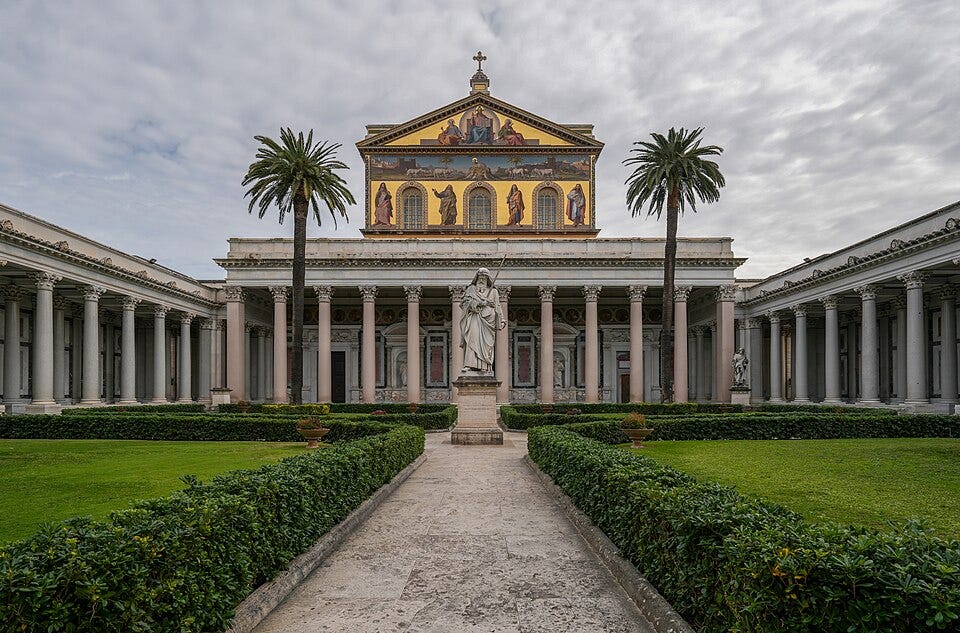
Azerbaijan and the Vatican signed an agreement on April 30 for the renovation of four statues at the Basilica of Saint Paul Outside the Walls, weeks after the Azerbaijani regime demolished an Armenian cathedral in an occupied region under dispute between both countries.
The announcement was made during a presentation at the Palazzo della Cancelleria in the Vatican, in which a foundation widely considered to be a wing of the Azerbaijani regime’s “caviar diplomacy” showcased the various projects it has funded in the Vatican since 2012.
The event was attended by Msgr. Pasquale Iacobone, president of the Pontifical Commission for Sacred Archaeology, and Archbishop Giovanni Cesare Pagazzi, Archivist and Librarian of the Holy Roman Church and secretary for the Dicastery for Culture and Education.
A Heydar Aliyev Foundation statement said that during the event included the presentation of the book “Pontes Culturae,” showing the works conducted by the foundation in the Vatican, and a documentary about the Holy See’s “friendship and cooperation” with Azerbaijan.
The book was prepared by the foundation, the Azerbaijani embassy to the Holy See, and the Pontifical Commission for Sacred Archaeology.
Ilgar Mukhtarov, the Azerbaijani ambassador to the Holy See said that “these projects are not limited only to the restoration of architectural monuments but also serve as an expression of respect for humanity’s collective memory, establishing a spiritual dialogue between the past and the future, and transferring universal values to future generations.”
During the event, it was announced that the Azerbaijani regime had signed an agreement with the Governorate of the Vatican City State to restore four statues in the Basilica of Saint Paul Outside the Walls on Apr. 29.
A Vatican governorate statement said that two statues of Saint Peter and Saint Paul within the Basilica and two of Saint Paul and Saint Luke in the church’s portico would be restored, and said that the agreement “expressed the sincere friendship and mutual cooperation existing between the Governorate and Azerbaijan.”
The announcement comes days after the Azerbaijani regime demolished the Armenian cathedral of the Holy Mother of God in the city of Stepanakert in the region of Nagorno-Karabakh, disputed between Azerbaijan and Armenia since the 1990s, and de facto controlled by Azerbaijan since 2023 after an offensive in the area that displaced 120,000 ethnic Armenians from the region.
Several human rights organizations and Armenian activists described the demolition of the cathedral as a part of a broader pattern of systematic cultural erasure in the region.
The demolition took place shortly before the 111th anniversary of the Armenian genocide, during which an estimated 1 to 1.5 million ethnic Armenians were killed and millions more were forcibly deported by the Ottoman government during World War I.
Construction on the cathedral began in July 2006 and when it was consecrated in April 2019 it became the largest Armenian church in Nagorno-Karabakh. The cathedral was used as a bomb shelter during the Second Nagorno-Karabakh War in 2020 but did not suffer significant damage.
Armenian cultural heritage watchdog Monument Watch has reported that the Church of Saint Jacob, built in 2007 and located in the same city, was also demolished in early April.
The Armenian Apostolic Church is the ancient national Church of Armenia, and is one of the Oriental Orthodox Churches, a roughly 70 million-strong communion that also includes the Coptic Orthodox Church.
The Armenian Apostolic Church said in an Apr. 23 statement that “It is obvious that the Azerbaijani government continues to target Armenian Christian holy sites with the aim of erasing the Armenian trace from Artsakh.”
“This state-level vandalism once again proves that Azerbaijan’s anti-Armenian policy has not changed, which makes statements about establishing a stable and lasting peace with Armenia questionable.”
This is not the first time the Vatican has been criticized for its ties to the Azerbaijani regime, which is accused by human rights organizations of ethnically-based persecution of Armenian Christians in border territories.
Azerbaijan signed agreements in September 2025 with the Bambino Gesù Children’s Hospital and the Vatican Apostolic Library and Apostolic Archives, alarming critics who accuse the Azerbaijani regime of human rights abuses against the Armenian minority and of practicing “caviar diplomacy” by using its cultural and economic power to influence Vatican policy in the South Caucasus region.
In April 2025, the Azerbaijani regime held a conference at the Pontifical Gregorian University, prompting widespread backlash.
The conference was entitled “Christianity in Azerbaijan: History and Modernity.” But Armenian activists and Church leaders called the event part of a broader campaign to erase Armenian Christian heritage from disputed territories.
Promotional materials for the conference included distinctly Azerbaijani texts on West Asian history, including a display of the medieval Armenian monastery of Dadivank, with the claim that it belonged to the “Caucasian Albanian” culture, an Azerbaijani government claim widely disputed by historians.
“This has no basis in reality. They say these are Caucasian Albanian churches, but Caucasian Albanians disappeared in the 8th century,” Orthodox Archbishop Vicken Aykazian, ecumenical director of the Eastern Diocese of the Armenian Apostolic Church of America, told The Pillar back in April 2025.
Despite these controversies, the conference received a letter of congratulations from Cardinal Claudio Gugerotti, prefect of the Dicastery for the Eastern Churches.
Months before the 2020 offensive in Nagorno-Karabakh, Azerbaijan’s First Lady Mehriban Aliyeva was awarded the Order of Pope Pius IX at the Vatican.
Ilqar Mukhtarov, Azerbaijan’s ambassador to the Holy See, received the same distinction on April 3, 2025.
The Heydar Aliyev Foundation lists the Vatican Apostolic Library and the Vatican Museums among its partners and several restoration projects that it is supporting at the Vatican.
The list includes the Roman Catacombs of Marcellinus and Peter, the Catacombs of Commodilla, and the Catacombs of San Sebastiano, the restoration of a statue of Zeus in the Vatican Museums, the restoration and translation of more than 3,000 books and 75 manuscripts in the Vatican Apostolic Library, the restoration of a bas-relief with the encounter between Pope Leo the Great and Attila the Hun in St. Peter’s Basilica, and the restoration of the Basilica of St. Paul Outside the Walls.
According to Italian outlet Irpi Media, the donations amounted to 640,000 euros (around $730,000). But an Azeri official said publicly in 2020 that the figure was “over 1 million euros.” Many of the restoration works came after 2020, suggesting the actual sum could be even higher.
One of the largest restoration projects was unveiled in 2024, when the Vatican City State Governorate announced an agreement between the Basilica of St. Paul Outside the Walls and the Heydar Aliyev Foundation.
Observers suggest links between the Vatican and the former Soviet republic were strengthened thanks to Cardinal Claudio Gugerotti, who is now prefect of the Dicastery for Eastern Churches and was the apostolic nuncio to Azerbaijan, Armenia, and Georgia from 2001 to 2011.
During Gugerotti’s service as nuncio, Azeri authorities signed a bilateral agreement with the Holy See in 2011, appointing an ambassador the same year, and began to have frequent meetings, both in Azerbaijan and the Vatican, with Holy See officials, among them then-Secretary of State, Cardinal Tarcisio Bertone, and Cardinal Gianfranco Ravasi, the then-president of the Pontifical Council for Culture.
According to Irpi Media, Ravasi is another central figure connecting Azerbaijan and the Vatican.
Ravasi opened the doors to Azeri-funded restoration projects in the Vatican with a 2012 agreement to restore Roman catacombs, as well as another to translate and restore manuscripts in the Apostolic Library.

