Bavarian Benedictines retain local council seats
Three Benedictine priests retained town council seats in elections Sunday.
Three Benedictine priests retained their town council seats following Sunday’s elections in the southern German state of Bavaria.
Church law states that “clerics are forbidden to assume public offices which entail a participation in the exercise of civil power.”
Among the most famous cases related to the norm is that of Fr. Robert Drinan, SJ, who served as a member of Congress for a full decade, beginning in 1971.
In 1980, Pope St. John Paul II directed that priests withdraw from public office, and Drinan did not stand for reelection to his seat.
Still, in Bavaria, the custom of Benedictine monks standing in local elections dates back more than a century.
The Benedictine priests argue that they are not violating canon law because the local council posts are non-partisan and they have no individual executive power, since decisions are made by collective majority vote. The monks are not allowed to be elected as mayors, they say, as they believe that would cross the threshold from civic participation to the exercise of civil power.
The Apostolic See has seemingly not intervened in the situation.
The custom makes Bavaria something of an outlier in Europe, where it is rare for clergy to run for elected office — but not unheard of.
In France, a country with strict Church-state separation, a priest can stand for election as a local mayor, though it seldom happens. Fr. Elie Geffray, a priest of the Diocese of Saint-Brieuc, served as mayor of Eréac, northwestern France, from 2008 to 2014.
In Poland, Archbishop Sławoj Leszek Głódź was controversially elected as a village administrator in Piaski in 2021. The former Gdańsk archbishop had been sanctioned by the Vatican over his handling of abuse cases. He appears to continue to hold the post.
More high-profile examples of priests running for office are found outside of Europe.
Fr. Hyacinth Alia was elected governor of Nigeria’s Benue State in 2023. He was suspended by his bishop when he announced he was standing for the post.
Bishop Fernando Lugo of San Pedro was laicized by Pope Benedict XVI after he was elected president of Paraguay in 2007.
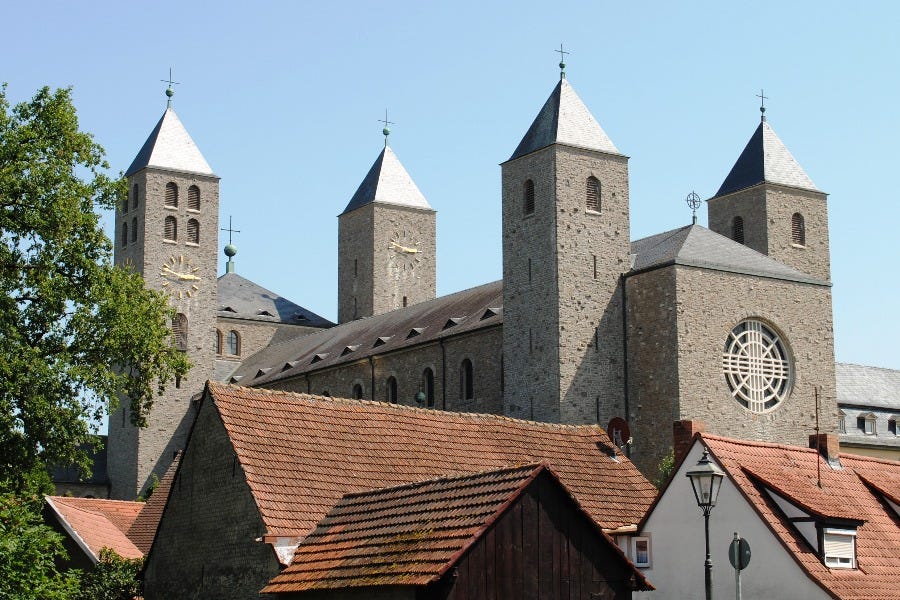
In Bavaria’s March 8 local elections, Fr. Christoph Gerhard of Münsterschwarzach Abbey retained his seat in Schwarzach am Main, Lower Franconia, after a list of the abbey’s monks gained 6.2% of the votes, giving the community one local council post.
Fr. Tassilo Lengger of St. Ottilien Archabbey also held his seat in Eresing, Upper Bavaria, after the abbey’s electoral list won 9.8% of votes, enabling the community to hold one council position.
Fr. Lukas Wirth was re-elected to a post he has held for 24 years on the council of Scheyern, Upper Bavaria. He was not elected from an abbey list but from a joint list of Bavaria’s conservative Christian Social Union party and a local voters’ association.
Wirth, a member of Scheyern Abbey, is typically placed last on the list, meaning that he qualifies for a seat through votes cast personally for him, rather than because of party allegiance. He came fifth on this year’s list.
Monks from Münsterschwarzach Abbey were first elected to the local council in 1918. The practice was interrupted during the Nazi era, but resumed after the Second World War.
The abbey, which belongs to the Benedictine Congregation of St. Ottilien, has around 90 monks. It is one of the area’s largest employers, with around 300 people working with the community, including in administrative and agricultural roles.
The abbey even has its own fire department, which attracted headlines in 2019 when it rescued a duck and five ducklings after they became stuck in the spillway of a hydroelectric power plant.
Fr. Gerhard, who has held a seat on the local council since 2014, said in a 2020 interview that monks who provide pastoral care in the local villages are not allowed to stand for election, as this would be seen as a conflict of interest. He oversees the abbey’s business affairs, in his role as cellarer, enabling him to hold the elected post.
As a council member, he has deliberated on topics such as schools, flood protection, highway expansion, and gravel mining.
The abbey expressed delight at its showing in the March 8 election, after it stressed the need to support local young people and develop the town of Schwarzach am Main in the run-up to the ballot.
“The abbey’s monks were particularly pleased about the increase in votes. Compared to the last election, significantly more voters chose the monastery list,” it commented.
Gerhard said: “We are surprised and pleased with the good election results. For us, this is a clear sign that people appreciate our commitment to the community.”

