
Belarusian archbishop highlights growing priest shortage
Plans for a Belarusian center in Rome are on hold amid falling clergy numbers.
The president of the Belarusian bishops’ conference said this week that the number of priests in the country is diminishing, making the provision of pastoral care increasingly challenging in the eastern region.
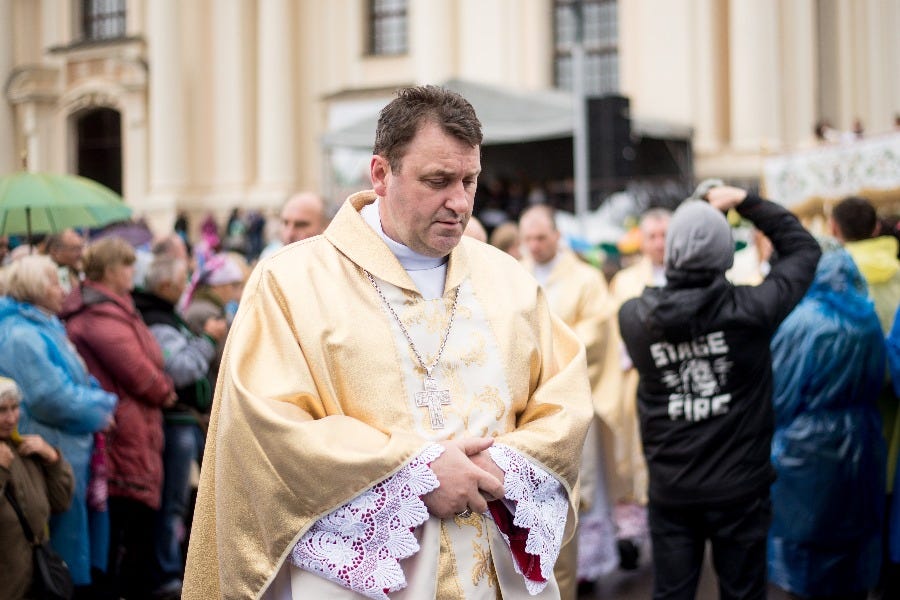
Archbishop Iosif Staneuski of Minsk-Mohilev told Vatican News’ Belarusian service that the priest shortage made it difficult to realize plans to establish a Belarusian Catholic pastoral center in Rome, known as the Belarusicum.
The interview with Belarus’ leading churchman, published May 28, offered a rare insight into the current state of the Church in the predominantly Orthodox Eastern European country, which has a population of around 9.5 million and borders Russia, Ukraine, Poland, Lithuania, and Latvia.
A 2016 state survey estimated that Catholics form 6% of the population, though the proportion may be higher. Many have an ethnic Polish background and most are Latin Catholics.
Staneuski, who was in Rome to attend the May 25-28 plenary assembly of the Italian bishops’ conference, said it would be hard to send priests to oversee a proposed Belarusian pastoral hub, based in a Rome parish, because clergy were needed at home.
He said that in the eastern Mogilev region, one priest had to travel hundreds of kilometers between the three parishes he served.
He also noted that priests from Poland, who have worked in Belarus for decades, are increasingly unable to extend their stay in the country, leading to the loss of experienced clergy.
Tensions between the governments of Poland and Belarus rose after the controversial re-election of Belarusian President Alexander Lukashenko in 2020, which sparked mass protests, and the 2022 full-scale Russian invasion of Ukraine, facilitated by Belarus.
As relations with Poland deteriorated, the Belarusian government began to view Polish priests with rising suspicion. Human rights groups reported this month that three Polish priests serving in the Vitebsk diocese and five in the Minsk-Mogilev archdiocese were refused permission to extend their residency.
Staneuski discussed the possibility of recruiting priests from further afield than Poland, including Africa and Asia. He said there was theoretically no barrier to this step, despite differences of culture and language, but the Belarusian Catholic community should aim to be self-sufficient.
“Every family, state, and Church is a family of families,” he commented, appealing to families to promote priestly vocations.
Publicly available statistics for Belarus’ four Latin Catholic dioceses end in 2022-2023 and therefore do not give the current picture described by Staneuski. The figures show an overall growth in the number of priests in the first decades of the 21st century, pointing to the continued resurgence of the local Church following the collapse of communism in 1991.
But there are marked differences between dioceses. The best-supplied diocese is Grodno, which is located in the west of the country, where the Catholic presence has traditionally been strongest. But even there the total number of priests has plateaued since 2016.
The three dioceses that cover the east of the country — Minsk-Mohilev, Vitebsk, and Pinsk — have markedly few priests. This is especially challenging for Minsk-Mohilev, which is geographically the second-largest diocese in Belarus, after Pinsk, and has the worst ratio of Catholics per priest. The further reduction in the number of priests in the archdiocese described by Staneuski is likely to have increased the pastoral burden on remaining clergy.
Welcoming priests from Africa and Asia is a possibility for the Church in Belarus. But there are significant obstacles. The clergy would likely undergo state vetting, might struggle initially with the Belarusian language, and would need to immerse themselves in the country’s distinctive culture and history to be pastorally effective.
Y'all have forgotten another jurisdiction
https://www.catholic-hierarchy.org/diocese/dbybz.html