Belgian bishop announces plan to ordain married men as priests
The bishop said he will “make every effort to ordain married men as priests for our diocese by 2028.”
A Belgian bishop said he intends to start ordaining married men to priesthood by 2028, in a move seemingly intended at pressuring Pope Leo XIV on the issue.
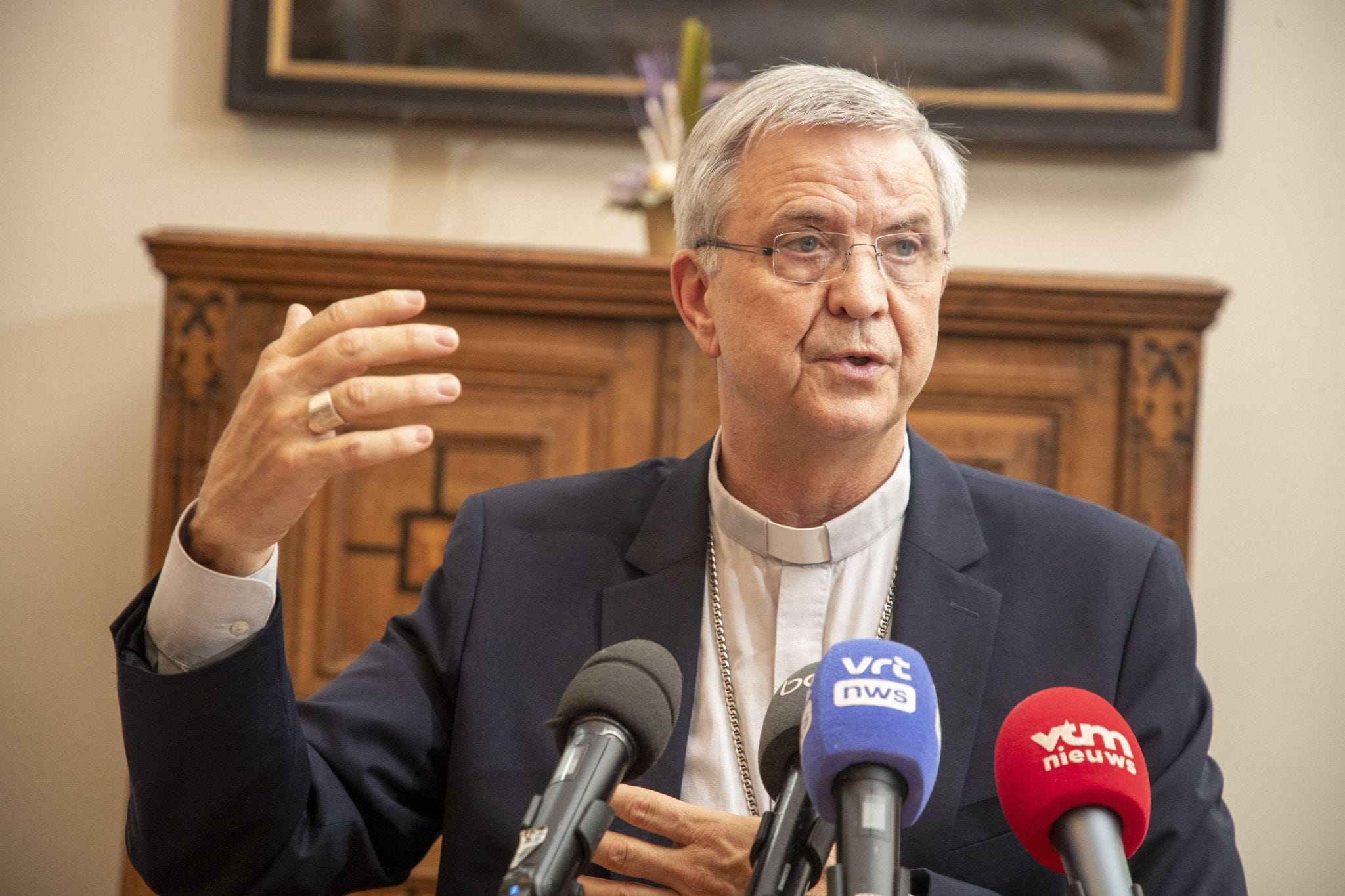
Bishop Johan Bonny of the Diocese of Antwerp published March 20 a document outlining the application of the synod on synodality in his diocese. In it, he said that “the question is no longer whether the Church can ordain married men as priests, but when it will do so, and who will do it.”
“It is an illusion to think that a serious synodal-missionary process in the West still has a chance without also ordaining married men as priests,” he added in his letter.
Bonny said in the letter that while foreign priests help in filling shortages in many dioceses and “enrich our church life with a healthy dose of universality and catholicity,” they “come to help us, not to replace us. Moreover, it would not be fair to place the burden of our shortages on their shoulders.”
“There is a historical shortage of local priests in many dioceses. The number of unmarried men who want to become priests has fallen to just above zero,” he added.
Pope Francis repeatedly stated that the synod on synodality was not intended to change Catholic doctrine, but to foster listening and participation within the Church. When asked about the issue in 2024, he said that “the synod is not a parliament,” and framed speculation about doctrinal change as ideological.
While Francis repeatedly allowed for discussion on married clergy, he also made clear his opposition to “optional celibacy.” In a 2019 press conference and in an interview that same year, he said that “optional celibacy is not the solution” to the vocational crisis in the West.
Moreover, when the issue became central during the synod on the Amazon, Francis ultimately declined to open the door to ordaining married men, making no provision for it in his post-synodal apostolic exhortation Querida Amazonia.
While Leo hasn’t spoken directly on the issue, he has repeatedly praised celibacy in various public interventions, calling it “undivided love for Christ and His Church.”
In his pastoral letter, Bonny said that he would “make every effort to ordain married men as priests for our diocese by 2028.”
“I will approach them personally and ensure that by then they have the necessary theological training and pastoral experience, comparable to that of other priest candidates. This preparation will be transparent but discreet, away from the media spotlight,” Bonny added.
The Belgian bishop said he intended to spend the next two years making “the necessary… arrangements” with the Belgian bishops’ conference and the Holy See, adding that for many bishops “the ordination of married men has become a matter of conscience. At that level, too, transparency, accountability, and evaluation are important for the credibility of the Church.”
He also argued that it is inconsistent for the Latin Church to exclude married men from priestly ordination while allowing married clergy from Eastern Catholic Churches and married convert ministers from mainline protestant communities to be ordained.
“Almost all dioceses work nowadays with a number of married Catholic priests, to everyone’s joy and appreciation. Some of these priests, as in our diocese, belong to an Eastern Catholic Church… Some were trained at our interdiocesan seminary in Leuven, together with the other seminarians. They celebrate the sacraments in both their rite and our rite.”
“Other married priests are converts; they were bishops, priests, or ministers in other Christian traditions, converted to Catholicism, and were able to receive Catholic priestly ordination as married converts. No one can explain any longer why the ordination of married men is possible for Eastern Catholic seminarians or for Catholic converts, but not for native Catholic vocations,” he added.
He also connected the move to the abuse crisis, saying that the “issue of sexual abuse continues to weigh heavily. Clerical subcultures and lifestyles have had their day… Trust in the Church and its ministers has been severely diminished as a result,” it said.
Bonny’s letter also addressed the issue of women in the Church. He said the report from the synod’s commission on female diaconate, which opposed women’s ordination to the diaconate, was “painful.” The bishop said that “the arguments used [by the commission] are theologically weak and anthropologically outdated. They have lost their persuasive power. They seem contrary to what the Spirit is saying to the churches today.”
He also said that “no adequate alternative is being offered [but] everyone knows and recognizes the important tasks that women perform, both in liturgical and sacramental life and in the administrative leadership of the Church.”
Bonny said in his letter that “there is room for diversity within the sacrament of ordination. Stating that there is no place at all for women in the matrix of this complex sacrament, seems a judgment made prematurely.”
“If it is true that women do not have a right to the ordained ministry, just as men do not, the ordained ministry has a right to women,” he added.
While Bonny did not explicitly announce a break with Catholic doctrine on female ordination, he said he would “take further steps in the development of an ecclesial ministry that is equally accessible to men and women, and that gives them an equal share in both the pastoral and administrative service of the Church.”
