Bishop: No Vatican order on concelebration at ordinariate Masses
Bishop David Waller told The Pillar there has been 'no pressure, no bullying, and no change to rubrics.'
The Vatican’s Dicastery for Divine Worship has issued no instructions to priests belonging to ordinariates for former Anglicans to concelebrate Mass, the Bishop of the Personal Ordinariate of Our Lady of Walsingham said Thursday.
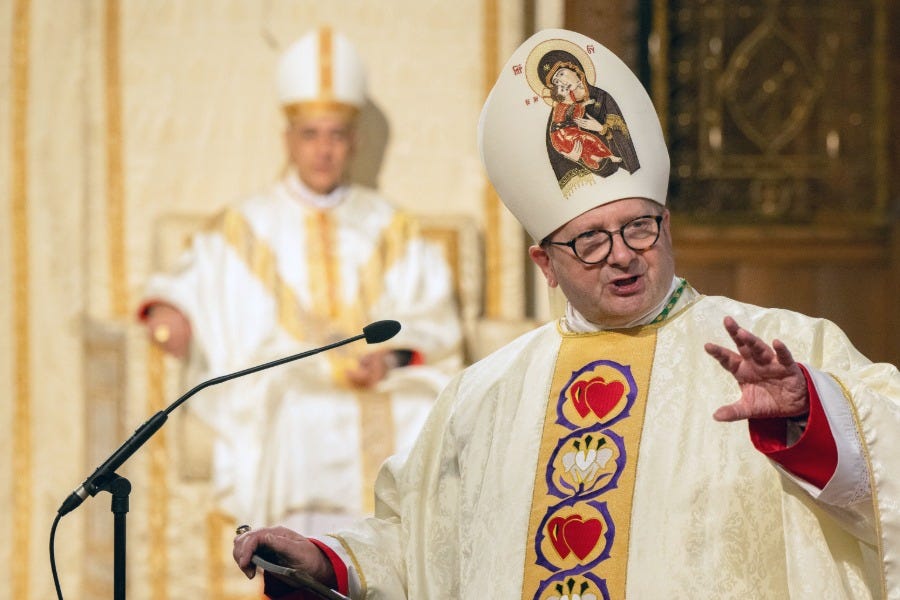
Reports which began circulating on traditionalist websites on April 23 that Cardinal Arthur Roche, prefect of the Vatican’s liturgical and sacramental office, had “ordered” ordinariate priests to concelebrate Mass and ordered that ordinariate priests not function as deacons or subdeacons in ordinariate liturgies.
However, Bishop David Waller, the head of the U.K.’s personal ordinariate, told The Pillar on Thursday that there had been “no pressure, no bullying, and no change to rubrics” from Roche or the Vatican, and affirmed that no priest could or would be compelled to concelebrate Mass.
The bishop also noted to The Pillar that priests dressing and acting liturgically as deacons is “not permissible” according to liturgical norms and was “not an issue” in the U.K. ordinariate.
Waller said there had “been no meeting with Cardinal Roche” when he and the two other bishops responsible for the ordinariates traveled to Rome in March. The visit included an audience with Pope Leo XIV and a meeting with officials at the Dicastery for the Doctrine of the Faith, which oversees the world’s three ordinariates.
In 2011, the Personal Ordinariate of Our Lady of Walsingham became the first ordinariate to be established for groups of former Anglicans, after Pope Benedict XVI’s publication of the apostolic constitution Anglicanorum coetibus. It was followed in 2012 by the Personal Ordinariate of the Chair of St. Peter, for North America, and the Personal Ordinariate of Our Lady of the Southern Cross, for Australia and Asia.
Anglicanorum coetibus said the ordinariate would have the faculty to celebrate the Mass “according to the liturgical books proper to the Anglican tradition, which have been approved by the Holy See.”
The Vatican approved “Divine Worship: The Missal,” the personal ordinariates’ distinctive liturgical book, for use in 2015. The missal draws on the Anglican “Book of Common Prayer,” which dates back to the 16th century.
Concelebration became widespread in the Roman Rite following the changes to the liturgy introduced following the Vatican Council II (1962-1965). Supporters of concelebration argued it was a restoration of an ancient practice, but critics argued it was an innovation with little basis in liturgical tradition.
Concelebration has remained a contentious issue, with some members of traditionalist institutes approved by the Church declining to concelebrate at annual diocesan Chrism Masses, believing it is incompatible with their commitment to the older form of the Roman Rite. Advocates of the newer form interpret this as a rejection of communion with the local bishop and the legitimacy of post-Vatican II liturgical changes.
At Solemn High Mass according to the 1962 Missal, one priest might preside at the Mass, while other priests serve as deacons or subdeacons, wearing the liturgical vestments associated with their respective roles. This three-minister structure has also been observed at ordinariate Masses.
Waller said in an email to The Pillar that he discussed liturgical topics in Rome with Bishop Steven Lopes, head of the Personal Ordinariate of the Chair of St. Peter, and Archbishop Anthony Randazzo, the apostolic administrator of the Personal Ordinariate of Our Lady of the Southern Cross, who was named in March as the prefect of the Dicastery for Legislative Texts.
“The three bishops did discuss some liturgical matters and note, as a matter of fact, that, as is the case with any rite, ‘Divine Worship’ must be celebrated according to its rubrics,” Waller said.
“The rubrics are: those in the text of the rite itself, the rubrical directory printed in the missal, the General Instruction of the Roman Missal, and the Ceremonial of Bishops.”
He added: “In some places, very few in the U.K., there has been a tendency to draw on rubrics from other rites, and that is not permissible.”
As an example of an unacceptable practice, Waller said a priest might celebrate Mass by reading the words in the ordinariate missal but using the manual actions of the older form of the Roman Rite.
“Any rite is words and rubrics, and it is a liturgical abuse to mix and match,” he commented.
Waller said that concelebration was “permitted and encouraged” within the ordinariate. “But any priest has the right to celebrate individually. That’s law, not just for the ordinariate. What is not permissible is priests dressing as deacons and subdeacons,” he said, adding that “most of this is not even an issue in the U.K.”
Following the three bishops’ visit to Rome, the Dicastery for the Doctrine of the Faith published a document affirming the ordinariates’ mission.
The text said the ordinariates embodied “a living sense of tradition that seeks to remain faithful to what has been received while also recognizing the place of organic development.”
It also said “the ordinariates promote a pastoral culture in which divine worship and daily life are profoundly interconnected.”
Peter Kwasniewski, the author of the original report on concelebration and the ordinariates, acknowledged April 23 that Bishop Waller had denied a meeting with Cardinal Roche took place in Rome in March.
He wrote: “This may be technically correct; when queried, my source specified that it was a meeting of Bishop Steven Lopes with Cardinal Roche, which makes sense if Roche perceived a problem specifically with the more traditionally-minded members of the Anglican Ordinariate in the United States.”

Unless it comes out that Cdl. Roche did make an order to Bp. Lopes regarding concelebration, this seems like a bit of a nothingburger. At any rate, I think Bp. Waller is right on the face of it: "Any rite is words and rubrics, and it is a liturgical abuse to mix and match", as he said. No priest has any more right to innovate on the rubrics than any other, even if he does so in a more aesthetically pleasing manner than typical liturgical abuses.
Concelebration is stupid. Can’t believe we make it a kind of shibboleth we fall out over.