
Bishop Seitz on Catholic immigration stance: ‘Mercy has to play a role’
'There has to be some proportionality to our response.'
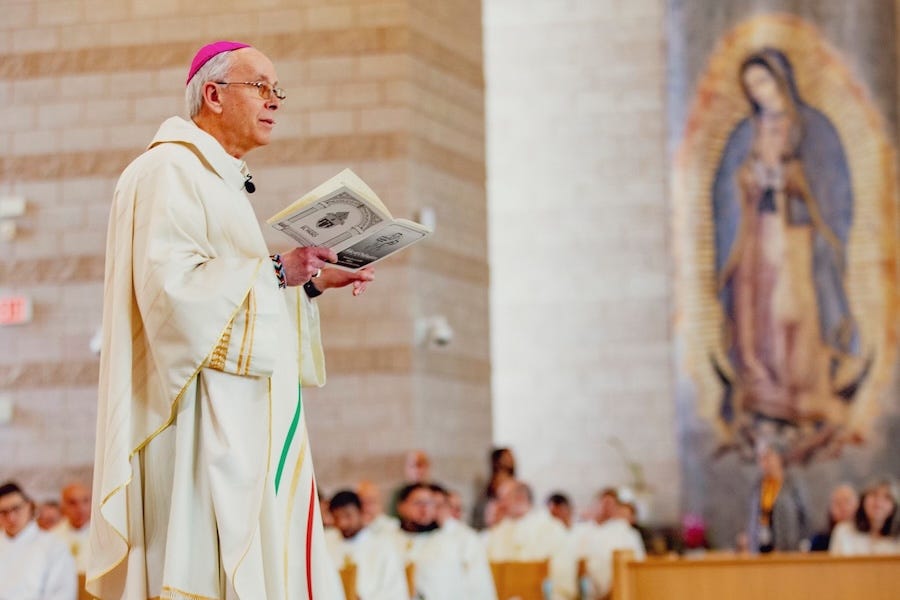
El Paso Bishop Mark Seitz released over the weekend a pastoral message calling for an end to the government’s policies of mass detention and deportation.
Detailing the abuses and deaths reported inside the local immigrant detention center, Seitz wrote that “the current national campaign of mass detention and deportations is a grave moral evil, one which must be opposed, with prayer, peaceful action and acts of solidarity with those affected.”
The Pillar spoke with Bishop Seitz, who said he intended his message not as an attack on any individuals of viewpoints, but as a call for further reflection on Church teaching.
In the interview, Seitz highlighted the Catholic understanding of justice, concerns about jobs and national security, and the role of language in the national debate over immigration policy.
The interview is below. It has been edited for length and clarity.
Your Excellency, many Catholics who support Trump’s mass deportation policies say those policies are a matter of justice: If people are in this country illegally, justice demands that they be removed.
But in your pastoral message, you say, ‘It is an injustice to make families, children, and the vulnerable pay the price of our inaction’ on immigration reform.
These are two very different understandings of justice. How should we think about that?
Well there has to be some proportionality to our response to a particular case in which a law has been in some way violated. We recognize that in our everyday life. If we’re driving and the police officer pulls us over because we were going over the speed limit, we’d say, “Oh, well, that’s unfortunate we were caught,” and we’ll pay the fine, I suppose.
But if the police officer were to say, “You were going five miles over the speed limit and I’m going to throw you into jail,” we would say, “That’s just not right.” We’d even recognize within that law about speeding that there are situations in which the violation of that law should not be considered an offense. If, for instance, we’re driving someone who is bleeding to the hospital, we would, within certain reason hopefully, go above the speed limit. Now, speed limits are a reasonable law and going too fast can be dangerous, but we recognize proportionality based upon the circumstances.
In Catholic theology, justice is tempered by mercy. Do you think mercy needs to play a role in shaping the understanding of justice here? Is that what is missing from the opposing view?
Mercy absolutely has a central role in our dealing with others. Even when the offense is a serious crime, mercy has to play a role. We don’t look for the blood of people who have committed a crime. We look to protect society if they are a risk to society. That’s why we imprison people who have committed a crime that is in some way harmful to others, and they’re at risk of doing it again.
But it seems like sometimes there really is a bloodthirst today in general, and that’s certainly the case with people that have only done exactly what you or I or any of us would’ve done in similar circumstances. If we found ourselves in a situation where our family was threatened and perhaps a family member had been killed, we would do whatever we needed to do in order to protect our family, including crossing an international boundary, if that’s what was necessary.
The people in those circumstances shouldn’t be considered violators of a law that has no flexibility in it. They should have the opportunity to be able to regularize their situation in a new place.
Many of the Catholics who oppose the bishops on this issue would describe themselves as faithful, orthodox Catholics who adhere to what the bishops teach on a whole host of other social issues.
What do you think is behind the discrepancy on this topic? Are people relying on misinformation? Is there a lack of education on Catholic social teaching? Seeing things through the lens of a political alignment rather than what the Church says?
I think actually you’ve listed a number of reasons that people come to those conclusions, and I think it is certainly complicated, but it’s a time in which people would do well to read the Gospel more and reflect upon it, and then listen to the teaching of the Church, which has developed over 2,000 years in fidelity to the Gospel to help us see how our particular actions relate to the Gospel or do not.
The Church is here to teach, and the magisterium is here to teach, and it’s not always going to reflect the view of society in general. Jesus’ teaching was rejected by the majority, perhaps, of the people in his time. And I would hope that people today would come to a point where they say, “Well, if this is what the Church is clearly teaching, then I should step back a little bit and reflect upon my own position.”
Now, as you said, there are a number of different misunderstandings that lead to the kind of conclusions that people are making, and certainly one is that they have adopted a mistaken narrative about immigrants, and they’ve accepted a false stereotype of who they are. We want to challenge that. The Church certainly believes there should be laws regarding immigration. We believe that people should be vetted carefully at the border to understand their reasons for coming. We believe that there should be an orderly system of visas for people who flee here. It’s called asylum, and there also should be the opportunity for people to come and work. We want an orderly system. We believe that people should be vetted, and we shouldn’t just allow anyone in who shows up at the border. But unfortunately, our system has not been responsive to the needs that are part of this broken world of ours. And we have put everyone under the category of a criminal when indeed they’ve done something that is their basic right.
The administration has defended its actions in the name of national security and rule of law. In your pastoral message, you were very clear that ‘Mass deportations will not make our communities safer.’
Do you think there is a better approach that would address concerns about rule of law and national security while also respecting the human dignity of the migrants who are here?
We think that that is very much possible, and that if we would be willing to continue a reasonable dialogue, the Church with the government sometimes, the Church with the people in this country and other people who are expressing their concern, we could come to some reasonable answers to how we should be treating people. But we also need to bring a welcoming, loving and merciful perspective to the way that we treat people who are the strangers among us.
How would you respond to Catholics who say that undocumented immigrants have flooded the labor market in ways that hurt them and their families, and they don’t feel a sense of solidarity from the Church?
I think those kinds of circumstances are very rare. The truth is we’ve had millions of job openings in this country in recent years, literally millions. The statistics I remember seeing, they’re perhaps a year old, would say there are about 8 or 9 million jobs that are going untaken, and many businesses are stressed because they can’t find workers. Now, what kind of jobs are immigrants taking? They’re picking our crops, they’re washing dishes in our restaurants, and doing jobs that many people born in this country have no interest in. Jobs that very often don’t pay enough for us to maintain what we expect of our lifestyle. There are issues there from the standpoint of the Church as well. But we think it’s rare that people come here and would take a job that someone else would want.
Your Excellency, your pastoral message says that the current campaign of mass detention and deportation is a “grave moral evil.”
Catholics who support the Trump administration’s approach would say that immigration is a matter of prudential judgment, and that people of good will can have differing opinions.
In your view, where is there space for prudential judgment on the topic of immigration policy, and where is the boundary into a definitive moral evil?
It becomes a moral evil when we define a whole group of people as criminals, and we treat them as though they were violent criminals. In our legal system, we always have a balance of response, based upon the seriousness of the offense. And this doesn’t seem to allow that anymore. It almost seems like in some cases, immigrants are having to pay the price of their life for having entered the country without documents.
In the Catholic Church, ‘grave moral evil’ suggests the possibility of mortal sin, if there is full knowledge and consent. What is the implication of that for ICE agents who are involved in mass detention and deportation policies -- and for the Catholics who support them?
Well it’s certainly something that people should step back and reflect upon, and be guided by what the Church is saying. We’re talking about an evil that is on the level of, in most cases, a communal kind of responsibility that we have. It’s not one person’s decision in most cases, but if one is certainly making possible an action that is threatening to another person’s life or their fundamental wellbeing, if they are supporting what amounts to a racist judgment about a whole group of people, then they need to look at that and prayerfully, carefully judge at what point they themselves would cross that line.
Are you suggesting that the Catholics who support these policies should not present themselves for Communion?
Again, I think a person needs to come to a judgment within themselves, but they have a responsibility also to inform themselves about what the teaching of the Church is. And for instance, there were people that died in our detention center, and one of them, the ruling was that that person had been killed. And so if you’re involved in something like that, and your actions were over the top and you contributed to the death of this person, then absolutely get the confession.
In the Church, we try not to just give black and white prescriptions on these things because, as you pointed out, a moral sin involves a serious wrong, which a person knows is seriously wrong and chooses anyway freely. So it takes all those steps. What I suppose the Church is saying here is this has the stuff of a serious moral issue.
What is the importance of word choice on this issue – undocumented migrant vs illegal alien? Do you think that that choice of language is important in our ability as a nation to have a dialogue about this heated issue?
The choice of language is extremely important. The language that we use against others has an impact. We’ve pointed out for a long time that characterizing a person as ‘illegal’ is not appropriate. A person may do something illegal, but that doesn’t mean the person, him or herself, becomes illegal. We’ve used it in such a way as to let it be a characterization of individuals and even a whole group of people, and that’s inappropriate. A person should never be treated as though they’ve lost their human dignity.
Are you hopeful that there will be progress on this issue anytime soon?
As a believer, I’m a person of hope. And that’s not mere wishful thinking. I also believe in the goodness of human beings -- those that I find are in agreement with what the Church teaches, and those who aren’t. So I’m hopeful that that goodness that is deep within every human being will guide us, and the grace of God will guide us to better solutions.
I think that in our nation, we’re coming to a point, having seen what mass detention and mass deportation looks like, having heard the stories about the harm that is coming to people and knowing that it’s coming to people who were not here to do any harm to anyone else, but simply to preserve their life -- I think that we are coming to recognize that this is not what we want as a country, and we have to find a better way to treat our brothers and sisters.
First, I think it’s disgusting to say that people who work to enforce the law fairly could be in a state of mortal sin. That’s absurd, and something these bishops never say about much more obvious issues.
Second, there is a clear financial conflict of interest which is neither disclosed nor asked about. Don’t believe me? Why is the USCCB selling their HQ building in DC, then?
Third, his straw man argument isn’t even true. There are no “mass deportations” happening. The policy as led by Tom Homan is to focus on illegal immigrants who have committed further crimes, or are on welfare, or who are not otherwise helping pull the wagon.
This continued idiocy from the bishops is totally counterproductive to making any progress in this area. It’s alienating the faithful from their bishops, and it’s obviously not effective in influencing policy. It comes off as petulant liberalism from the Catholite USCCB staff betas.
"Now, what kind of jobs are immigrants taking? They’re picking our crops, they’re washing dishes in our restaurants, and doing jobs that many people born in this country have no interest in. Jobs that very often don’t pay enough for us to maintain what we expect of our lifestyle."
-If we got rid of the (wage) slaves, who would pick our crops?