Bishop Shaleta arrested on charges of embezzlement, money laundering
The bishop was picked up at the San Diego airport as he attempted to leave the U.S.
Chaldean Catholic Bishop Emanuel Shaleta was arrested Thursday on several counts of embezzlement and money laundering.
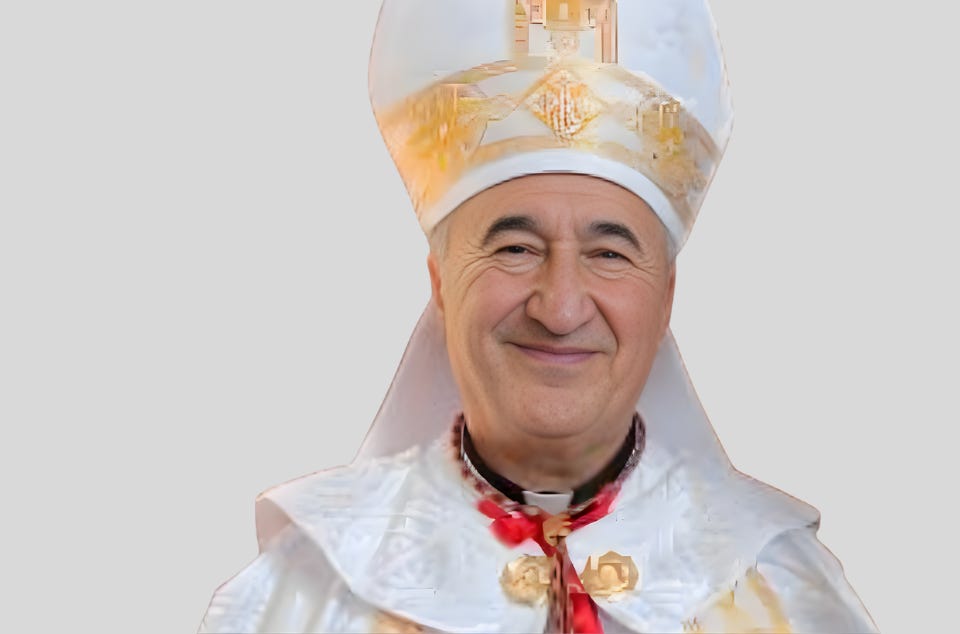
The San Diego County Sheriff’s Office said in a press release Thursday that the bishop was picked up at the San Diego airport as he attempted to leave the United States.
The Pillar reported earlier this week that Shaleta was expected to travel to Rome. He had submitted his resignation to the Vatican earlier this year.
Shaleta, who leads the Chaldean Catholic eparchy covering the western half of the United States, was arrested on eight counts of embezzlement, eight counts of money laundering, and one count of aggravated white collar crime enhancement, the sheriff’s office said.
“Shaleta was transported and booked at the San Diego Central Jail for the aforementioned charges. He is currently being held on $125,000 bail and a hold under Penal Code section 1275.1 was approved by the court,” the press release said.
It added that the San Diego Sheriff’s Office was originally contacted by a representative of the church last August.
He appears the first sitting U.S. diocesan bishop to be arrested on felony charges.
The Pillar reported last month that Shaleta submitted his resignation in late January after a Vatican-ordered investigation into allegations of substantial embezzlement and personal misconduct.
The bishop was accused of taking hundreds of thousands of dollars in cash from his cathedral, attempting to reimburse missing funds with checks signed by him from a cathedral charity account.
He was also accused of visiting regularly the Hong Kong Gentlemen’s Club in Tijuana, which operates as a brothel close to the U.S.-Mexican border.
While Shaleta has insisted that he did not mishandle money, The Pillar reviewed financial records indicating that he “reimbursed” his cathedral with checks from its own charity account, signed by him, after reportedly directing a parish tenant and others to make payments to the parish through him in cash, which went unaccounted for.
The bishop has not offered an explanation for the reimbursement discrepancies in his diocesan accounts.
But in Feb. 22 remarks at his cathedral, the bishop insisted that he had not taken money, and that he was the victim of a media campaign and of Chaldeans in his diocese who opposed his leadership.
“Many of you have heard the news on social media, about Shaleta — myself — and about how I handled the Church money. I have never in my priestly life or episcopal life abused any of the Church money. On the contrary, I have done my best to preserve and manage the donations of the Church properly,” the bishop said Feb. 22, as his cathedral’s Sunday liturgy concluded.
“One donor from the community gave me money to give to the poor and to the needy. He told me, ‘I trust you, [Bishop], and I will not ask for any receipts —- give this money to the poor that you know.’”
While the bishop insisted that he did give money to the poor, he told his congregation Sunday that “a financial committee member of our Church reported to the Vatican that there were monies missing. He mentioned that money that was dedicated for the poor. When he asked me about it, I said that money was given for the purpose to be given to the poor and I gave it to the poor. He then gathered paperwork from the Church files without my consent, and sent them to Rome. The Vatican did an investigation about me without even notifying me.”
As Shaleta insisted that he had managed finances transparently, he did not address directly reports that he had directed a parish tenant and others to make cash payments to the parish, taken the cash, and then “reimbursed” the parish with checks from its charity account, signed by him.
But The Pillar reported last month, after examining supporting documentation, that the bishop had seemingly directed that hundreds of thousands of dollars in rent due from a diocesan property be paid to him personally, in cash, and was never deposited, with the bishop instead transferring money to cover the missing rent from an eparchial fund for the poor.
Shaleta’s Feb. 22 remarks insisted that the charges were part of a plot against him.
“But some people were not happy and had other agendas. They think they can control even the Church of Christ,” the bishop said.
Elaborating, the bishop explained his view that “there is a mean and vicious media campaign funded by very rich people against the Chaldean Church and its clergy. Therefore, I ask all of you who actually attended this Holy Mass and witnessed the service that we are all offering to the Lord, I ask that during this holy Lenten season, to pray for those people, and enlighten their souls and minds, so that negative, evil people will not control the Church, and so that those people will not spread scandals among the simple and good Christian faithful, fabricating even other lies to prove their points.”
The bishop asked for prayers, and for the support of his people.
“I am not a rich person with big social influence, and I don’t have a rich family to fight those people. All I have are the Church people, yourselves, that I have sincerely served faithfully for 42 years as a priest and as a bishop. You are the only one who can believe me and defend my integrity and transparency in the Church financial matters and in life.”
In addition to financial misconduct, Shaleta is accused of personal misconduct.
A private investigator’s report sent to the Vatican last year recounted allegations that the bishop had regularly visited Hong Kong Gentlemen’s Club in Tijuana, flagged by human rights journalists as “a brothel where trafficked women and girls are forced to work in the sex trade.”
That retired FBI special agent Wade Dudley told The Pillar that the bishop’s car had been observed “in a parking lot exclusively for patrons of Hong Kong, and we have seen him walking to the border and across the border, and we have seen him get picked up by a third-party ride share that exclusively takes customers to that establishment.”
The report also documented an unusual and longstanding situation in the bishop’s personal life.
Shaleta has held for years a joint personal bank account with a woman who was the parish secretary when Shaleta was a pastor in Michigan.
In 2025 the bank account’s balance was in excess of $40,000, and appeared to receive regular deposits from Shaleta.
When Shaleta became in 2015 the eparch for Chaldean Catholics in Canada, the woman “started making frequent visits to Toronto, staying either at a nearby hotel or at his house,” the private detective noted.
In 2017, Shaleta was appointed to lead the Chaldean Eparchy of Saint Peter the Apostle of San Diego.
The bishop relocated to San Diego in August 2017, and the woman “immediately moved to San Diego,” the detective’s report said.
Dudley documented that “Shaleta has unfettered access to the [woman’s] home” — entering regularly by using the garage door code, and visiting during the day several times each week.
In turn, the woman “has keys to [his] home… and has been observed using her keys to open the door.”
She had, the detective reported, “visited [Shaleta’s] home for a prolonged period of time on multiple occasions.”
The Pillar reported this week that soon after the bishop submitted a letter of resignation from his diocesan post in late January, Cardinal Sako consulted with Chaldean bishops about his hope to see the bishop transferred to an administrative post in Baghdad, as a high-ranking official of the Chaldean patriarchate.
Sako had previously acknowledged to The Pillar that he raised the prospect of a transfer to Vatican officials, but suggested the idea was floated only before the Vatican-ordered investigation into Shaleta was “clear.” Sources have told The Pillar that the dicastery received a report on the case in late 2025, well before Sako polled Chaldean bishops about a transfer this year.


This is the best thing that could have happened for a satisfactory resolution for this saga. I was thinking yesterday when I read the other article that he might not come back to the U.S. if he went to Rome, to avoid exactly this, and I was also not completely convinced that he was going to face serious consequences from the Church itself. Now, he will likely face civil penalties and the decision makers in the Church will have their minds made up for them, lest they fail to take action against a bishop who is very likely to be a convicted criminal before long.
Well, that escalated quickly.