Bishop Varden: ‘St. Joseph is the patron saint of unselfishness’
What was that first Christmas like from St. Joseph’s point of view and what can his disposition teach us?
Take a look at the Christmas cards you’ve received so far this December. Can you see the figure of St. Joseph?
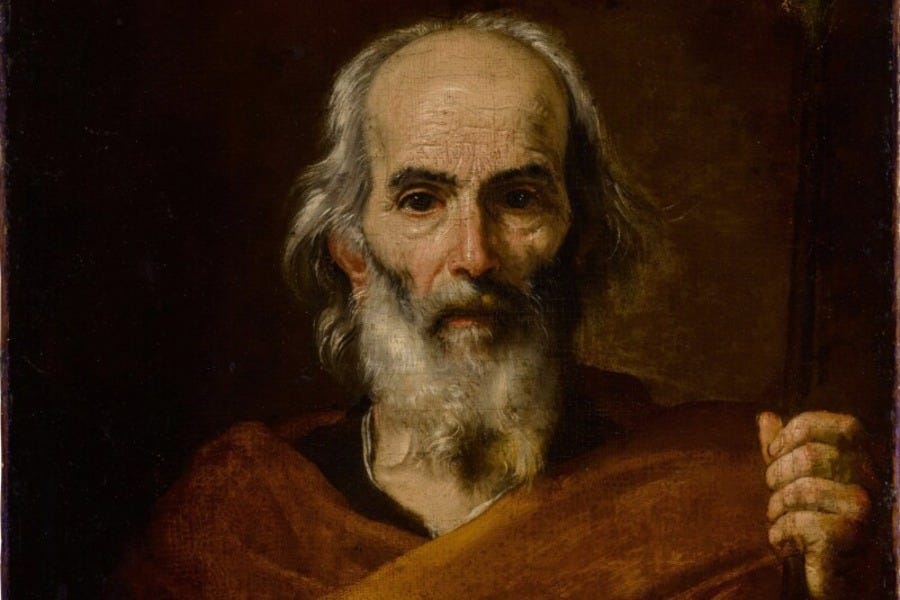
The chances are he is there somewhere, but probably not at the front and center of the array. Despite his critical role in Christ’s Nativity, St. Joseph is usually a background character — a gentle, watchful presence on the margins.
But what was that first Christmas like from St. Joseph’s point of view? How did he react as the Incarnation unfolded before his eyes? What can his disposition and actions teach us?
The Pillar put these questions to Bishop Erik Varden, the Trappist monk and spiritual author who has led Norway’s Territorial Prelature of Trondheim since 2020.
Shortly after receiving the questions, the bishop traveled to the neighboring Territorial Prelature of Tromsø, where he has served as apostolic administrator since 2023. The island city of Tromsø is in the middle of its polar night season, when the sun remains below the horizon for the whole day. But the city isn’t in perpetual darkness. In the early afternoon, there is just enough light to bathe the surrounding fjords and mountains a deep blue.
Perhaps coincidentally, Bishop Varden’s latest book, a collection of essays on hope, is called “Towards Dawn.” His next, due to be published in 2026, will be based on his “Desert Fathers in a Year” series.
Would it be right to say that the first Christmas — the birth of the Savior — came at a time of immense turmoil in the life of St. Joseph?
That is what Scripture tells us. We read in the Gospel of Matthew that Joseph, when Mary was found to be with child, resolved to divorce her. He would do so “quietly,” for kindness’s sake; but break off relations all the same. The pregnancy made him think that the woman who was to be his wife had either betrayed him or been compromised in such a way that she could not speak of it; either circumstance made the prospect of a shared future seem impossible.
That is when the angel intervenes and tells Joseph what is going on: the life conceived in Mary is of the Holy Spirit; the Son she will bear is an answer to prophecy; he will save his people from their sins; for that reason, Joseph must not fear. The exhortation to be fearless, which runs right through the New Testament, is present from the outset — in the annunciation to Mary, then in the angelic reassurance of Joseph.
Faced with the intervention of God in history, human beings, even these signally virtuous specimens, respond with turmoil and anxiety. It is unsettling to have one’s life turned upside-down by grace; it takes time to adopt a divine perspective on human affairs.
In iconography, certain representations of Christ’s Nativity integrate a detail easy to overlook. It is a scene known as the temptation of St. Joseph. Sitting a little apart from the cave with the Mother and Child, and looking uncannily like Rodin’s Penseur, Joseph is approached by a devil (remember, the Greek word diabolos means “puller-apart”) disguised as a harmless shepherd.
We can imagine the sort of things this fellow would have whispered in Joseph’s ear: “You don’t seriously believe that nonsense of a dream? Do you think God intervenes like this? Get away while you can!”
These are very human trials, crises of confidence and faith many of us have known from experience. It is good to know that St. Joseph has been there too; and that he did not let devilish suggestions sway his mind, staying instead steadfast in loyalty. He himself had to battle to persevere in faith; therefore he is well equipped to sustain us in our battles.

Is there something we can learn from St. Joseph’s attitude amid the trials of traveling to Bethlehem for the census and searching for a place for Mary and the Christ Child to shelter?
Discretion, peace, an absence of fuss. These qualities are especially evidenced in the journey to Egypt, necessitated by Herod’s ravings. Joseph, whom tradition portrays as a man of mature years, leaves his home, his livelihood, and everything familiar in order to protect the protagonists of God’s recklessly precarious plan.
The need to up sticks gave the Holy Family no chance to close in on itself in private coziness. The leave-taking of Mary and Joseph almost as soon as they welcome Jesus into their lives establishes a paradigm for faithful existence. It also says something vital about parenthood. There’s a tendency abroad these days that considers progeny an acquisition, a way to crown a parent’s ambition for him or herself — for of course it is possible, now, to get (a significant verb!) a child without the inconvenience of trailing a spouse or partner.
The example of Joseph speaks to us of parenthood as a kenotic state, a state of coherent self-outpouring in love for the sake of a purpose other than one’s own. St. Joseph is the patron saint of unselfishness.
Is it not striking, in the light of this, that he also stands before us as a singularly joyful saint?
How did the Incarnation change St. Joseph’s life?
You know the way we feel when we are near a really good person? Just being in the same room as such a one affects us. We become conscious of the interior distance there is between us and them — the light they carry sets off our darkness in ways that are uncomfortable. At the same time, their goodness is a source of encouragement. I might think: “If someone so good and pure-hearted, who can surely see through my pretenses, puts up with me and does not chase me away, perhaps there is hope for me?”
Now, if exposure to degrees of human perfection can affect us that deeply, what must it have been like to live day in, day out alongside God-made-man?
Here we touch upon a mystery about which it is almost impossible to speak. We can only be contemplatively silent before it. We can, though, deduce the effect of God’s incarnation on St. Joseph’s life from the fact that he discreetly lets himself be eclipsed from the story. Having done his providential duty, having brought up the Son of God and protected him while he needed it, St. Joseph is content to withdraw from the scene without as much as a furtive bow to the audience.
Something of the dynamic Paul speaks of, “It is no longer I who live, but Christ who lives in me,” can be seen in Joseph’s graciousness. As long as I need to draw attention to myself, thirsty for recognition and acclaim, stuck in selfie-mode, I have not truly yielded to the fascination of God’s epiphany in Christ. Once I realize what it is actually about, I shall long to be invisible, not to cast my own shadow over the mystery of Light.
There seems to have been a revival of interest in St. Joseph in recent years. Think of the popularity of the Consecration to St. Joseph and the Sleeping St. Joseph statue, or the Year of St. Joseph proclaimed by Pope Francis.
What does this suggest about the nature of our time?
I think it says something about a search for deeper appraisal of the realism of the Incarnation. The more virtual our human relationships become, with “friendships” reduced to thumbs-up on social media; the more we struggle to give an account of what it means to be human, a woman or man; the more society relativizes the value of a human life — the more we need a sane corrective.
That is what the Gospel provides. The various devotions to St. Joseph allow us to reflect on the concrete human conditions in which the Word was made flesh, letting us hear the sounds and smell the smells of the Infant Jesus’s voyages and exile, then of his home life. St. Joseph makes all this humanly credible. He brings the sublime very near.
At the beginning of Advent, I visited the Dominican Museum in Kraków. There, I found this detail from an 18th-century Polish altarpiece with scenes from the life of St. Joseph. It is not, perhaps, the world’s greatest painting, but it is touching and insightful. I love the zest with which the Boy Jesus imitates Joseph’s gestures, seeing in him a model of manhood and skill.
The Word, in whose image human nature is made, himself needed an image of human maturing. At such times Joseph must, in his heart of hearts, have sung a Magnificat of his own.
By reflecting on St. Joseph we are kept from letting our faith become too abstract. That is a good thing.

Finally, if you would permit me a question on a different topic, could you recommend a film that you believe truly sheds light on the meaning of Christmas?
I’d recommend three!
First of all, why not watch this electric performance of Bach’s Christmas Oratorio by the Netherlands Bach Society, which extraordinarily keeps making stellar recordings available to people of good will for free out of sheer philanthropy.
Next, I would suggest a documentary. At Christmas we hear the angels’ proclamation of peace. The world in which we live is marked by unpeace. There are terrible wars going on, and rumours of further wars. We are fearful and perplexed. How to construct society and conduct dialogue in the midst of tension, with many people bearing heavy loads of hurt?
That was the question Daniel Barenboim and Edward Said, firm friends, battled with for years in exasperation at on-going conflicts in the Middle East. It caused them to co-found a great institution, The West-Eastern Divan Orchestra. A film made in 2006 tells the story of this orchestra, showing its impact on individuals. I have seen it many times; it shows a parable of peaceful encounter that can keep hope’s flame alive even in the face of intractable situations.
Finally, I would point to Mikhail Aldashin’s Christmas. This cartoon made in 1996 is in the best sense naïf, capable of seeing reality as it is, yet gloriously illumined. Works such as this remind us what wonder means. It is vital to keep that faculty alive. Without it, our view of the world is contorted, warped.
For all its simplicity, this film is full of subtle allusions to biblical typologies, expository narratives, and great works of art. It makes us want to join the angelic band, even if our instrumental skill does not extend beyond the triangle. What does it matter!
