Bishops consecrate US to the Sacred Heart of Jesus
"O Desire of Nations and Center of History, we ask you to bless these United States of America."
The bishops of the United States consecrated the nation to the Sacred Heart of Jesus on Thursday, asking for God’s blessings ahead of the country’s 250th anniversary.
The consecration took place during Mass at the bishops’ plenary assembly in Orlando on June 11, on the eve of the Solemnity of the Sacred Heart.
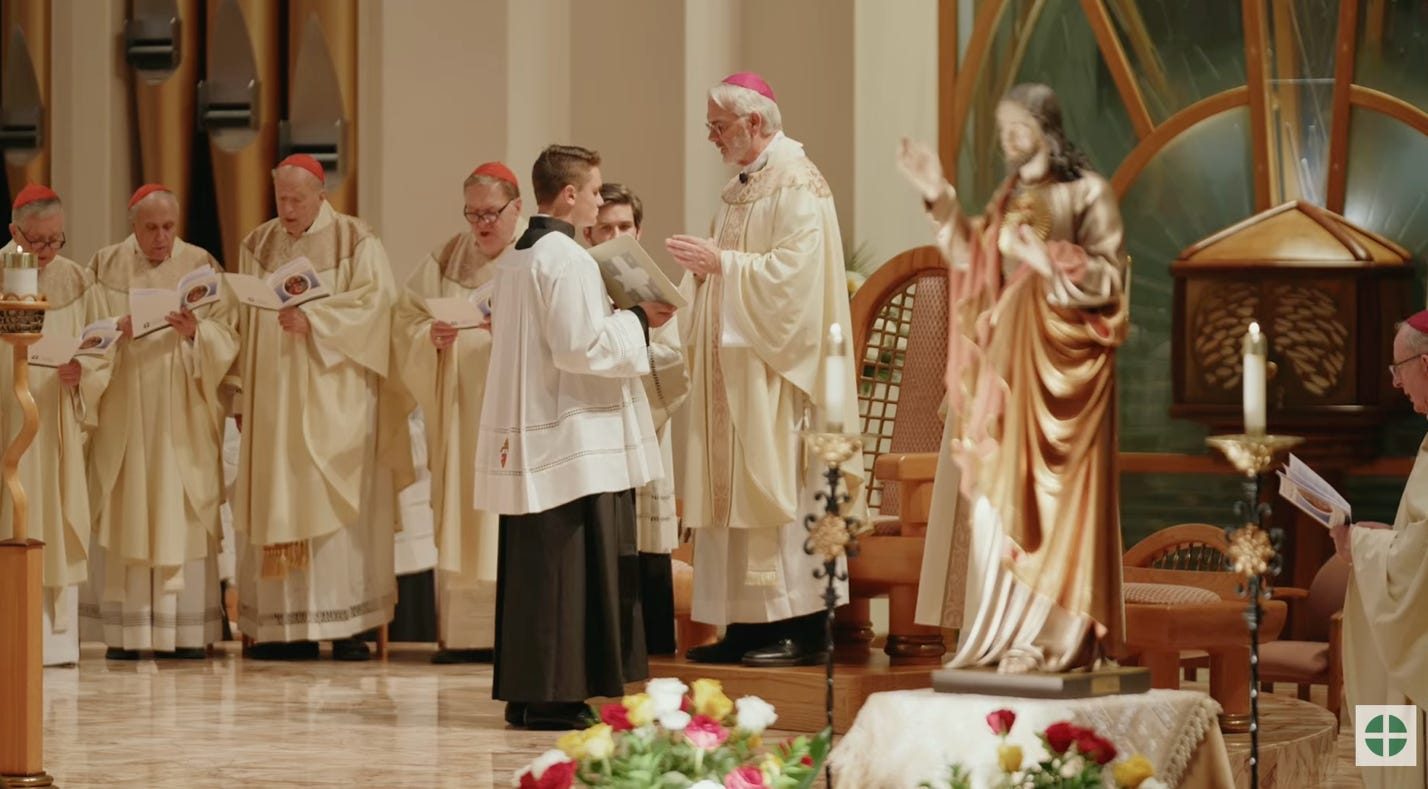
Archbishop Paul Coakley of Oklahoma City, president of the U.S. bishops’ conference, was the main celebrant at the Mass, which was held at the Basilica of Mary, Queen of the Universe.
Archbishop William Lori of Baltimore, the first Catholic diocese in the United States, delivered the homily at the Mass.
“As we approach this great anniversary of our nation, we may be tempted towards nostalgia for the past or anxiety about the future,” he said.
“Today we choose something better: trust. Today we place the Church in the United States, and this nation we love, into the Sacred Heart of Jesus. Not because we have everything figured out, but because we know the One whose love endures forever. In his Heart, we find gratitude for the past, strength for the present, and hope for the future.”
He called for a recognition of both the successes and shortcomings of the past 250 years.
“There have been moments of extraordinary witness and holiness. But there have also been moments of failure, division, and sin,” he said.
“Consecration requires the humility to acknowledge both. We cannot come to the Heart of Christ while pretending we have no need of His mercy. To consecrate ourselves and our nation is to place our wounds, our shortcomings, and our sins before the One whose love is greater than all of them.”
The consecration of the nation is also a time for hope in the future, he said.
“It is a declaration that the future does not belong merely to political movements, economic forces, or human plans. The future belongs to God. And so we place into His Heart, not only ourselves but generations yet unborn, and all those who will inherit the Church and the nation we leave behind. Remaining in the Love of Christ in a culture that prizes independence and self-reliance, we gather publicly to acknowledge that our deepest identity and our truest hope come, not from ourselves but from the Lord.”
Lori emphasized that all Catholics must work together for the renewal of the Church.
“We consecrate our nation, not because it is perfect, but because it is beloved by God,” the archbishop said.
“We entrust to the Heart of Christ our achievements and failures, our hopes and anxiety, our present challenges and our future aspirations. We ask him to heal what is wounded, strengthen what is good, and guide us towards a future marked by justice, peace, freedom, and respect for the dignity of every human person.”
During the Mass, the bishops prayed the consecration prayer together in unison:
“Oh most Sacred Heart of Jesus, you know the longings of our hearts, and you desire that we enjoy friendship with you. From your pierced side, you have poured out the wellspring of life, for which we thirst. Your heart burns with a love for all people to return to a right relationship with you. We celebrate the abundant gifts you have given this nation, founded on the self-evident truths that our Creator has endowed all people with the right to life, liberty, and the pursuit of happiness. We make reparation for the offenses against you and against human dignity that have taken place in this nation. May our hearts be united to yours, so that our families and communities enjoy peace and happiness. May broken relationships be reconciled, injustices repaired, and the wounds of our land be healed. May your holy Catholic Church serve as a sign pointing all people to your infinite love. O Desire of Nations and Center of History, we ask you to bless these United States of America.”
Earlier in the day, in preparation for the consecration, the bishops listened to reflections on the Sacred Heart from three members of the conference.
Bishop Shelton Fabre of Louisville focused on the Sacred Heart of Jesus as a source of communion. He encouraged the bishops to reflect on Christ’s instruction to his apostles: “Love one another as I have loved you.”
“Before these words become a pastoral directive for the Church at large, they are first a summons to us,” he said.
“If we desire our parochial communities to become authentic parishes animated by communion, missionary discipleship, trust, and mutual charity, we must first model that communion — we must ensure that our words and choices make visible our life-giving incorporation into Jesus Christ, a lived participation in Christ that binds us to each other with an unfeigned love.”
Fabre urged the bishops the personal and particular love of Christ for each one of them, and to strive to love each person they might encounter with this same love.
“The Sacred Heart of Jesus never encounters us as categories,” the bishop said. “Jesus Christ does not love abstractions. He loves people. He calls each of us by name and sees the human heart in all its complexity and dignity. If we are to always be continually striving to love one another authentically as brothers, we must resist the temptation to reduce one another to labels or conventions.”
Like the original apostles, he said, the bishops today should recognize communion as an essential part of the task to which they have been entrusted.
“Before the apostles would preach, govern, sanctify, and hand on the life of the Church, they first had to learn to love one another as brothers,” he said. “Their communion was not secondary to their mission; it was integral to it. The unity of their love would become a visible witness to the Gospel they proclaimed. The Church would not be built simply through their teaching, but through the charity that united them in Christ.”
Archbishop Bernard Hebda of St. Paul – Minneapolis spoke about how the love of Christ has the ability to soften hearts that have become hardened through sin, neglect, or barriers erected to numb feelings of pain and grief.
“If we approach the heart of Jesus, on fire with his love, it’s going to set even our dry or hardened hearts on fire,” Hebda said.
The wounded heart of Jesus desires to speak to our own wounded hearts, Hebda told his fellow bishops.
He pointed to John Henry Newman’s episcopal motto: Cor ad cor loquitur, heart speaks to heart.
“Drawing near to the heart of Jesus, entering into that intimate dialogue with Jesus, changes everything,” he said.
Hebda encouraged the bishops to be intentional about spending time with the heart of Christ in prayer, as well as through encounters with Christ in the poor.
“If we’re going to be conduits for [Christ’s] love, we have to be willing to hold out our hearts, no matter how painful, and to demonstrate how our hearts have been molded, softened and enlivened by an encounter with the Sacred Heart,” he said.
Archbishop Alexander Sample of Portland, Oregan reflected that the Sacred Heart of Jesus offers liberation, not from political or social forces, but from the chains of self-centeredness, despair, and the fear of being unloved.
In a world of consumerism and endless distractions, people are left anxious, lonely, and ashamed, the archbishop reflected.
Christ seeks out each person, he said, to answer the brining question: Am I really loved?
“Looking at Christ crucified, we see that God’s love is not theoretical. It is personal. It is costly. It is faithful unto death,” the archbishop said. “When we know that we are loved by Christ, we no longer need to build our identity on achievements or failures. We are liberated from the exhausting need to earn God’s affection. We discover that our deepest identity is not what we do but whose we are.”
Christ’s love allows people to become less superficial, and more detached from the noise and distractions in the busy, screen-filled culture, Sample said.
It also reaches the depths of the wounds that so many people carry from grief, family conflict, or rejection, he said.
“The Sacred Heart does not ignore these wounds. It enters them. Jesus bears His wounds forever, not as signs of defeat but as signs of redeemed love. When we place our wounds within His wounded Heart, we discover hope. We learn that suffering does not have the final word. Love does.”
Accepting God’s love means that one’s own heart is shaped and transformed to become more like his, the archbishop continued. And having been transformed, each person is sent out on mission to love other people with that same love of Christ.
“The Sacred Heart of Jesus is not merely a symbol,” the archbishop emphasized. “It is the living Heart of the Risen Lord, still beating with love for humanity. In that Heart we find our true home. In that Heart we discover who we are. In that Heart we find the freedom for which we were created.”’


