Polish bishops appealed this week for reconciliation amid what they described as “cases of growing aggression between Ukrainians and Poles.”
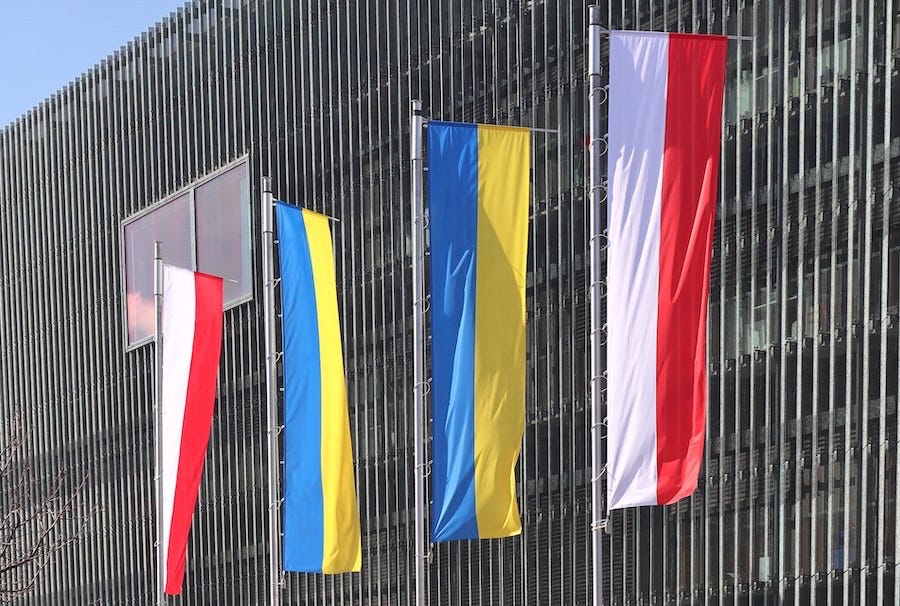
The Polish bishops’ permanent council urged the authorities Aug. 26 to step up efforts to prevent “incidents motivated by national animosity,” which have reportedly occurred amid political tensions between Poland and Ukraine.
“We appeal to believers and non-believers alike, and to all people of goodwill in Poland, to seek above all a spirit of reconciliation and Christian love in Polish-Ukrainian relations,” the bishops said.
Poland welcomed 1.7 million refugees after Russia launched its full-scale invasion of Ukraine in February 2022. The refugees, some of whom traveled on to other European Union countries, joined a pre-existing Ukrainian population of around 1.3 million people, many of whom had sought work in Poland.
According to figures cited by Poland’s Ministry of Foreign Affairs, 77% of Poles actively helped Ukrainian refugees, with 7% offering shelter in their homes.
The bishops noted that Poles’ response to the refugee influx “aroused admiration and respect around the world.” They recalled that the Church was at the forefront of efforts to support the newcomers, in parishes and via Caritas Poland.
The bishops said that reported cases of aggression between Poles and Ukrainians stood “in stark contrast to the efforts undertaken by the Church for more than four years.”
“The Polish bishops’ conference has repeatedly appealed for solidarity with those in need in Ukraine and for reconciliation between our nations, both of which have been affected by painful wounds of history,” they said.
“We firmly believe that these wounds can heal, and that mutual respect and reconciliation can prevail over them.”
The bishops called for “an honest historical dialogue” over what they described as “dark chapters” in relations between Poland and Ukraine, without specifying which eras they were referring to.
They were likely alluding primarily to 1943-44, when Ukrainian nationalist forces carried out a campaign of ethnic cleansing against the Polish civilian population in Volhynia and Eastern Galicia, amid the Nazi German occupation and the advance of Soviet forces.
The Bandera faction of the Organization of Ukrainian Nationalists and its military wing, the Ukrainian Insurgent Army, waged the campaign in an effort to remove the Polish population from territory that Ukrainian nationalists regarded as part of an independent Ukrainian state.
Poland officially recognizes the murder of tens of thousands of Poles — many of them women and children — as genocide. Ukraine, meanwhile, emphasizes the thousands of Ukrainians killed in retaliatory attacks. Some Ukrainians also refer to post-war events such as the 1947 Operation Vistula, in which Poland’s communist authorities forcibly resettled more than 140,000 people, predominantly Ukrainians.
The historical dispute reopened in May 2026, when Ukrainian President Volodymyr Zelenskyy signed a decree giving a special forces unit the honorary title of “Heroes of the Ukrainian Insurgent Army.”
In June 2026, Poland’s President Karol Nawrocki announced that Zelenskyy would be stripped of the Order of the White Eagle, Poland’s highest state honor, which the Ukrainian president had received in 2023.
Zelenskyy returned the honor, saying that Ukraine remained open “to all meaningful formats of engagement with Poland in order to try to avoid conflicting interpretations of the difficult and painful chapters of our shared past and to ensure proper respect for all innocent victims of the 20th century.”
Despite wartime conditions in Ukraine, Polish and Ukrainian archeologists are conducting joint excavations of mass graves linked to the 1943 Volhynia massacres. Poland also continues to provide Ukraine with substantial humanitarian and military aid.
On June 29, 2026, Polish and Ukrainian Catholic leaders issued a joint appeal for a de-escalation of tensions, recalling St. John Paul II’s efforts to promote reconciliation between the two nations.
“It is with pain that we observe the growth of mutual tension and the revival of hostility between Poles and Ukrainians,” said the text signed by Ukrainian Greek Catholic Major Archbishop Sviatoslav Shevchuk, Ukrainian Cardinal Mykola Bychok, and the Polish Cardinals Grzegorz Ryś, Konrad Krajewski, and Kazimierz Nycz.
“Even more painful is that this is happening at a time when Ukraine continues to experience the horrors of war, and Poland has shown great solidarity with millions of Ukrainian sisters and brothers in recent years.”
Polish police received 180 reports of hate crimes against Ukrainians in the first six months of 2026, roughly 30% more than in the same period in 2025.
Throughout the summer, there have been reports of clashes between Poles and Ukrainians, some of which were recorded and shared widely on social media.
On July 12, a man was recorded insulting two 11-year-old Ukrainian girls on a bus in the Polish city of Bielsko-Biała.
On Aug. 1, an 18-year-old Ukrainian man allegedly attacked a 30-year-old Polish woman with a knife in the city of Wrocław.
On Aug. 2, eight men reportedly attacked three 20-year-old Ukrainian men in Radom, a city in east-central Poland, after an argument that began with a discussion about Volhynia.
Protests against anti-Ukrainian violence were held in 25 Polish cities Aug. 9.
In their Aug. 26 statement, the Polish bishops said: “All such incidents, regardless of whether they are motivated by national, hooligan, or criminal factors, are worthy of condemnation.”
