Brazil has a Catholic 'data center.' Why the US probably won't
Assuming responsibility means assuming liability. That's unlikely in the US.
The Brazilian bishops’ conference last week approved the creation of a national data center, which will aim to make information sharing between the country’s dioceses easier, while making available to both Church officials and the public information about the status of the nation’s clerics.
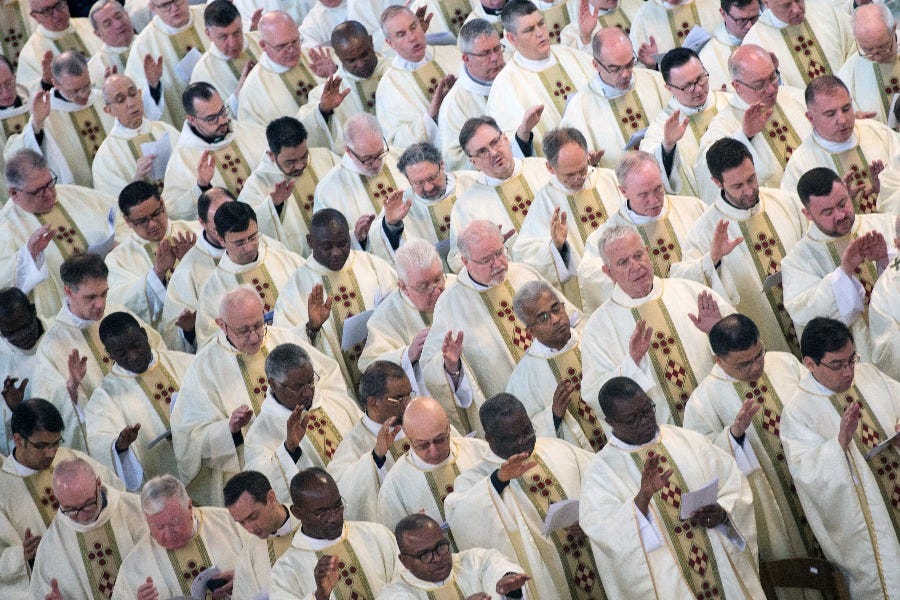
While clerics and Church leaders in the U.S. have called for a similar system to make ministry easier, a system similar to Brazil’s Catholic Church Data Center is not likely to be established soon in the United States, despite available technology and widespread calls for changes to current systems of information sharing on clerics.
—
When the bishops of Brazil met in their plenary assembly last week, the decision which made the most headlines locally was the approval of new guidelines for evangelization in the country. Those guidelines challenged Brazilians to take up the work of the Great Commission in the face of declining Catholic identity in the country, where Protestants are projected to outnumber Catholics by 2030, and a growing number of people say they have no religion at all.
Brazilian bishops have called Catholics to greater participation in the life of the Church, and urged Catholics to see the country’s upcoming 2027 Eucharistic congress as a moment of ecclesial renewal around which evangelical efforts could be focused.
On those fronts, the work of the Brazilian bishops might seem quite similar to their American counterparts, who have also in recent years hinged a plan for evangelization and renewal around a national Eucharistic congress.
But the other part of the bishops’ deliberations is not likely to be enacted in the United States anytime soon: the approval of a national data center, a digital clearinghouse of information on the Church and her sacred ministers.
At least, not in the way widely seen as the most useful iteration of that possibility.
According to the Brazilian bishops’ conference, the national data center will facilitate communication and information between dioceses, and provide information about clerics — seemingly including their status in the Church.
There is a lot of information which flows between dioceses on a daily basis — premarital inventories and marriage files among them, along with information about religious institutes and clerics, and other processes in the life of the Church.
Much of that information flows through the U.S. postal service, by mail, with paper sent back and forth between diocesan chanceries.
There is also steady traffic of information about the status of clergy: letters of good standing sent between dioceses when priests want to minister in another diocese, to take a wedding in another diocese, to concelebrate at a parish while visiting relatives, or to cover for a buddy while he is on vacation.
The onus of initiating that traffic is usually on individual clerics, who when intending to travel must ask their chancery to send out the requisite information, affirming that they possess clerical faculties, that their safe environment status is ensured, and that there are not otherwise any irregularities in their suitability for ministry.
And while that information is shared between dioceses when requested, there is not presently any systematic way in the U.S. for ordinary lay people to know whether a priest is in “good standing,” above reproach, and free to engage in sacred ministry.
Advocates for change have said often that emerging technologies provide any number of ways for a secure and authenticated national database which would make clear the status of priests to those who needed to know — whether for official purposes, or for lay people who want to be sure that a priest they’re connected with is on the level.
Indeed, the technology is the simplest part of an initiative like that, and a platform could likely be programmed by a capable expert in a matter of hours.
But the accuracy of the information in such a database would depend on the faithful input of information from diocesan staffers, comfortable at varying degrees with new technology, and often taxed with a broad portfolio of responsibilities.
It is easy to imagine situations in which a priest’s status changed — his faculties were suspended or he was temporarily prohibited from ministry — and the database not updated. And it is easy to think of the potential implications of that situation.
Whatever the moral consequences of such a situation, there are considerable legal ones. And that’s the reason why such a database seems unlikely in the United States. The holder of the database would inevitably rely on information from other sources. But wrong information would inevitably place the host — whether a bishops’ conference or otherwise, in a path towards legal liability, or at least adjacent to it. And no amount of disclaimers would likely mitigate entirely the prospect of being named, and having to offer a defense, if the system failed to accurately convey information, and inaccurate information caused harm.
In short, it seems unlikely in tortious American society that insurance companies and attorneys would give any ecclesiastical entity a greenlight to host and backstop a database like this.
And — again — the moral consequences of “user error” are the ones which should give the most pause.
Those issues might eventually be solved. And while Brazil’s legal environment is very different from that of the U.S., the lessons of the Brazilian database may well prove instructive. Until then, the mail will almost certainly continue — chancery to chancery, day after day, all across the United States.

