Archbishop Gabriele Caccia, the Vatican’s representative to the United Nations, criticized on March 25 a U.N. resolution to condemn transatlantic trafficking of Africans by European powers as the “gravest crime against humanity.”
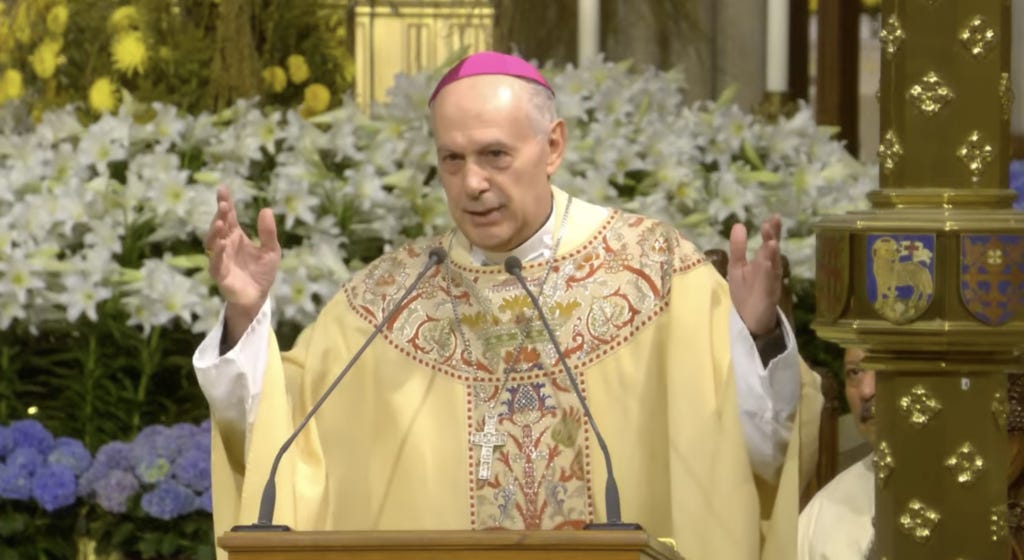
The archbishop said the U.N’s approach to the issue contained a “partial narrative” that “does not serve the cause of truth” — especially suggesting that the historical context and intent of some ecclesial documents was not fully understood.
The U.N. Assembly General’s resolution March 25 came on the International Day of Remembrance of the Victims of Slavery and the Transatlantic Slave Trade. The document included two 15th century papal bulls authorizing the slavery of Africans as primary examples of the legal codification of chattel slavery.
Caccia, recently appointed as nuncio to the US, said that “The Holy See unequivocally condemns slavery, including in its modern forms. The call for remembrance today is a reminder to all states of their duty to uphold historical truth and ensure legal accountability.”
“These convictions have been expressed in numerous papal documents. For example, as early as 1435, Pope Eugene IV condemned the enslavement of the inhabitants of the Canary Islands and excommunicated those who refused to free them,” Caccia added.
“More recently, in 1888, Pope Leo XIII condemned slavery as contrary to the Christian values recalling that, according to St. Augustine, ‘having created man a reasonable being, and after His own likeness, God wished that he should rule only over the brute creation; that he should be the master, not of men,’” he added.
The nuncio questioned the resolution saying that it “contains a partial narrative, which, regrettably, does not serve the cause of truth. Historical memory, when based on accurate and impartial historical information, together with education and awareness-raising, plays a fundamental role in preventing the recurrence of such grave scourges of humanity.”
“At the same time, it is important to reaffirm that, under international law, modern slavery constitutes a crime against humanity, when committed as part of a widespread or systematic attack directed against a civilian population. Therefore, the Holy See reaffirms that no one should be held in slavery or servitude, as set out in the Universal Declaration of Human Rights,” he said.
The resolution received 123 votes in favor, 52 abstentions, and three votes against from Argentina, Israel, and the United States.
The resolution emphasized that “the trafficking of enslaved Africans and racialised chattel enslavement of Africans as the gravest crime against humanity by reason of the definitive break in world history, scale, duration, systemic nature, brutality and enduring consequences that continue to structure the lives of all people through racialized regimes of labour, property and capital.”
Moreover, the document mentioned a series of laws and decrees from European powers from the 15th to the 17th century as proof of the “progressive codification of the racialized chattel enslavement of Africans across the world.”
The document mentioned “the papal bull Dum Diversas of 18 June 1452 and the Romanus Pontifex of 8 January 1455,” which, it said, “authorized the reduction of African persons to ‘perpetual slavery;’ the Portuguese peça de Índias commercial standard of 1 July 1513, which legally calculated enslaved Africans as accumulation units… the Spanish Asiento de Negros formalized on 18 August 1518, which transformed the African person into a ‘taxable commodity.’”
Ambassador Dan Negrea, US representative to the UN Economic and Social Council (ECOSOC), said prior to the vote that the resolution was “highly problematic in countless respects.”
“The United Nations exists to maintain international peace and security” and “was not founded to advance narrow specific interests and agendas, to establish niche International Days, or to create new costly meeting and reporting mandates,” Negrea said.
Meanwhile, UN Secretary General António Guterres said that “we must remove the persistent barriers that prevent so many people of African descent from exercising their rights and realising their potential.”
“We must commit — fully and without hesitation — to human rights, equality, and the inherent worth of every person.”
—
A March 2023 statement from Dicastery for Culture and Education, and the Dicastery for Promoting Integral Human Development clarified that bulls such as Dum Diversas or Romanus Pontifex were not framed or intended to convey the teachings of the Church but acts of governance by the Roman Pontiff in the political role he played among European powers at the time.
The Vatican dicasteries explained that “the legal concept of ‘discovery’ was debated by colonial powers from the sixteenth century onward.. according to which the discovery of lands by settlers granted an exclusive right to extinguish, either by purchase or conquest, the title to or possession of those lands by Indigenous people.”
It added that the Church “repudiates those concepts that fail to recognize the inherent human rights of indigenous peoples, including what has become known as the legal and political ‘doctrine of discovery’.”
“Historical research clearly demonstrates that the papal documents in question, written in a specific historical period and linked to political questions, have never been considered expressions of the Catholic faith,” the statement said.
“At the same time, the Church acknowledges that these papal bulls did not adequately reflect the equal dignity and rights of Indigenous peoples,” the statement continued.
Moreover, Pope Paul III’s 1537 papal bull Sublimis Deus defined involuntary, non-penal enslavement as contrary to natural law.
“We define and declare,” he stated, that “the said Indians and all other people who may later be discovered by Christians, are by no means to be deprived of their liberty or the possession of their property, even though they be outside the faith of Jesus Christ; and that they may and should, freely and legitimately, enjoy their liberty and the possession of their property; nor should they be in any way enslaved.”
Almost immediately after the discovery of the Americas, Catholic monarchs, philosophers, and bishops spoke out against cruelty and enslavement of the Indigenous peoples. However, enslavement of Africans remained legal, even if technically condemned by the Church and criticized by many churchmen.
In 1500, when Christopher Columbus sent Indigenous people to Spain as slaves, Queen Isabella of Castille ordered them to be freed and returned to the Americas. She would later officially prohibit officials from enslaving Indigenous people in 1503.
However, even with the protections granted by the Spanish crown, abuses against the local population were rampant in the Spanish possessions, which led to voices such as Fr. Bartolomé de las Casas, OP to speak out against the cruelty associated with colonialism in the Americas.
Both de las Casas and Fr. Francisco de Vitoria, OP, a philosopher at the influential University of Salamanca, helped draft the 1542 Leyes Nuevas, which granted more legal protections to the Indigenous people under the Spanish crown. De las Casas became the Bishop of Chiapas a year later.

