Canon law and the Dubuque model
The archdiocese’s novel clustering program raises interesting canonical questions.
The Archdiocese of Dubuque, Iowa, announced this month the clustering of its 160 parishes into 24 “pastorates,” each of which will share a common pastor assisted by one or more assistant priests.
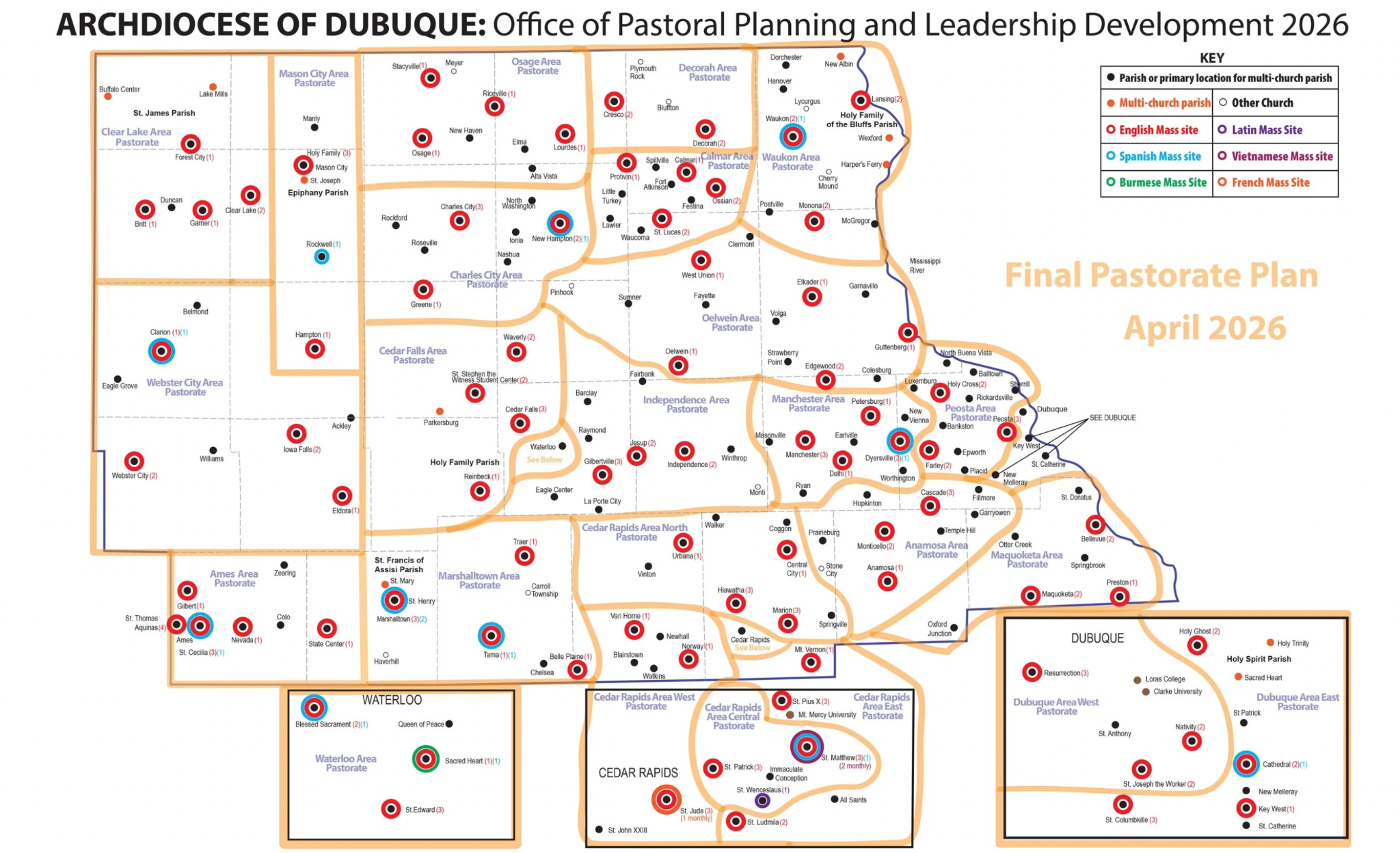
The move, announced April 11, is in line with other parish clustering programs undertaken by U.S. dioceses to cover adequately existing territorial parish footprints in the face of declining Mass attendance and shortages of priests.
The plan for Dubuque, however, has prompted some objection, especially since it will see Sunday Mass discontinued in more than half of the archdiocese’s parish churches.
While the archdiocesan parishes will remain canonically separate and distinct for the time being, the arrangement means that there will be effectively no provision in many Iowa parishes for the fundamental sacramental obligation of parishioners — attendance at Sunday Mass — within the parish territory itself.
The prospect of mass parish federation, or the merging of several parishes into larger parishes with several church buildings, has become a common theme in American diocesan restructuring, but it is unusual to see a diocese establish in one fell swoop that more than half its existing parishes will discontinue the celebration of Sunday Mass.
But the Dubuque model raises some interesting canonical questions.
And while some of the more obvious questions raised by the Dubuque plan actually appear to have straightforward canonical answers, others would seem to be open to legal challenge. But the most interesting question is who exactly has standing to challenge them, and whether any such persons would be inclined to do so.
—
The Archdiocese of Dubuque’s plan to reorder its 160 parishes into 24 “pastorates” — while maintaining each parish as a separate canonical entity — is a bold proposal.
But that Sunday Mass will no longer be celebrated at half of the archdiocese’s parishes has led some to question in what sense they remain “parishes” at all.
Canon law defines a parish, generally a territorial reality, as “a certain community of the Christian faithful stably constituted in a particular Church [diocese], whose pastoral care is entrusted to a pastor [parochus] as its proper pastor under the authority of the diocesan bishop.”
The pastor, in turn, is “entrusted with the pastoral care” of the parish, and with representing it in juridic matters, and he is “obliged to make provision so that the word of God is proclaimed in its entirety to those living in the parish,” and for the parishioners to receive necessary formation “especially by giving a homily on Sunday.”
The pastor is also, according to canon law, “to see to it that the Most Holy Eucharist is at the center of the parish assembly of the faithful,” and has the obligation to “apply a Mass for the people entrusted to him on each Sunday and holy day of obligation.”
The pastor is also responsible for the administration of baptism, performance of funeral rites, the celebration of Sunday and holy day Masses, and assisting at marriages for the people of the parish.
While the presumption of the law is that “a pastor is to have the parochial care of only one parish,” the law allows the care of several neighboring parishes to be given to a single pastor “because of a lack of priests or other circumstances.”
Interestingly, although several of a pastor’s obligations to his parish involve the celebration of Mass on Sundays, there is no explicit requirement in the law that these Sunday or holy day of obligation Masses be celebrated in the parish church — or indeed within the territory of the parish at all.
In fact, the law nods at the necessity of a pastor with multiple parishes needing to combine his Eucharistic provision, noting that his obligation to offer a Sunday Mass for the intention of the people of each parish is combined into a single Mass by the law.
In Dubuque, every “pastorate” will have a priest assigned as pastor of all the parishes, along with one or more other priests assigned as vicars for the pastorate. The plan is not for the entire pastorate to have a single location designated for Sunday Mass, but rather for the team of priests to provide stable Sunday Masses at several of the parish churches.
So, for example, in the Anamosa area pastorate, seven parishes are to be federated under a pastor with two parochial vicars. Of the seven parishes, four will have no weekend Masses, while three will — with the locations fixed.
The churches of the parishes without Sunday Masses will not become derelict — practically or sacramentally. They will continue to have weekday Masses on a to-be-announced schedule, and be used for weddings, funerals, and one assumes various other ordinary parts of parish sacramental life — including offering confession, and perhaps providing the venue for the administration of confirmation.
In this sense, these parishes remain active and functioning in every way the law describes a parish to be so.
Still, it is highly irregular that half the parishes of the archdiocese will not offer the single most central aspect of parish life, Sunday Mass, as a permanent state of affairs.
That seems to suggest that the Dubuque plan is not intended to be the permanent juridic situation of the archdiocese. And what happens next — and when — is not addressed in the archbishop’s message accompanying the plan’s announcement.
In theory, the “pastorate” model could be argued to be an indefinite accommodation to a shortage of priests, with a long-term aspiration to resume ordinary Sunday Masses if new vocations arise to make it possible.
—
In the meantime, the plan raises interesting questions about who can object to it — especially through the formal canonical mechanism of a recourse.
Since there is not an explicit obligation in the law that the pastor offer Mass in the parish church — or in the parish territory even — it could be argued that parishioners do not have a legal right to demand it, and thus are without grounds to appeal canonically the archdiocesan plan.
But pastors are in a different situation.
The pastor of each “pastorate” will be canonically the pastor of each parish within it. And ordinarily, pastors do have the full canonical responsibility for organizing the sacramental life of the various parishes.
In that sense, pastors could argue canonically that by determining where Sunday Mass is and is not to be celebrated among the different parishes, the diocesan archbishop has infringed upon their pastoral rights, removing from them the ability to know their people and discern for themselves the best way of meeting each community of parishes’ spiritual needs.
In theory, a Dubuque pastor could opt for recourse against the plan. But it actually seems unlikely that any pastors will be inclined to do so.
As acknowledged by the archbishop in his message earlier this month, the entire plan — and especially the location of Sunday Masses — is expected to garner considerable criticism. “Division” was the word used by the archbishop. But given that Dubuque’s priests have borne the responsibility for staffing numerous parishes, with the incumbent challenges, it is likely that most pastors will be relieved to have a contentious decision taken out of their hands.
It is also possible that the designation of some parishes for Sunday Masses, and some not, is a reflection of data analysis and a best attempt to ensure a Sunday Mass is as close as possible for everyone — or as many people as possible — across the entire territory, with “fairness” among the parishes themselves a secondary concern.
Of course, it is also likely that the stable allocation of Masses to only half of the parishes indicates that they will be the remaining parish churches of the archdiocese after a future rounds of juridic consolidation within the pastorates.
If this is the case, the parishes without Sunday Masses would in all likelihood become future satellite churches or mission chapels, after being merged into those parishes scheduled to retain Sunday liturgies.
Here, though, there could be a question of canonical forethought. As other American dioceses and diocesan bishops can attest, large-scale parish consolidation projects can be both complicated and often acrimonious. And the closure or merger of a parish can be canonically challenged by affected parishioners, if they can show legitimate grounds for doing so.
Rome’s Dicastery for the Clergy, which hears appeals against acts of governance by diocesan bishops, has been clear in its ruling that bishops, in taking decisions to close parishes, have to show specific reasons and consultation on each parish closure. It is not legally sufficient for a bishop to simply come up with the best overall plan for redrawing the parochial map and ask his advisors to consult on the plan as a whole.
In the execution of such a future round of parish closures or mergers, if the archbishop is able to say, for example, that ordinary Sunday Mass has not been celebrated in a parish for a period of years, it will likely be taken by the dicastery as a proof that the parish is not sustainable and suitable for closure or merger.
This, in itself, could prove a way of canonically preempting objections to a later and more permanent redrawing of the archdiocesan parish map.
If that is the case, and if it works on all fronts, the Dubuque model could soon become a template which other bishops are tempted to implement.

