Caritas critical in Venezuela earthquake aftermath
Thousands remain unaccounted for after devastating twin quakes
Caritas Venezuela has received more than 14,700 tons of humanitarian aid for victims of the June 24 earthquakes, according to a July 7 announcement from the humanitarian arm of the Venezuelan bishops’ conference.
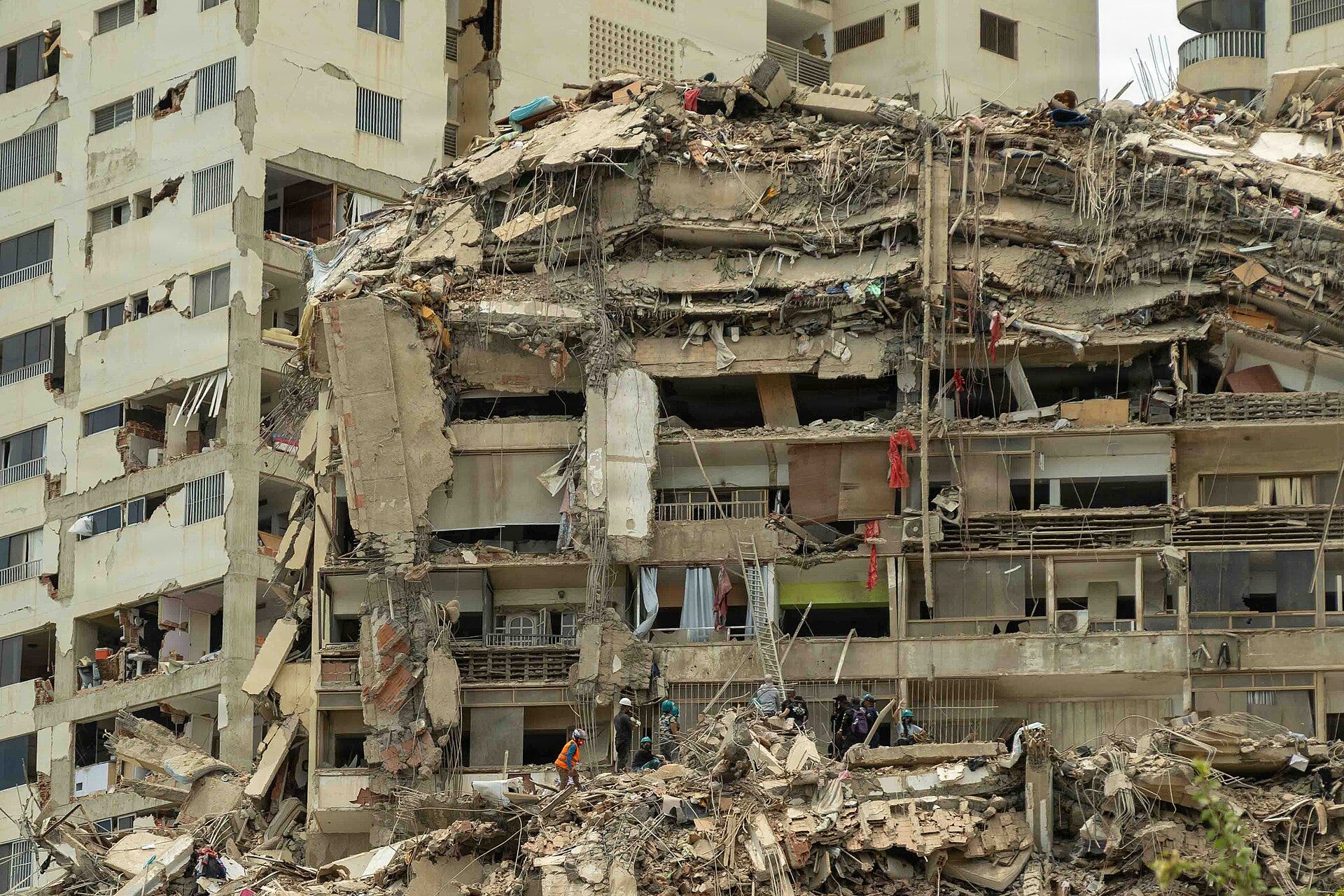
More than two weeks after twin earthquakes struck Caracas, the country’s capital, and the nearby city of La Guaira, relief efforts have shifted from search-and-rescue to recovery and care for those affected, with Caritas Venezuela at the helm of much of that response.
Official figures put the death toll at more than 4,000, with tens of thousands more unaccounted for, more than 17,000 people left homeless and nearly 1,000 buildings partially or totally destroyed — numbers that are rising by the day, as assessment of the damage continues.
In a July 7 report, its first accounting of the humanitarian response, Caritas Venezuela said it had already distributed 61% of the aid it has received, with the remainder still in stock.
Water made up the largest share of the distribution, at 4,031 tons, followed by 3,247 tons of food. The organization also distributed 73,356 kits containing medical supplies and medicines, according to the report.
Caritas has deployed 3,360 volunteers throughout the affected areas, including members of Caritas Spain, Caritas Germany, and Caritas Puerto Rico.
Venezuela has been largely cut off from the international banking system since 2003, when the government imposed currency exchange controls, a restriction that complicates donations from abroad. Meanwhile, official state institutions are widely distrusted amid rampant corruption and even the Venezuelan Red Cross has been intervened by the Venezuelan regime and has been embroiled in corruption scandals.
That has left Caritas, which holds several international bank accounts and is broadly regarded as a reputable, transparent institution in Venezuela, to serve as one of the primary channels for international aid.
The report also highlights the pastoral involvement of the local hierarchy and the leadership of the Venezuelan bishops’ conference.
Venezuela renewed its consecration as a nation to the Blessed Sacrament on July 2.
During a Mass commemorating the consecration, Archbishop Jesús González de Zárate, president of the Venezuelan bishops’ conference, said that “at this time of tragedy that has plunged our nation into mourning, we proclaim that Jesus Christ is the way to heaven and that our departed brothers and sisters are called to share in the heavenly banquet.”
In his homily, González pointed to the spirit of solidarity that Venezuelans have shown since the earthquake.
“In every corner of the country, Venezuelans have shown themselves to be people of faith and goodwill, setting aside their differences to stand as one in the face of adversity. This love must be made present by putting aside the rivalries and struggles that impoverish us.”
“We are not alone, nor should we remain indifferent; we are built upon the firm rock that is Jesus Christ in the sacrament of the altar. The final call is to renew ourselves inwardly and to renew Venezuela,” he concluded.
At a Mass at the Caritas headquarters on the same day, Archbishop José Luis Azuaje of Maracaibo – vice president of the bishops’ conference and president of Caritas Venezuela – said in his homily that “Chaos, fear, and destruction do not have the final say. The final say belongs to the One who seemed defeated on the cross but rose again on the third day—to tell us that not even death itself can overcome His love or cause us to lose hope.”
Azuaje urged Caritas volunteers and members to become a “source of comfort in the midst of the storm. We are not an institution of empty words, but a mother who suffers alongside her children. At this critical moment, our parishes, our Caritas organizations, and our institution have become centers of activity and the heart of the Church.”
—
Diplomatic and Church sources told The Pillar they fear the final death toll could be around 20,000-30,000 or higher, with nearly 30,000 people still missing.
And after two weeks of rescue operations, most international specialized teams have left the country as hopes of finding survivors in the rubble have dwindled to almost nothing.
Several rescue teams complained of delays in obtaining authorization to enter the country or begin operations, harassment by local authorities, and the denial of entry to medical teams—particularly during the first days after the earthquake, widely regarded as the most critical period for finding survivors.
Local media reported that several people have taken to renting cranes and heavy machinery – at rates ranging from $3,000 a day to $5,000 a week, depending on the equipment – to clear rubble from collapsed buildings themselves and recover the bodies of loved ones, saying state-led efforts have been slow and insufficient.
More than 80 shelters have opened across the country for those whose homes were destroyed. But local and international experts have warned that poor conditions in those shelters could leave survivors newly vulnerable.
“In the coming weeks, the greatest health risks may stem not only from injuries caused by the earthquakes, but also from disruptions to health services, overcrowded conditions, deficiencies in water and sanitation and reduced access to vaccination and routine healthcare,” Jarbas Barbosa, director of the Pan American Health Organization told Reuters on July 9.
-
Northern Venezuela was struck by two back-to-back earthquakes around 6 p.m. on June 24, one measuring 7.2 and another 7.5 on the Richter scale.
The papal almoner’s office quickly moved to donate 100,000 euros for humanitarian efforts to the Venezuelan bishops, in what papal almoner Archbishop Luis Marín de San Martín, OSA, described to The Pillar as “an initial urgent [measure of] help.”
“We’re in contact with the nunciature, we’ll try to respond to concrete needs,” Marín told The Pillar.
Archbishop Raúl Biord of Caracas told Vatican News that several parishes in the cities opened their doors to people who lost their homes so that they could spend the night in the parish churches.
Caritas Venezuela said in a June 25 statement that the national headquarters of the Venezuelan bishops’ conference would serve as a collection center for donations of drinkable water, non-perishable food, and essential medicines, while several diocesan Caritas would also establish local collection centers.
The statement also said that the “national and international bank accounts of Caritas de Venezuela are available to receive monetary donations, which will be used to help address the needs that our technical teams on the ground will be identifying with greater precision in the coming days, as the damage assessment progresses.”
The statement concluded by adding: “we pray for so many brothers and sisters who have lost their lives, their homes, and their possessions in these hours of trial… To them we say: you are not alone. The Church, through Caritas, walks at your side.”
“We call on all Venezuelans, both within the country and abroad, and we encourage the solidarity of all companies and people of goodwill, to come together with strength and generosity to support this network of solidarity, which today brings relief in moments of profound anguish. Every gesture of help, however small it may seem, becomes a tangible sign of God’s closeness to his people,” the statement ends.
Archbishop Víctor Hugo Basabe of Coro, one of the Venezuelan regime’s staunchest ecclesial critics, blamed the authorities for failing to prepare for the earthquake — a view echoed by many local observers, as initial rescue efforts were carried out largely by private citizens after emergency services were quickly overwhelmed by the scale of the destruction.
“They have spent 28 years mistreating, keeping on starvation wages and without supplies all emergency services, forced to work with almost nothing but their own hands and goodwill,” Basabe said on social media.
“We urgently need the help of the world. The years of destruction that we Venezuelans have endured over the past 25 years make it impossible for us to face the tragedy before us today with only the little we have left. International solidarity is urgently needed to save lives.”
