Catholic clergy ‘promote China’s ethnic unity law’
The government is using state-sanctioned Church bodies to promote a new law aimed at ethnic minorities.
The Chinese government is reportedly using state-sanctioned Church bodies to promote a contentious new law aimed at ethnic minorities.
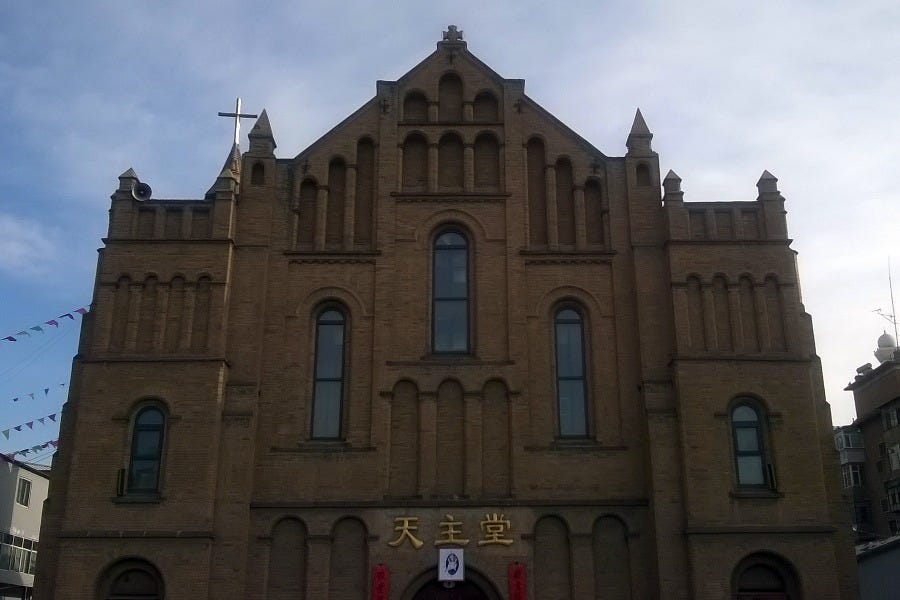
The online magazine Bitter Winter published a June 2 article documenting an event in the autonomous region of Inner Mongolia, in which priests reportedly handed out booklets on the Law on Promoting Ethnic Unity and Progress, scheduled to go into effect July 1.
Chinese authorities present the law as an effort to strengthen national cohesion and guarantee equality between the country’s 56 officially recognized ethnic groups. But Western governments and human rights activists claim it seeks to subsume minority languages, cultures, and religious practices into a unified Chinese national identity that reflects the norms of the majority Han culture.
The new law embeds Chinese leader Xi Jinping’s policies promoting the “Sinicization of ethnic minorities” into the country’s legal framework. It requires state organizations, social institutions, schools, and religious groups to foster “the communal consciousness of the Chinese nation,” in practice moving the country away from a model of ethnic autonomy adopted after the People’s Republic of China was established in 1949.
Officially recognized Church bodies, such as the Chinese Patriotic Catholic Association, are expected to support the law through the promotion of ethnic unity, social cohesion, and the Sinicization of religion.
The U.S. Commission on International Religious Freedom has defined the Sinicization of religion as “the complete subordination of religious groups” to the ruling Chinese Communist Party’s political agenda.
Article 46 of the new law says: “Religious groups, religious schools, and religious activity sites shall carry out publicity and education on forging a strong sense of the community of the Chinese people, persist in the direction of Sinicization of our nation’s religions, guide religions to adapt to socialist society, guide religious professionals and believers to carry forward the tradition of patriotism, and promote ethnic, religious, and social harmony.”
The European Parliament passed a resolution April 30 calling for the repeal of the law, which, it said, “openly promotes assimilation policies and restricts the cultural, religious, and linguistic freedoms of various groups within China and beyond.”
The Bitter Winter article, written under the pseudonym Zeng Liqin, said that local Patriotic Catholic groups organized the event in Inner Mongolia. Photographs showed men identified as Catholic priests standing before a crowd of people in a church courtyard behind tables stacked with booklets.
“Clergy distributed booklets on the legislation, explained the Party’s ethnic policies, and urged believers to cultivate what officials call national, civic, and legal consciousness,” the article said.
“The message was that Catholic life must be aligned with the state’s priorities, and that the law should permeate parish activities, daily routines, and the formation of the faithful.”
The article said it was significant that the event took place in Inner Mongolia, because the local population has resisted efforts to downgrade Mongolian-language education and promote assimilation to Han norms. Inner Mongolia has a notable Catholic population, the result of 19th-century missionary efforts, in the region’s western belt.
Bitter Winter said local clergy were told to stress that national law takes precedence over religious convictions and believers must display their loyalty to the state by committing themselves to the “five identifications” proposed by Xi Jinping.
The “five identifications” require the country’s 56 recognized ethnic groups and five state-sanctioned religious communities to identify with “the great motherland,” the Chinese nation, Chinese culture, the Chinese Communist Party, and “socialism with Chinese characteristics.”
The article said: “The Patriotic Catholic Church has become one of the most active participants in this campaign. Its online presence contains multiple articles praising the law. Yet, it offers no reference to [Pope Leo XIV’s encyclical] Magnifica humanitas, despite the encyclical’s global significance and its direct relevance to questions of human dignity, cultural rights, and the protection of minorities.”
The law’s impact is likely to be felt most strongly by the Catholic Church in regions with a notable ethnic minority presence, including not only Inner Mongolia but also Guizhou, Yunnan, and Xinjiang.
In these areas, state-recognized Catholics will be expected to promote the wider use of Mandarin Chinese, take part in ethnic unity education programs, and stress the importance of an overarching national identity.
There are around 10 million Catholics in China, out of a population of 1.41 billion. Up to 6 million belong to the state-recognized Church, while the remainder are part of the underground Church.
China broke off relations with the Holy See in 1949, following the Communist Revolution. The two countries reached a provisional agreement on the appointment of bishops in 2018. The agreement, whose terms remain secret, has been renewed three times, most recently in 2024. It is next due for renewal in 2028.
The agreement’s supporters say it promoted unity within the Catholic Church in China, by ensuring that all bishops were recognized by both Beijing and the Vatican. But critics argue that it gave the Chinese Communist Party undue influence over episcopal appointments.

