
'Catholic out loud' - Dorothea Project aims to spread Catholic social teaching
"We're here not because we're conservative or liberal...we're here because we're Catholic."
In the spring of 2025, Katie Holler was newly postpartum with her second baby.
So when the Steubenville, Ohio mom and social worker saw that the government was revoking policies on the humane treatment of pregnant and postpartum women in immigrant detention facilities, she found it particularly troubling.
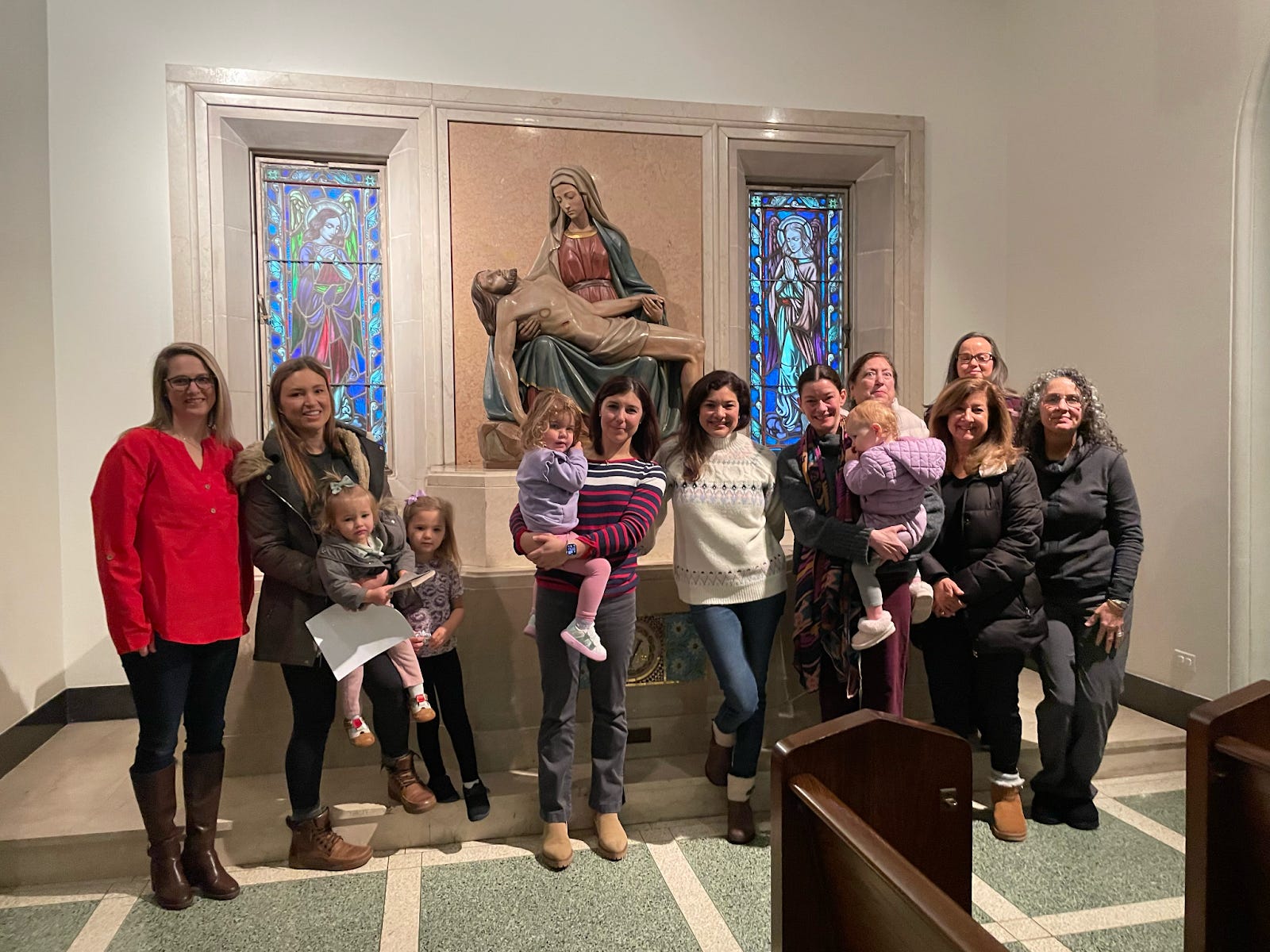
Holler told The Pillar she was deeply dismayed by the Trump administration’s immigration policies in general. She felt that the approaches being used showed a disregard for human dignity.
She was upset by the emphasis on detainment and deportation, the arrests of immigrants as they were arriving at court hearings, trying to move through the system legally, and the administration’s attempt to remove Temporary Protected Status for immigrants who had fled conflict or disasters in their home countries.
But the breaking point, for Holler, was seeing U.S. Customs and Border Protection announce that it was rescinding protections for pregnant and postpartum women, as well as their infants, in immigrant detention facilities.
Among other things, these protections guaranteed access to adequate water, milk and snacks for pregnant and postpartum moms, as well as formula, diaper changing stations, and safe sleepers or bassinets for infants.
“At the time, I was newly postpartum with my second baby. And so that rescinding of that policy just really struck a chord with me, in addition to seeing a story about a mother being deported away from her baby that she was still breastfeeding,” she said.
Holler wanted to do something – specifically, something rooted in her Catholic faith.
Initially, she posted on a few Catholic women’s groups on Facebook, asking if anyone wanted to get together and discuss the things that were happening in the news, and what they might be able to do in response.
She received dozens of replies from women who were concerned that what they were seeing in the headlines went against the principles of their Catholic faith.
“We scheduled a Zoom meeting, and there were about 15 of us on that first call…And from there, it steadily grew,” Holler said. “We took a lot of time to really be intentional and prayerful about things like the name, what we wanted to do, the mission, the vision.”
From this effort came the Dorothea Project – a group of Catholic women working to promote education on the Church’s social teachings, and prayer-based action based on those teachings.
The group offers curricula for parishes, small groups, and individuals to learn more about Catholic social teaching. And it holds action days and prayer events, both nationally and locally around the country.
“Throughout history, women in the Church have largely been at the front of the social movements and leading the charge of protecting human rights and human dignity,” Holler said. “But we also just feel there’s something special about bringing women together within the Church in a prayerful and intentional way.”
The name of the project is a blend of two Servants of God – Dorothy Day, known for her activism and solidarity with the poor, immigrants, and workers, and Thea Bowman, an African American religious sister who called on the bishops and Church leaders to work more publicly for racial justice in the 20th century.
The group has adopted a third patron as well, Mary the Mother of Sorrows. Holler said the group’s members felt a desire to be close to Mary at the foot of the cross, in their own experience of pain at witnessing the suffering and injustice around them.
The mission of the Dorothea Project, Holler said, is “bringing Catholic social teaching education to our communities, so that Catholics would be better equipped to take action in defense of human dignity and human rights.”
“So many of us feel like Catholic social teaching is not shared widely enough, either in parishes or in communities.”
Holler said she first encountered Catholic social teaching in college, at Franciscan University of Steubenville.
Although she was active in her parish and youth group growing up, she said she had never learned about the Church’s social teachings, which includes themes of solidarity, a preferential option for the poor, and the universal destination of goods.
Many of the group’s members have similar experiences, and say they were never taught about Catholic social teaching in their Catholic schools or parishes, she recounted.
Holler believes it’s an area of Catholic teaching that is often neglected – either dismissed as being too political, or overlooked as something only tangentially related to the faith.
“I think it is sometimes seen as a secondary piece of our faith rather than a primary piece of the Gospel…. an additional thing that if you want to, you can go a little bit further and do a little bit more.”
Even the phrase “social justice” can prompt assumptions about political and theological leanings, Holler acknowledged.
To try to overcome those political assumptions and biases, the Dorothea Project focuses on sharing resources based in the catechism or papal encyclicals.
In addition, Holler said, the group rejects political labels.
“That’s something we say at the start of all of our meetings and in our community. We say, ‘We’re here not because we’re conservative or liberal, not because we’re Republican or Democrat, we’re here because we’re Catholic and we want to be Catholic out loud’.”
“We’re just here because we’re Catholic and we want to fully live out what it means to be Catholic. And that means diving deeper into our faith, into its richness of how people live out the Gospel, and how they always have, and how we can do it more today.”
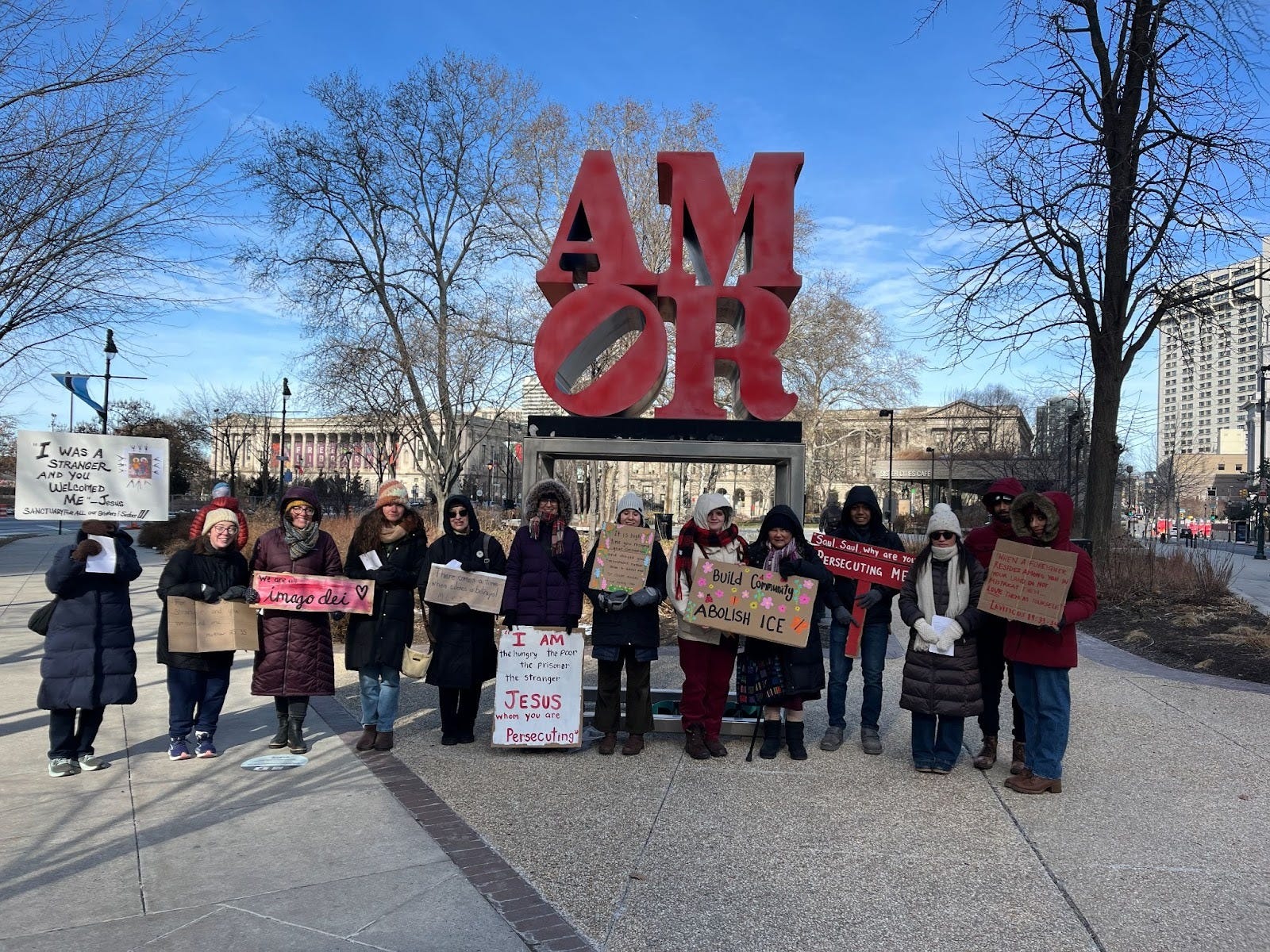
Catholic social teaching has much to say about the treatment of immigrants, Holler said.
“It starts with dignity. I think it starts with seeing that all people are made in the image and likeness of God first,” she said. “And everything that comes after that should be informed first by that fundamental truth that we hold as Catholics: they’re made in the image and likeness of God, and whoever they are, we need to treat them first from that identity.”
“What I’m seeing in the way that ICE is treating people is not with dignity. It’s not with respect,” she said.
Reports from ICE detention centers in recent months have included detainees being served spoiled food and denied beds and access to showers and hygiene products, as well as pregnant women and young children being refused medical care, and nursing mothers being separated from their infants.
“While yes, there is a need to follow just laws and make sure those are applied and followed, there’s ways to do it with dignity and compassion,” Holler said.
“I think as a project, we’re always coming back to, is this the dignified response? Is this honoring this person’s dignity? Keeping them in detention centers, where they’re not able to talk to their family members, where they’re living in deplorable conditions, where the food is moldy and has maggots in it, all these concerns and reports we’re hearing out of detention centers, is this honoring a person’s dignity? And if it’s not, then we need to respond and make sure it’s changed.”
The Dorothea Project holds monthly general meetings, open to all members, which include times for planning and sometimes speakers.
There are also regular prayer evenings, including a recent evening reflecting on Pope Leo’s first apostolic exhortation Dilexi Te and an upcoming evening to pray a Divine Mercy Chaplet for those detained or living in fear of deportation.
But much of the group’s work at this point is being done at a local level – through the creation of local chapters, formed in parishes or communities. So far, there are almost 80 local chapters that are either already established or in the formation process.
The chapters plan action days and promote educational resources about the Church’s social teachings.
Alison McGrimley, a stay-at-home mom of four kids in Dallas, is currently working to start a local chapter of the Dorothea Project at her parish.
She encountered the group over the summer, at a time when she found herself looking at the news surrounding immigration and wondering, “Why is everybody not as upset as I am?”
Finding the Dorothea Project has been a blessing, she said.
“To find other women whose hearts were also being broken by what they saw, really just motivated me, really kind of a balm to my soul to be able to connect with those people.”
McGrimley said she has a strong interest in politics and is naturally drawn to the idea of protesting or joining a political campaign to work for change.
But as she took the matter to prayer, asking God what to do about her broken heart over the suffering she saw around her, she felt Him saying to her, “You are a mom of four kids…The answer is in what you’re already doing.”
“I’m already very involved in my parish. I know a lot of people, especially a lot of other women,” she said. “Over and over, He’s told me the answer is through His Church.”
Through prayer, she said, she came to realize that rather than waiting for Church leaders to act, she was feeling a tug on her own heart to act, within the context of her local Church.
“It feels like the right way to take action.”
McGrimley said that while her parish has groups that serve those in need, like the St. Vincent de Paul Society, it does not have a group specifically for educating people on Catholic social teaching.
She believes many Catholics have not learned the principles of the Church’s social teaching. Since so much information is presented through a political lens, that becomes the default way in which people – including Catholics – think about social issues, she said.
“There becomes the ‘conservative Catholic’ view and the ‘liberal Catholic’ view. And there’s not really a Catholic view anymore. It’s very hard to parse out…how should I view this issue through my Catholic faith?”
McGrimley said she thinks much of the focus of Catholic action in the public sphere has been centered on abortion. While she believes it is right that abortion takes precedence as an issue of focus, she also thinks that “it’s sort of become this issue that overrides everything else and causes people to only look at that issue when they’re forming their conscience about how to take action on things.”
In her view, there are similarities in how rhetoric surrounding immigration and abortion both ignore human dignity.
“It hurts my heart when I hear pro-choice activists refer to a baby as a ‘fetus’. And I think that’s intentional because it dehumanizes that baby. And in the same way we’re seeing that happen with immigrants, calling them ‘illegals,’ calling them ‘aliens,’ that really dehumanizes them,” she said.
“And so I see a lot of similarity in these issues that should cause us to put on our Catholic faith lens and …thinking about all of these things, not just one issue. But in our media landscape, we don’t really get access to information that way. We get it from one political side or another.”
McGrimley hopes that starting a local chapter of the Dorothea Project at her parish will allow people to learn about what the Church teaches. Her plan is to focus on the principles of Catholic social teaching broadly, rather than focus on specific political issues.
In order to help share Catholic social teaching, the Dorothea Project has developed educational resources, which are available on its website and can be used for study by parishes, small groups, or individuals.
Ana Lopez, a member of the Dorothea Project living in Los Angeles, helped develop the group’s Catholic social teaching curriculum.
For Lopez, the daughter and granddaughter of immigrants, the issue is personal.
“All my immediate family, they have U.S. citizenship, but we’re still being racially profiled,” she told The Pillar. “I mean, I’m here in Los Angeles. There was an ICE raid last week at the taco shop five blocks from my house where someone was taken. It’s a concrete part of my life.”
With a Masters in Divinity degree, Lopez feels privileged that she has been able to study the Church’s social teaching – and she believes she has a responsibility to help others do so as well.
Lopez serves on the Dorothea Project’s Theology and Catechetics committee, and has helped draft curriculum on Catholic social teaching for parishes to use.
The curriculum includes three tiers – beginning, intermediate, and advanced – offering options for parishes without any prior exposure to Catholic social teaching as well as those who are interested in a more in-depth study.
Each level is rooted in Church documents and includes resources encouraging people to take action within their community.
Lopez said there are a number of misconceptions surrounding Catholic social teaching, such as the idea that it is associated with Marxism – particularly when people have not read the relevant encyclicals and Church documents.
“There are some Catholics who just flat out have some incorrect thinking around what the Church says or has said, or they just unfortunately don’t know. They’ve never read the documents. They don’t know. They’re not being taught,” she said.
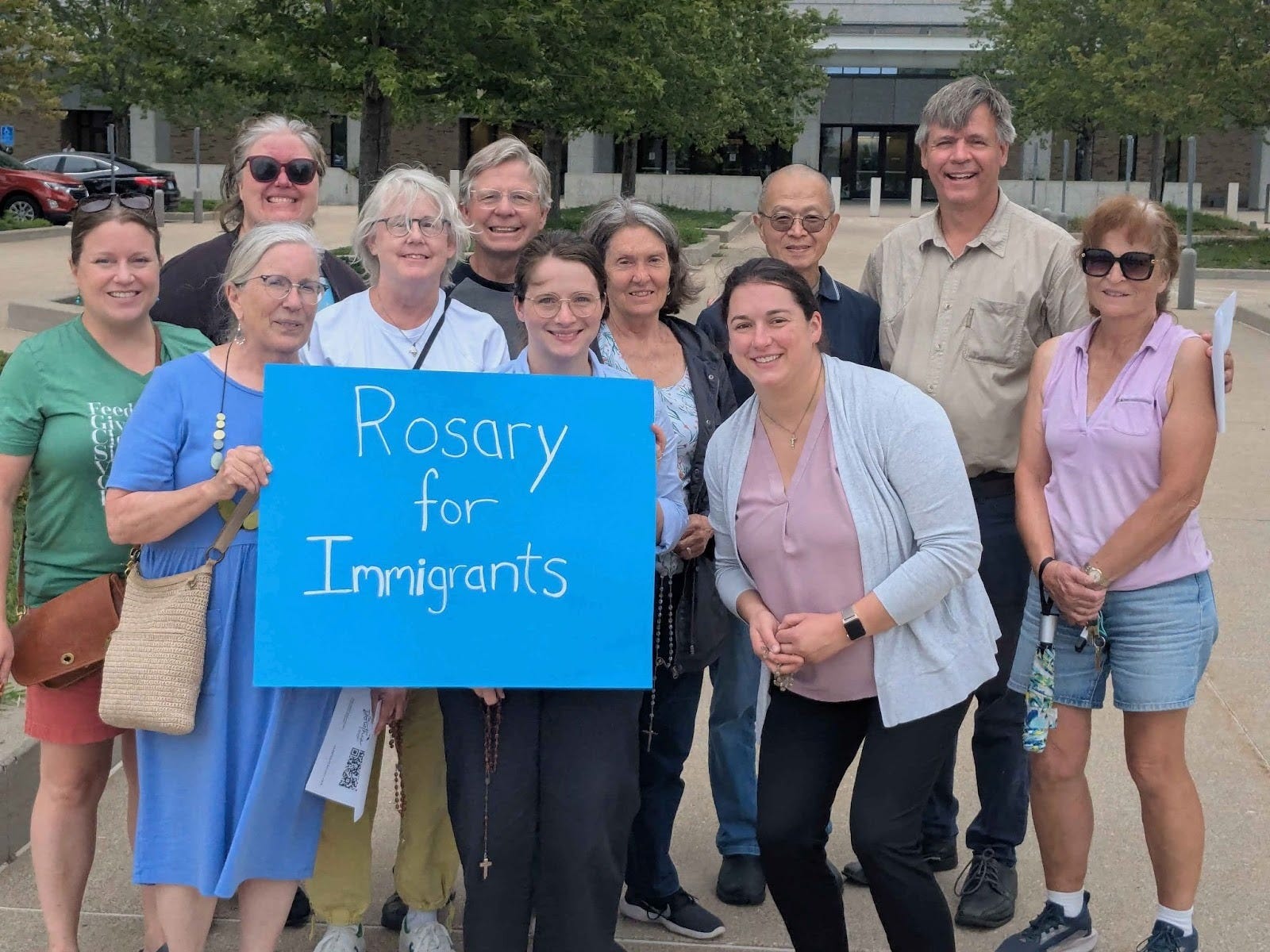
Holler stressed that education about Catholic social teaching should inspire action based on that teaching.
To help members put their faith into practice, the Dorothea Project holds action days – organized both at the national level and in local chapters.
The project began last year with a letter-writing campaign. Women wrote letters to their bishops, asking them to speak up about the issue of immigration.
“It was a pretty simple first action, but it was so powerful for so many women who had never tried to contact a bishop before to be able to send them a letter and say, ‘I’m seeing this moment and I’m afraid of it, and I would like you to speak out on it and speak in defense of immigrants and stand in solidarity with them’,” Holler said.
The project has held other action days since then. For example, its members observed the Feast of the Conversion of St. Paul as a day to pray for the conversion of ICE agents.
And members may take additional actions, either individually or with their local chapters.
Kathy Phipps, a member of the Dorothea Project in Indiana, volunteers with a local non-profit group that ministers to immigrants being detained at a local ICE facility.
With her parish priest, she also helped establish a weekly communion service inside the men’s detention center, at which she serves as a cantor.
“Learning about the Dorothea Project was a real consolation to me, because it made me realize I was part of a community of like-minded women who had similar concerns, and that we could support each other in prayer and share important information with each other through the group,” Phipps told The Pillar.
Whenever she heads into the detention center to minister to the men being detained there, she asks the group for prayers.
“I feel like I’ve just had a real sisterhood with the Dorothea Project, where I can share with them and ask for prayer about these men that I’ve met,” she said.
And she tells the men, “Know that you are supported by women who pray for you every day. Know that you’re not forgotten. Know that you’re not alone. There are people on the outside who care about you, who know about you and are praying for you.”
“I think it’s a real consolation to them,” she added.
Phipps said the stories she hears in the detention center are heartbreaking. Many of the men she meets had been in the United States for decades, she said, and have families from whom they have now been separated.
One man, she said, is the father of four children, all American citizens, and the sole breadwinner in his family. His wife cannot work outside the home because she cares for their children – including one with special needs.
Another is a man from Nigeria seeking asylum in the United States, paying his way through college along with his wife.
Phipps is hopeful that education on the Church’s social teaching will help Catholics see immigrants as human beings with dignity, worthy of dignified treatment, regardless of how they came to the country.
“I think the language that secular authorities have used has created the fear and the division that many people feel,” she said.
“If immigration is framed with a language of ‘invasion’ or framed with a language of ‘criminals,’ [it creates] an atmosphere of fear that something is being taken away from me, whether it’s a house or a job or something else.”
In contrast, she said, the Church focuses first on seeing the human dignity of each person involved, which shifts the entire approach to the issue.
“Our Church reminds us that we have to seek the common good and we have to seek the good of the family,” she said.
“One of the things I find so refreshing about our Church’s teaching on immigration is the primacy of the family. That of course, the country has the right to a strong border and national sovereignty, but not at the expense of the common good and not at the expense of the family.”
Since its launch last spring, the Dorothea Project has grown to nearly 1,000 members.
Holler believes there is an openness among many Catholics to hear the Church’s social teachings, particularly in a moment when violations of human dignity are widespread.
Right now, the Dorothea Project is working on creating a voter guide based on the seven themes of Catholic social teaching as outlined by the U.S. bishops’ conference.
The group plans to submit that guide to the USCCB, asking the bishops to allow it to inform their current efforts to update and revise their “Forming Consciences for Faithful Citizenship” document on voting as a Catholic.
Holler said the goal is to “to shape the way we look at political issues -- rather than through the lens of a political party, instead through our Catholic faith.”
Holler encouraged Catholics to step up and witness their faith publicly, and to fight discouragement through connection and action.
“I think we need to overcome disillusionment… Christ has given us a commandment to love one another as he loved us, and that love was sacrificial and it was unending, and we get to do the same thing,” she said.
“And it’s hard and it’s discouraging, but when we know each other and when you know each other’s stories and know what you’ve been through and know what your neighbor has been through, it makes it a little bit easier.”
She also encouraged those who may be feeling unsettled by the things they are seeing in the news, to allow themselves to question their assumptions and learn more about what the Church teaches.
“No matter what you have supported in the past, if you are feeling a pull on your heart that what you’re seeing in the news or in your community doesn’t fit with your faith, it’s a perfect time to do something about it,” she said.
“You don’t have to change your identity, you don’t have to change your worldview entirely, but if right now you’re feeling a tug at your heart that this doesn’t sit right, listen to that. That might be the Spirit talking to you.”
This is wonderful, full stop. This sounds a lot like pro-life action groups, but for Catholic social teaching more broadly, albeit with a very understandable special focus on immigration. They're basing themselves squarely in magisterial teaching, not hitching themselves to specific political bandwagons, and carrying out both education and works of mercy. They're truly doing the Lord's work.
"The cruelty is the point" has been way overused, but that is clearly the animating principle of the Trump 2 immigration effort.