
The Synod of Bishops of the Chaldean Catholic Church has agreed on a new procedure for electing bishops, which will give its members more time to study candidates before voting, Patriarch Paul III Nona said this week.
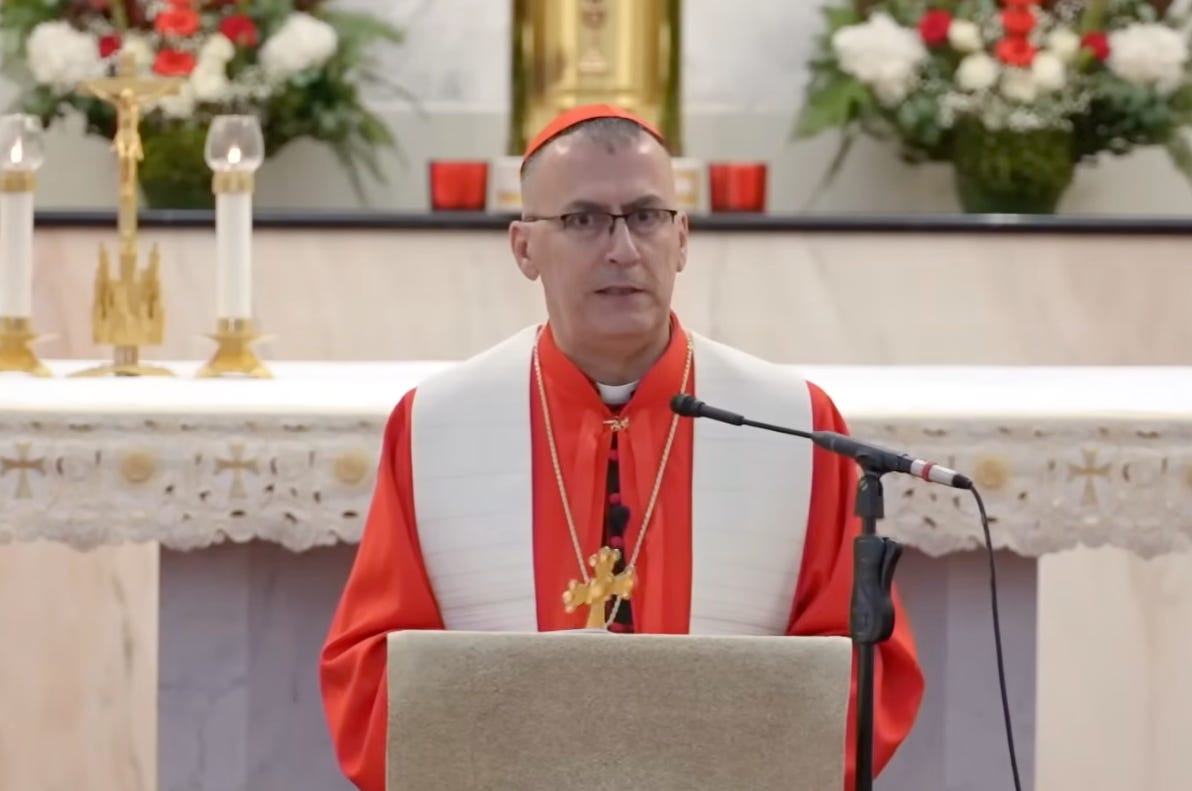
The Chaldean Catholic leader said in an interview published on the patriarchate’s website Oct. 23 that the bishops reached agreement on the new mechanism at an Oct. 16-19 assembly of the Synod of Bishops in Rome.
He said: “After lengthy discussions, we agreed on a specific procedure that will give synod members sufficient time to research and investigate the candidates and become better acquainted with them before electing them. This procedure will be implemented beginning with the next synod.”
Nona did not share further details about the new procedure or how it differs from the previous one.
The selection of suitably qualified candidates for the episcopate is a pressing issue for the Chaldean Catholic Church, one of the largest of the 23 Eastern Catholic Churches in full communion with Rome.
The Chaldean Catholic Church was shaken by a major episcopal scandal in February when allegations of embezzlement and sexual misconduct emerged against Bishop Emanuel Shaleta, the head of the Eparchy of St. Peter the Apostle of San Diego. Shaleta faces more than a dozen charges of money laundering and embezzlement, and is expected to face a criminal trial.
Pope Leo XIV accepted Shaleta’s resignation March 10, on the same day as that of Cardinal Louis Raphaël I Sako, the head of the Chaldean Catholic Church. Sako’s resignation paved the way for the April 12 election of Nona as his successor.
The Chaldean Church, which has approximately 600,000 members worldwide, has 23 ecclesiastical jurisdictions. Nine are in Iraq, four in Iran, two in the U.S., and one each in Australia, Canada, Egypt, Israel, Jordan, Lebanon, Syria, and Turkey.
Vacant sees or jurisdictions under patriarchal administration include the Eparchy of Alqosh in Iraq, three jurisdictions in Iran — the Archeparchy of Ahvaz, Eparchy of Salmas, and the Archeparchy of Urmia — and the Archeparchy of Amida in Diyarbakır, Turkey.
The list also includes the Eparchy of Cairo in Egypt, the Eparchy of St. Thomas the Apostle of Sydney in Australia, and the Eparchy of St. Peter the Apostle of San Diego in the U.S.
This indicates that at least a third of Chaldean Catholic jurisdictions lack a resident bishop, leaving a significant proportion of the world’s roughly 600,000 Chaldean Catholics without a local shepherd.
In a statement at the end of their meeting in Rome, the Chaldean Catholic bishops said they had discussed “the circumstances of our dioceses and their need for shepherds, along with matters concerning episcopal ministry, retirement, and the procedures for the selection of bishops.”
Nona said in his interview — published on the Chaldean Catholic Church’s official website — that the Synod of Bishops made decisions concerning the election of bishops for vacant sees. But he noted that the decisions could not be announced until they were confirmed by the Holy See.
“We discussed this matter with complete openness and frankness, seeking to determine what the synod considers best for each diocese,” Nona said.
The Synod of Bishops, together with the patriarch, is the supreme authority within the Chaldean Catholic Church, which is a sui iuris (self-governing) Church. After the Synod of Bishops elects a new bishop for a vacant see, the decision is presented to Rome for confirmation by the pope.
Nona said that among the most important decisions taken at the Rome assembly were the adoption of regulations governing synodal commissions and the election of a bishop to oversee each one.
The nine commissions cover areas such as family and youth, theology and catechesis, Chaldean heritage, diaspora issues, liturgy, and safeguarding.
Nona said the strengthening of the commissions was significant because the Synod of Bishops’ work will be based on reports prepared by the commissions.
“These must be submitted sufficiently in advance of the synod so that its members can review and study them thoroughly. During the sessions, matters requiring approval or further research and study will then be discussed,” he said.
“This procedure is, in fact, fundamental to the synodal process, ensuring that the work is not conducted on an individual basis or subject to personal preferences and interpretations.”
Nona also acknowledged in the interview that the growth of the Chaldean Catholic diaspora in recent decades, driven by upheavals in Iraq, had stretched pastoral resources.
“The widespread dispersion of the Chaldean faithful is accompanied by a shortage of priests and consecrated religious, both men and women, as well as the considerable pressure placed upon them. As a result, pastoral accompaniment has many shortcomings and difficulties,” he commented.
Nona said the shortage of priests was especially acute in Europe, which is served by an apostolic visitator rather than a resident eparchial bishop. There are substantial Chaldean Catholic communities in Sweden, Germany, France, and the U.K. The patriarch said that in Europe, “a single priest may be responsible for serving more than three centers located far apart from one another.”
After Nona was elected patriarch by the Chaldean Synod of Bishops in April, he requested and received ecclesiastical communion from the pope, in accordance with Church law.
Nona celebrated an Oct. 14 Mass of Ecclesiastical Communion in St. Peter’s Square with Cardinal Luis Antonio Tagle, the dean of the College of Cardinals, who was representing Leo XIV. The pope was unable to participate because he underwent surgery to remove lung cancer Oct. 13.
The Mass formally acknowledged the bond of communion between the Chaldean patriarch and the Bishop of Rome.
The following morning, Oct. 15, Nona celebrated the Chaldean Divine Liturgy at the Altar of the Chair of St. Peter in St. Peter’s Basilica.
In his homily, the patriarch said: “The Chaldean Church of the East, with her heritage, her liturgy, her wounds, and her hope, is called today to bear witness anew to this profound truth: communion does not mean simply being together, but becoming one in Christ, without anyone losing their distinct identity and without anyone being excluded from love.”