Charlotte bishop bans altar rails, kneelers for communion
“Receiving Holy Communion is to be done as the members of the faithful go in procession.”
The Bishop of Charlotte announced Wednesday that altar rails, kneelers, and prie-dieus will not be permitted for reception of the Eucharist in the diocese, beginning next month.
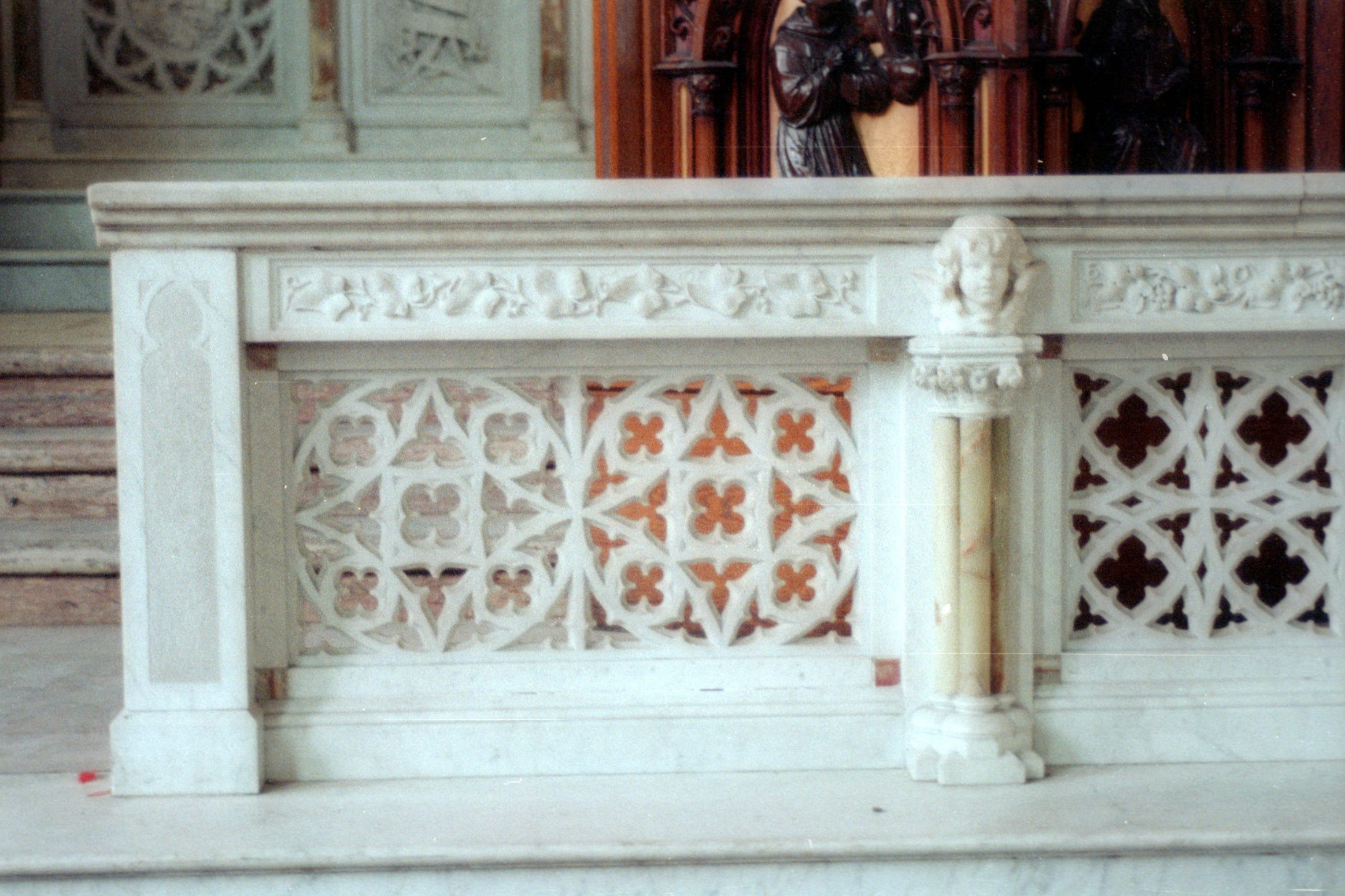
“The episcopal conference norms logically do not envision the use of altar rails, kneelers, or prie-dieus for the reception of communion. Doing so is a visible contradiction to the normative posture of Holy Communion established by our episcopal conference,” wrote Bishop Michael Martin, OFM Conv., in a Dec. 17 pastoral letter distributed to priests, specifically on the reception of Holy Communion.
“Instead, the instruction emphasizes that receiving Holy Communion is to be done as the members of the faithful go in procession, witnessing that the Church journeys forward and receives Holy Communion as a pilgrim people on their way.”
Martin’s letter instructed that altar rails, kneelers, and prie-dieus may not be used for the reception of communion in public celebrations starting Jan, 16, 2026. Temporary or movable fixtures used for kneeling to receive communion must be removed by that date.
Martin’s pastoral letter emphasized standing to receive the Eucharist as the normative posture in the United States, while also acknowledging that Catholics have a right to receive kneeling if they wish to do so, and cannot be denied the Eucharist based solely on their desire to kneel.
“A normative posture is not only given so that we may be united in how we receive Holy Communion, but also as an aide to direct our catechesis and sacramental preparation,” Martin said.
“Clergy, catechists, ministers of Holy Communion, and teachers are to instruct communicants according to the normative posture in the United States. They are not to teach that some other manner is better, preferred, more efficacious, etc.”
The bishop emphasized the importance of unity in the reception of the Eucharist.
“The faithful who feel compelled to kneel to receive the Eucharist as is their individual right, should also prayerfully consider the blessing of communal witness that is realized when we share a common posture,” he said.
Martin’s pastoral letter also encouraged the distribution of Holy Communion under both species on Sundays and specific holy days, although did not issue a requirement that this be done. It further stated that “the role of Extraordinary Ministers of Holy Communion is to be welcomed and used in our parishes, churches, missions, and schools.”
The pastoral letter comes amid months of controversy over liturgy in the diocese.
In May, a draft text of broader liturgical policies for Charlotte was leaked online, prompting widespread opposition.
The draft included not only provisions on altar rails and kneeling for communion, but also a broad swath of other liturgical restrictions, among them a prohibition on Roman style vestments, altar crucifixes and candles (in favor of those used in the processional and placed next to the altar), the use of the Latin language, and the recitation of vesting prayers, customarily recited by priests as they don the vestments used for Mass.
Sources told The Pillar that when those plans were raised this spring at meetings of both the diocesan presbyteral council and an ad hoc liturgical working group established by Martin, they were met with strong opposition from each group.
While the draft text was spiked after internal opposition, some sources suggested that Martin might eventually publish more elements of the policy draft in a “piecemeal” fashion and over time.
The leaked text of liturgical policies began to circulate online in May just days after Martin announced a new policy restricting the celebration of the Traditional Latin Mass to one designated chapel in the diocese, despite permission from the Vatican for parish churches in Charlotte to continue offering the Traditional Latin Mass.
That decision was also met with widespread criticism in the Charlotte diocese, where several extraordinary form communities were integrated into local parishes, creating, according to some sources, a sense of solidarity between those who attend the older liturgies, and Catholics attending other Masses.
The ongoing flare up over liturgy is part of a larger pattern of controversy in the diocese since Martin arrived last year.
Sources in the diocese told The Pillar that an anonymous open letter to Martin — circulated in the diocese in January 2025 — had support from much of the diocesan presbyterate when it was published, as it flagged several alleged issues with Martin’s leadership.
Among the charges made in the letter were “arbitrary micromanagement,” “the speed of change and lack of pastoral sensitivity,” “failure to consider the effects of decisions”, and insufficient “synodality” in the diocese, which amounted to an “autocratic approach.”
The letter urged Martin to “please consider freezing any major changes for at least two years, allowing time to establish relationships across the diocese, listen, in fulfillment of your word, and provide yourself time to understand the unique needs of this diocese. This pause would demonstrate a true willingness to understand your flock prior to navigating the ship in a new course.”
It is not clear whether Martin will issue subsequent liturgical directives on other elements of the leaked comprehensive policy draft.


Some more context from a CLT Catholic: His presbyteral council told him not to do this. His own committee which he formed told him not to do this. Earlier this fall, St. Mark's in Huntersville—which the bishop has already floated the idea of turning into his cathedral—announced that they would remove their altar rail. The pastor announced that it was at the bishops request, and there was a pretty massive blowback, such that the pastor walked it back as recently as this month. Meanwhile, the *community* had been the vector of change, asking for more reverence, for more chant, for more Eucharistic reverence and fewer EM's in the middle of the aisles, etc. ... This is not, and has never really been, something imposed by traditionalist clergy.
Martin also denied that he had ever made that request, leading to a weird thing where the diocesan office and the pastor had to shrug and talk about "miscommunication," even though someone somewhere was probably lying.
Also, there was a three-day fast/protest outside the diocesan office during the First Week of Advent. The good bishop didn't even bother to reply to the letters sent to him about it.
Meanwhile, he's personally invited Fr. Casey Cole to do street evangelization in Charlotte (not bad, that), but that's brought home for many of us Fr. Cole's many suspect statements on things like the historicity of the Gospels and Church teachings on sexuality. Fr. Cole has also, of late, been making more and more liturgically-focused videos that deliberately misquote the GIRM and speak against kneeling *after* communion, of all things. So if *that's* what our bishop wants, I don't know many people here who would trust him.
All this from a bishop less than two years in his office, and who has *never* had permanent residence in this diocese prior to his elevation, and who was a only parish pastor for about two years before he became a bishop.
At every turn, Bishop Martin has done things which have alienated huge swathes of his flock, not at all limited to those who lean liturgically traditional.
Francis said that he wanted shepherds who smell like their sheep. Bishop Martin has given everyone the impression that he caught a whiff of his sheep, gagged, and has been determined to hose us down.
You inherited a good diocese, Excellency. Stop treating us as a problem in desperate need of fixing.