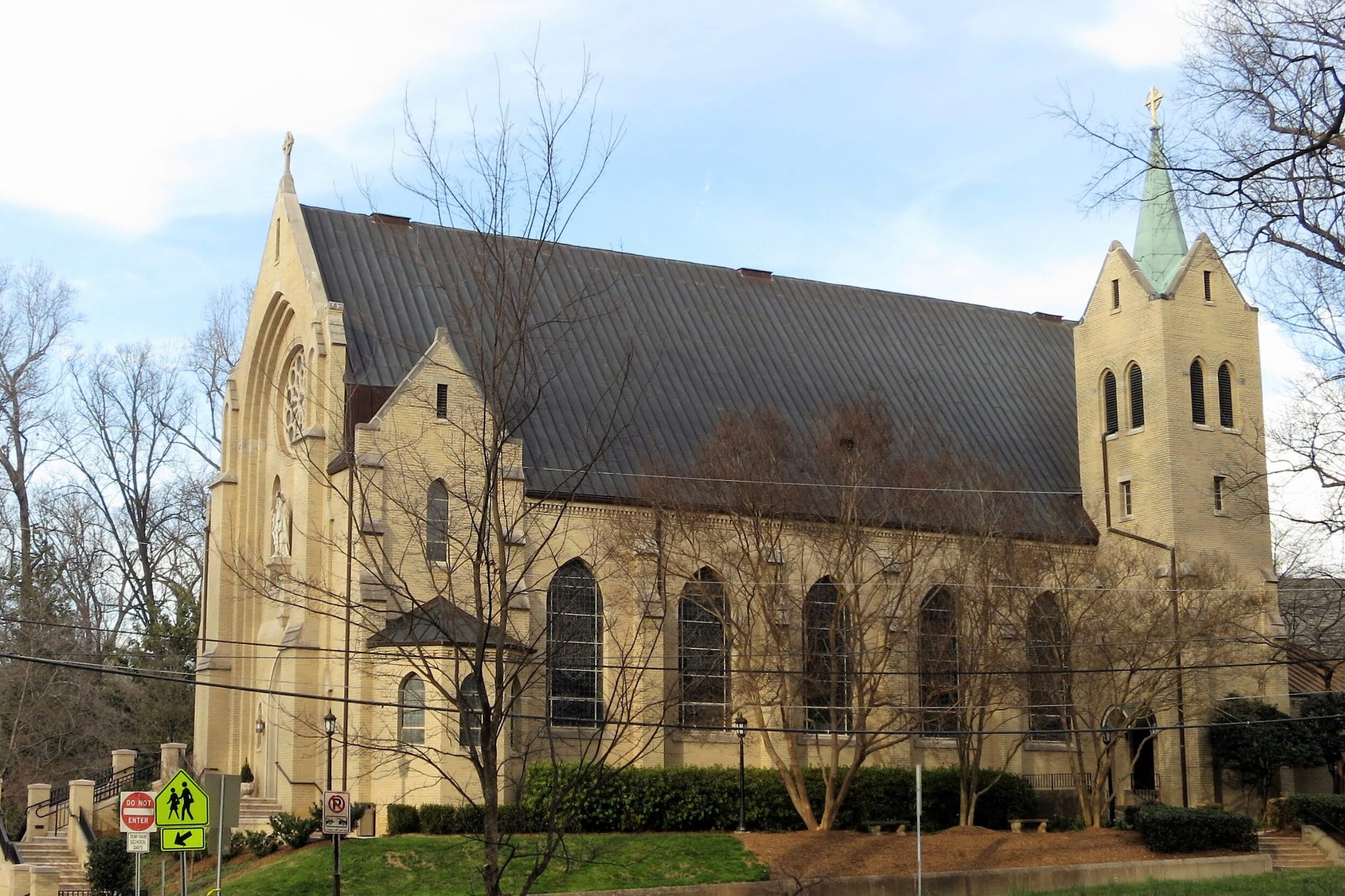
Charlotte priest assignment sees pushback over ‘credible’ allegations
Does a priest assignment point to broader challenges for the Church?
The bishop of Charlotte, North Carolina has faced pushback after reinstating to ministry a priest removed more than five years ago amid allegations of child abuse.
But the case could point to a gap in the Church’s canonical norms for clerics accused of abuse before ordination, and towards ambiguity about the status of some accused clerics. It could also point to the difficulty posed by differing uses of the term “credible” to characterize allegations of abuse.
—
In 2019, the Charlotte diocese announced that a person had come forward to the diocese alleging that Fr. Patrick Hoare had sexually abused him in the early 1990s, in Pennsylvania, before Hoare was ordained a priest.
In July 2020, Bishop Peter Jugis announced that two allegations had by then surfaced against Hoare — “both of which involved accusations of inappropriate touching of relatives in the 1980s and early 1990s.”
Jugis wrote that the allegations had been investigated in Abington, Pennsylvania, whose police department “informed the diocese that their investigation found the claimants to be credible.”
However, “citing the statute of limitations, local authorities said they were unable to bring charges” against Hoare, the bishop said.
Jugis added that the Charlotte diocesan review board “did not have access to the police investigation,” but conducted its own investigation.
“The review board concluded that while some of the allegations appeared credible, no specific incident of sexual abuse of a minor was identified based on the evidence presented and recollections of ages and events decades earlier,” Jugis wrote.
The priest was placed on administrative leave, Jugis announced.
Three years later, in a letter to parishioners of Hoare’s former parish, Jugis said that other complaints had been raised about Hoare’s ministry.
The bishop wrote that the diocesan review board had recommended to him “that Father Hoare remain out of active ministry, after the board’s investigation found instances [during Hoare’s ordained ministry in the diocese] in which observed behavior by Father Hoare with minors constituted boundary violations under our policy, and raised quested about his judgment.”
In the same 2023 letter, Jugis wrote that Hoare had been repeatedly been “the subject of complaints from the faithful that he failed to live up to contemporary standards of conduct with minors, with concerns raised at each parish where he had been assigned since his ordination in 2007.”
Though Jugis said that the Pennsylvania police investigation had found the 1990s abuse allegations against Hoare “credible” — and that the diocesan review board also found allegations “appeared credible” — the priest was not placed on the diocesan list of credibly accused priests.
And because the allegations of child abuse dated from before Hoare’s ordination, they were not tried as canonical delicts in an internal ecclesiastical penal process.
That left Hoare in something of a no-man’s land — with his bishop stating that accusations had been found “credible” by police and withdrawing him from priestly ministry, but without any penal process to assess the charges against him.
But last month, Charlotte’s current Bishop Michael Martin announced that Hoare had been assigned as chaplain to a Catholic retirement community sponsored by the diocese.
Following the USCCB’s “Charter for the Protection of Children and Young People,” policy in the Diocese of Charlotte says that “no clergy may serve in ministry who are known to have a credible allegation of child sexual abuse against them.”
In light of that, some Catholics in the diocese have said that Hoare should not be returned to ministry — especially given Jugis’ statement that the police investigation into Hoare had found his accusers to be “credible.”
For many in the life of the Church, the term “credible” can be a loaded word, with varied, and sometimes inconsistent usages.
In some dioceses, the term “credible” is used to describe a claim that is “not manifestly false or frivolous.” In others, the term is used alongside “substantiated” to denote something which has been materially investigated.
Inconsistent use of the term has been criticized by canon lawyers and safe environment experts, who say it can create unclear expectations for victims, or an ambiguous sense of the actual assessment of a case.
In 2024, the Dicastery for Legislative Texts issued guidance to bishops which said that canon law prohibits published lists denoting clerics “credibly accused” of sexual abuse crimes. It is not clear how that guidance might be implemented in the U.S., where such lists were often first published as a result of litigation or bankruptcy proceedings, and with some legal agreement to do so.
—
According to sources in the Charlotte diocese, Martin faced internal pushback when he began discussing the prospect of assigning Hoare to ministry last year.
Sources close to the chancery told The Pillar that Martin began considering an assignment for Hoare in early 2025.
“It definitely has struck me as problematic,” one senior source told The Pillar.
Martin had considered a parish assignment initially, sources said, with an expectation that the priest might also engage in campus ministry with college students.
“He clearly wanted to assign Fr. Hoare to a parish,” a source said, “and to get him into ministry.”
But “priests were concerned about any assignment for Fr. Hoare,” another source said, “and especially concerned about one that might involve proximity to young people,” whether in campus ministry or at a parish.
“The bishop framed it as a priest who hadn’t been convicted of anything, and still deserves some assignment,” one source close to the chancery said, “[but] in our day and age, after everything the Church has been through … this is a serious decision.”
Some Charlotte clerics, who asked not to be named because they were not authorized to speak on the record, expressed concern that there did not appear to be any monitoring plan in place to oversee Hoare’s assignment — a step they said they would have expected in light of the allegations he’s faced.
And sources close to the chancery told The Pillar that even while Martin had the support of the diocesan review board, there has been a sense among some priests that Martin is downplaying the seriousness of the Pennsylvania allegations against Hoare, and Jugis’ assertion that his accusers were found to have had credibility.
In a Dec. 19 letter, Martin indicated that Hoare had been removed from his ministry as a pastor in 2020, after the diocesan review board “found allegations of boundary violations with minors observed in group settings to be credible.”
“The review board recommended multiple steps, including an independent assessment and boundary counseling, he could follow for a possible return to ministry — recommendations that [Martin’s predecessor] Bishop Peter Jugis accepted.”
Martin’s letter added that Hoare had appealed to the Vatican Jugis’ decision to remove him as pastor, and that the appeal was not successful.
“During this five-year appeals process, Father Hoare remained on administrative leave, engaging in a period of reflection and counseling,” Martin said.
“Father Hoare has repeatedly shared with me his remorse, unaware in those moments that his actions with minors might be perceived as boundary violations,” the bishop’s letter explained, adding that Hoare had undergone a “professional assessment, counseling,” and “course work in respecting healthy boundaries.”
Those circumstances, Martin wrote, indicate that Hoare “meets the standards for public ministry.” The priest is set to begin his retirement community ministry next week, in a job that will see him “responsible for ministering to residents, visiting the sick, administering last rites, and demonstrating Catholic values, as well as the ecumenical spirit for which Pennybyrn is known.”
Martin’s December letter did not address other allegations raised against Hoare, the alleged acts of child abuse which Jugis said had undergone police investigation.
But in a May letter to Hoare’s former parishioners, Martin did address the abuse allegations, saying that Hoare denied the allegations, “both of which involved accusations of acts of inappropriate behavior with relatives when he was in his teens or early 20s.”
“The [diocesan] lay review board concluded that while some of those claims appeared credible, the precise ages of those involved could not confidently be ascertained based on the evidence presented to the lay review board and recollections of people’s ages and events decades earlier.”
Martin did not mention Jugis’ claim that a police investigation “found the claimants to be credible.” Instead he stated that “Pennsylvania authorities also investigated the abuse claims in 2020 and reported to the diocese that they were unable to pursue charges” — without mentioning Jugis’ claim that the decision not to pursue charges pertained to Pennsylvania’s criminal statute of limitations.
But Benne Hutson, chair of the diocesan review board, told The Pillar that the review board “thoroughly assessed both the allegations made against Father Hoare in 2020 and his request to return to active ministry in 2025.”
“The decisions made by both Bishop Peter Jugis as to the allegations and Bishop Michael Martin as to the request to return to active ministry were consistent with the board’s findings,” Hutson told The Pillar by email. “During my nearly 10 years on the board, both bishops have relied on the Board’s independent expertise to guide them and the Father Hoare matter was no exception.”
In response to questions about the abuse allegations faced by Hoare, Hutson emphasized that police “did not pursue charges.”
And, he said, the review board “did a full investigation of the allegations in Pennsylvania including interviews with all involved by our investigator, who is a former FBI agent, and separately by the full Lay Review Board,” and did not identify specific instances of child sexual abuse.
But, he said, the review board did have concerns about Hoare’s ministry.
“We did find credible three complaints against Fr. Hoare of boundary issues involving minors in public settings and recommended that Fr. Hoare complete an assessment and education program before being considered for a possible return to ministry.”
According to Hutson, “Bishop Jugis accepted that course of action.”
Jugis could not be reached for comment.
Hoare is not the only priest in the U.S. who has faced allegations of committing serious sexual misconduct before his ordination.
The most well-known case is Minnesota priest Fr. Michael Keating, who was accused in a 2013 lawsuit of sexually abusing a teenager while he was in priestly formation in the late 1990s. Keating’s alleged victim first reported the priest to his archdiocese in 2006, but an internal review determined there was not enough evidence to remove him from ministry.
But in 2013, Keating was removed from ministry, and placed on a “leave of absence” in light of the allegations against him.
The archdiocese told The Pillar this week that “Father Keating has been out of ministry since 2013 due to a lawsuit presented at that time alleging that he had sexually abused a minor before he was a priest. The archdiocese investigated the claim and presented it to the Archdiocese’s Ministerial Review Board for its recommendation. The recommendation was that Father Keating not be permitted to return to ministry at that time.”
Keating has not been since returned to ministry.
—
Hoare did not respond to several requests for comment from The Pillar.
A spokesperson from the Diocese of Charlotte declined to comment on the priest’s assignment.


All I can say is that I'm really glad the Pillar is reporting this.
Given all of the news about Bishop Martin, I can understand why Bishop Jugis didn’t comment…. Especially because it looks like he made the right calls, and the only people casting doubt on that are the people on the diocesan review board (also very confused how this board was simultaneously supportive of Fr. Hoare’s removal from office and now supports Fr. Hoare’s new assignment).