
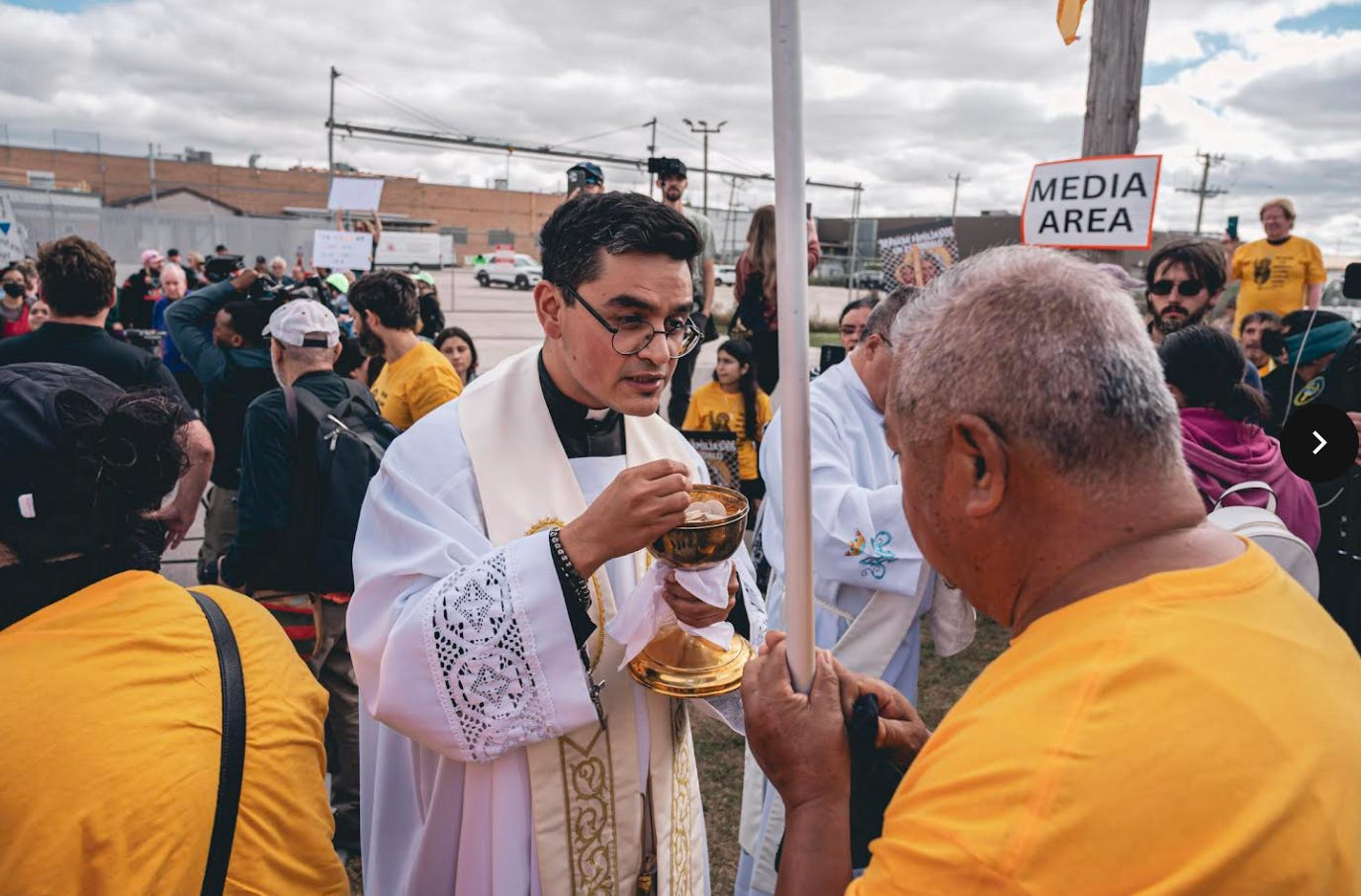
A Chicago priest who helped to organize an immigration-focused Eucharistic procession Saturday said the group aimed to call attention to injustices faced by detained immigrants, including a lack of pastoral care in federal detention centers.
But Fr. Larry Dowling also courted controversy Monday, when he accused several bishops of affiliation with “white Christian nationalism” — a charge that one bishop says is “disingenuous,” and another called “deeply irresponsible.”
—
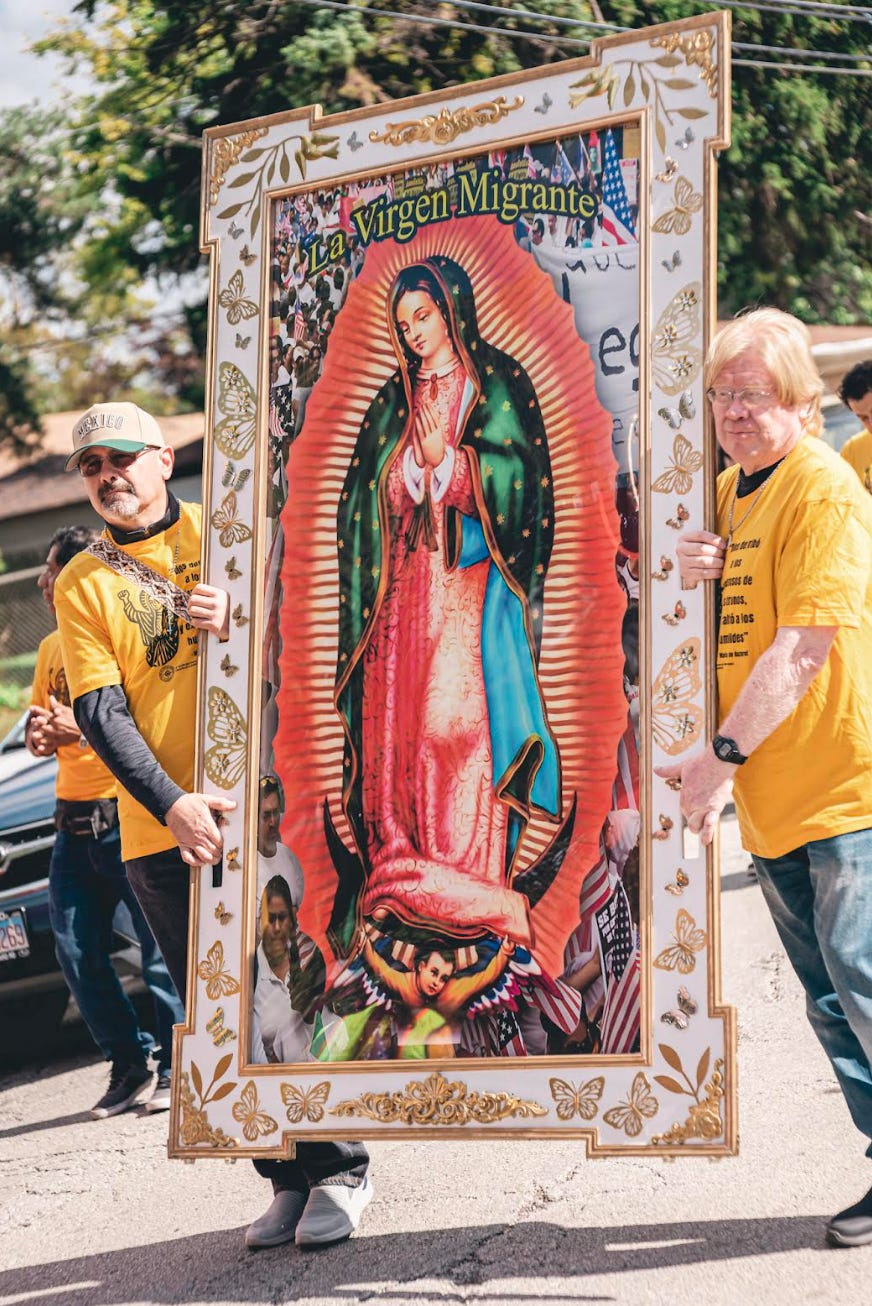
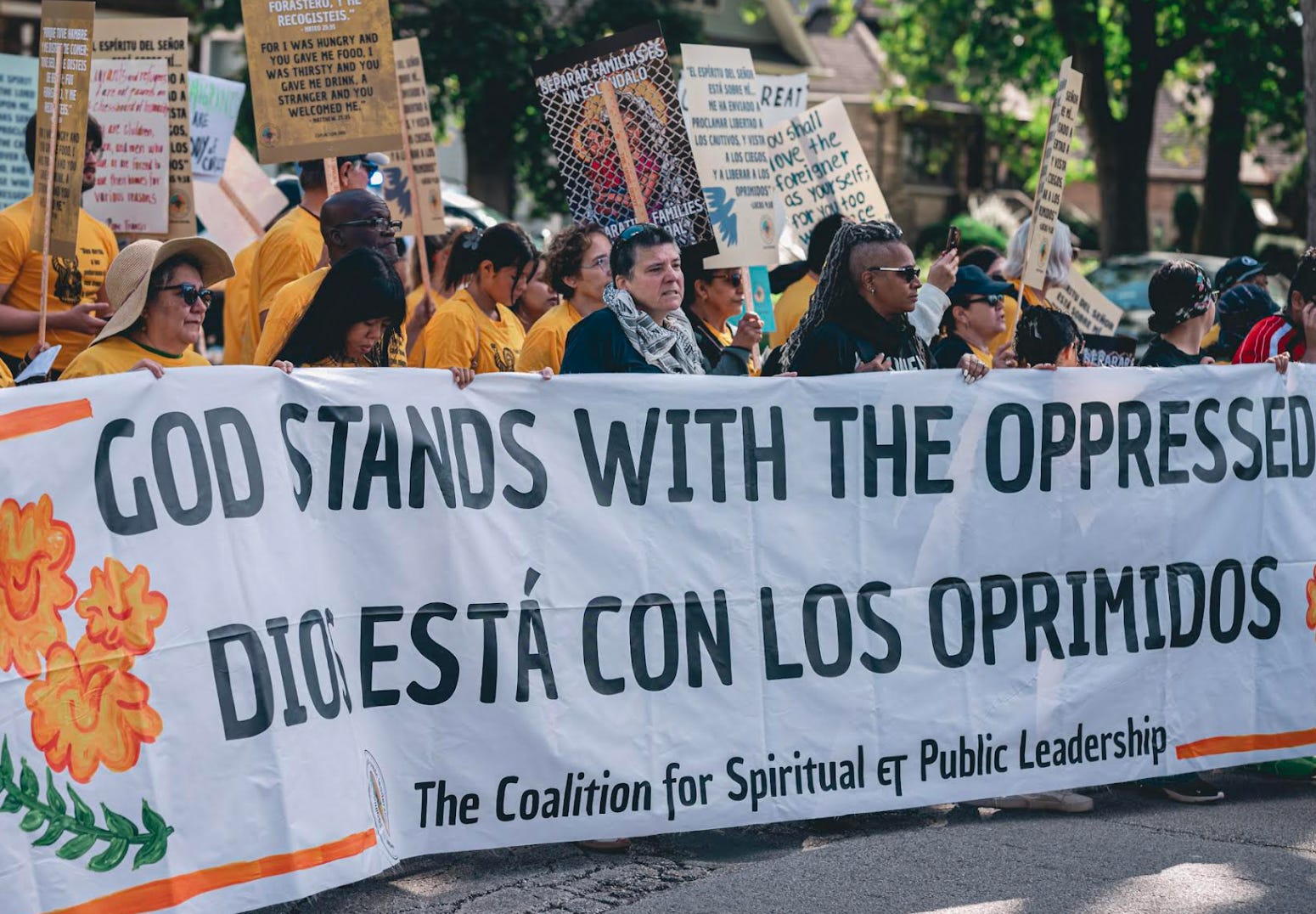
The Coalition for Spiritual and Public Leadership told The Pillar on Monday that about 1,000 “Catholics and people of faith” attended a 1-mile walking Eucharistic procession from a parish church in Chicago’s suburbs to the nearby Immigration and Customs Enforcement facility in Broadview, Illinois, where organizers hoped to enter the facility and administer the Eucharist to detainees.
“The intent was basically to do a Eucharistic procession — with the monstrance and prayer and song and praying the rosary and all that — to the detention center: To pray, but also to go inside to distribute communion to those who are being held in detention,” explained Fr. Dowling, moderator of the Chicago-based Priests for Justice for Immigrants, and a member of the CSPL’s clergy caucus.
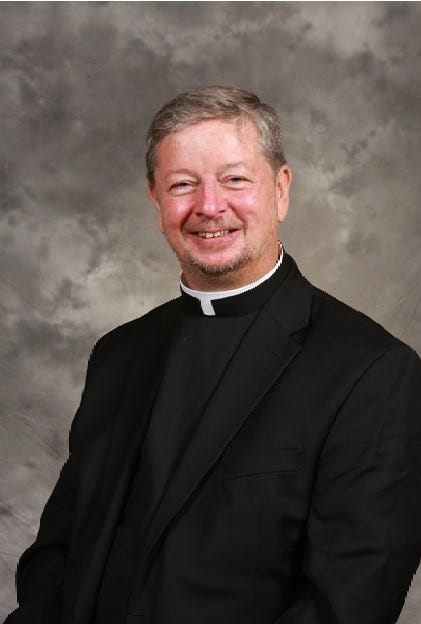
Dowling, who is retired in the Chicago archdiocese and helped to both organize and lead the procession, explained that local clergy had until recently been able to provide sacramental ministry at the ICE facility, which opened in 2006.
That sacramental ministry became impossible several months ago, “when all this stuff started to happen under the Trump administration,” Dowling said — referring to the ramp-up leading to Operation Midway Blitz, an ICE initiative that began in early September, and has aimed to arrest and process for deportation undocumented immigrants with criminal records in the Chicago area.
The effort has been the subject of repeated protests in the area including clashes between protesters and federal agents, along with litigation from the state of Illinois and the city of Chicago, and eventual White House deployment of National Guard troops aimed at quelling the protests.
ICE agents have been accused of illegal tactics amid the operation, and the Broadview facility has been criticized for allegedly indecent conditions, insufficient nutrition, and detentions without access to legal counsel, though the federal Department of Homeland Security has disputed those charges.
On Saturday, 15 people were arrested outside the Broadview facility, though they did not appear to be affiliated with the Eucharistic procession.
Dowling told The Pillar that the Eucharistic procession was not meant to be a protest, but instead aimed to express solidarity with detainees, many of whom are Catholic, he said.
Videos which have circulated online show priests, one carrying a monstrance, requesting access to the facility, and then for permission to approach a secured fence in order to distribute the Eucharist to ICE agents and to detainees. That request was denied by ICE officials, who communicated through the Illinois State Police officers accompanying the procession.
Still, Dowling said, the Eucharist was administered outside the facility to many of those participating in the procession, and to police officers who provided security during the procession.
The priest said the effort was not meant as a political stunt, but that organizers did hope to “raise awareness … and to exercise our right to minister to the people in detention.”
In other parts of the country, dioceses and religious ministers have reported inconsistent standards on access to ICE detention centers in recent months, or unclear protocols for chaplains and volunteers. Dowling said there has been no clear communication about pastoral care at the Illinois facility.
Religious and clergy distributed communion regularly to detainees at the Broadview facility until the 2020 pandemic, Dowling said. Access was in the years after that sporadic, the priest said, but has been completely curtailed in recent months.
For Saturday’s effort, the priest said, “we put in the request in advance, and then they chose when we got there to say no.”
The Department of Homeland Security told The Pillar that its decision on Saturday was a security precaution.
“Over the past month, rioters have swarmed the Broadview ICE facility and Chicago streets. They have assaulted law enforcement, attacked law enforcement with vehicles, thrown tear gas cans, slashed tires of cars, been arrested with firearms in their possession, blocked the entrance of the building, and trespassed on private property. Our ICE staff informed the Coalition for Spiritual and Public Leadership that the Broadview processing center was not able to accommodate visitors on such short notice, for their safety as well as that of detainees and staff, and due to the ensuing riots,” a Department of Homeland Security official who did not provide a name, told The Pillar by email.
The official added that even tours of ICE facilities require requests filed a week in advance — even for lawmakers.
“As ICE law enforcement has seen a surge in assaults, disruptions and obstructions to enforcement, including by politicians themselves, any requests to tour processing centers and field offices must be approved by the Secretary of Homeland Security. Requests should be made with sufficient time to prevent interference with the President’s Article II authority to oversee executive department functions — a week is sufficient to ensure no intrusion on the President’s constitutional authority.”
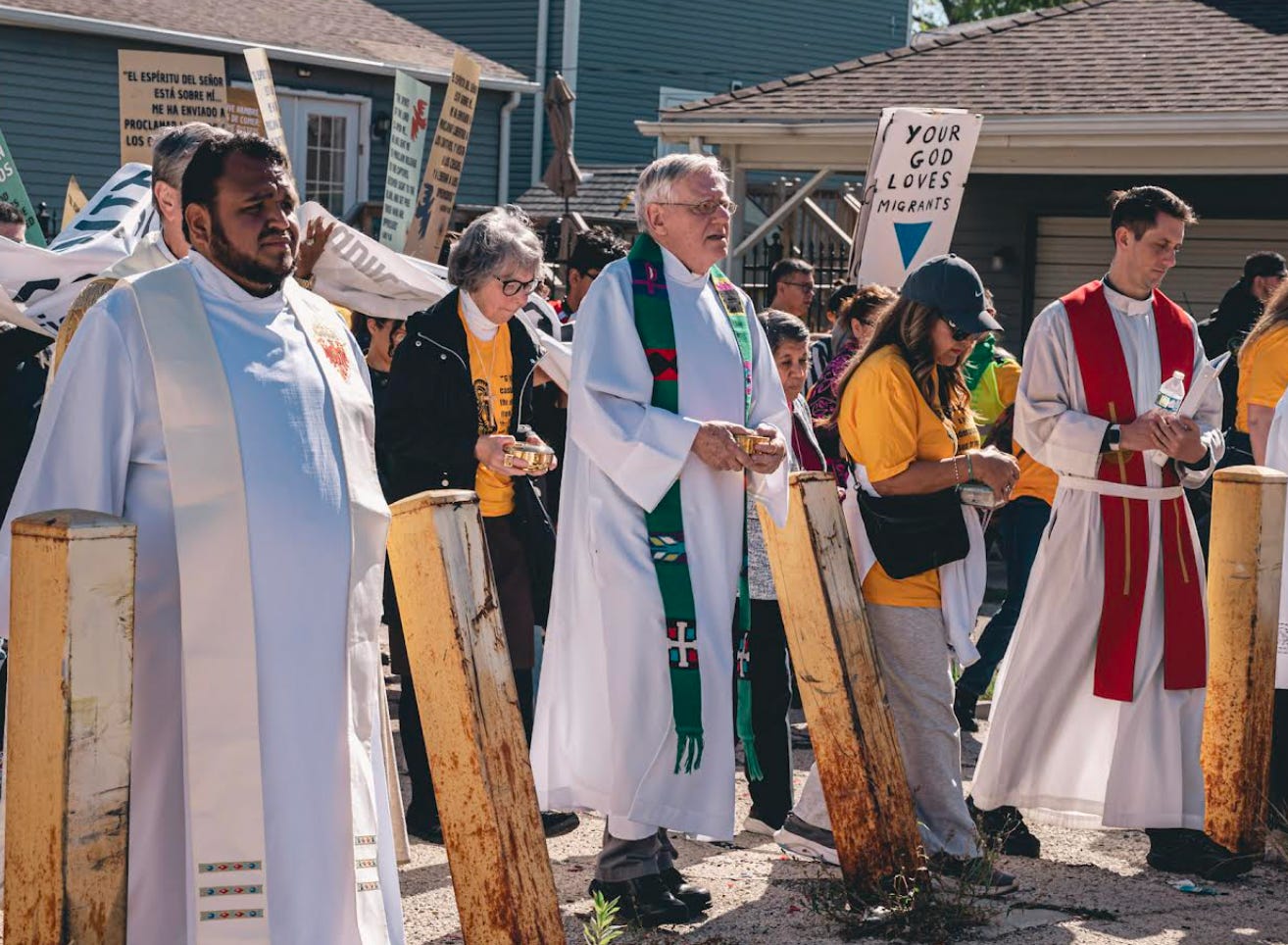
For their part, Dowling told The Pillar that the procession’s participants aimed to “point out ways in which we’re not able to bring the love of Christ to the world.”
“I’ve heard people say that this is a political stunt, or that it’s just publicity,” he acknowledged, “but that was never our intent. The people planning this are faith-centered and peaceful, and wanting to do this in a very respectful way.”
Asked about criticism that the Eucharist could be “politicized” in a procession toward an ICE facility, the priest said the procession’s aim “is not to make the Eucharist a weapon … it’s basically exercising a right as Christians to bring the Christian message and the love of God to these people who are in really inhumane conditions inside the jail.”
“We went and prayed. We prayed over the place. Hopefully people inside could hear our singing and our praying for them,” he said. “And so you can define it in any way you want, but politics is the action of the people. And for us, it’s a religious act to be in solidarity with the people that are suffering, and many of them — many, many of them — unjustly.”
Dowling added that he was edified by an “incredible mix” of young people and families at the procession Saturday.
And he said the procession toward the ICE facility is a way of understanding the Church’s Eucharistic Revival efforts.
“The Eucharist is central, obviously, to who we are,” and “Eucharistic piety is really, really important — it’s central to my own spirituality,” the priest said.
“But for me, the Eucharistic Revival needs to ask how we can challenge people to not only raise up the body and blood of Christ in the Eucharist, but to be the body and blood of Christ in the world. I think sometimes there has been a disconnect … I think that’s where the Church falls short all the time is that we encourage people to go out and live wonderful individual holy lives, but we don’t tap into the collective power of the faith community, to say there’s ways that we can act collectively in a more powerful way to be the body and blood of Christ in the world.”
Dowling told The Pillar that the group aimed to address a religious liberty issue — restrictions on sacramental ministry for federal detainees — and emphasized that processing with the Eucharist was central to the group’s efforts.
“Solutions to these issues have to come from a spiritual perspective. We have to be engaged, not just in political processes, but be connected to asking God to help us, and to give us the wisdom in helping us to do our individual part in this whole thing,” the priest said.
“Are we going to really be the people that God calls us to be and not let laws that are hurtful and harmful compete with the law of love that God calls us to live?”
But while Dowling expressed a positive vision for the Oct. 11 procession, he also courted controversy in his remarks to The Pillar.
The priest explained that he hopes to contact a federal religious liberty commission, established by President Donald Trump in May, to raise the issue of religious liberty for immigration-related detainees and those who would minister to them.
“I’m not sure I would expect much [from the commission],” Dowling told The Pillar, “considering it’s basically a white nationalist Christian group, including the bishops that are on the commission.”
Asked to explain that characterization, Dowling named some bishops affiliated with the commission, and charged that bishop participants had not been sufficiently outspoken on immigration:
“It’s Barron, it’s Dolan, it’s Paprocki,” he said. “They’ve all had the opportunity to speak to the immigration issue, and there’s been nothing from their platforms. It’s been nothing but support or basically silence in regard to this stuff. And I’m sure that’s pandering to their closeness to the president, and it’s also pandering to the people who are their followers and all that kind of stuff. But for me, it’s sad.”
There are five Catholic bishops affiliated with the commission. Bishop Robert Barron and Cardinal Timothy Dolan are members of the commission itself, and Archbishop Salvatore Cordileone, Bishop Thomas Paprocki, and Bishop Kevin Rhoades are members of an advisory board of religious leaders.
Paprocki told The Pillar on Monday that Dowling’s mention of “white nationalism” was “disingenuous.”
The bishop cited a recent column, in which he wrote that “policy decisions on how best to help immigrants are prudential judgments. Deportation is not intrinsically evil (i.e., morally wrong in all circumstances) and civil governments have the right — and at times the duty — to enforce immigration laws. At the same time, Sacred Scripture and Catholic teaching uphold the dignity of every human being and urge compassion for those who find it necessary to migrate when necessary to protect their life, dignity, or livelihood, as the Holy Family did when Jesus, Mary, and Joseph had to flee to Egypt when their lives were endangered by King Herod (see Matthew 2:13-15).”
In the same column, Paprocki noted his longtime ministry among immigrant communities, and his history of legal work.
“As a priest with a civil law degree, I co-founded the Chicago Legal Clinic to help provide legal services for the poor. My primary focus was immigration law, helping people to obtain legal status as lawful immigrants and citizens. When migrants are undocumented, they are vulnerable to unscrupulous employers who pay them below minimum wage, threatening to call immigration authorities if they complain. The best way for immigrants to thrive in our country is to come here legally. Our immigration laws are in need of reform to address current realities more adequately,” the bishop wrote.
Bishop Robert Barron told The Pillar that Dowling’s remarks regarding the commission “are absurd and insulting. It is just this kind of deeply irresponsible rhetoric that leads to violence.”
For his part, Archbishop Cordileone focused on the religious liberty of ICE detainees.
“As faith leaders we are called to speak to the moral issues of the prominent policy priorities of our time, but in a way that does not embroil us with partisan politics,” the archbishop told The Pillar on Monday evening.
“With regard to immigration, the Church has taught consistently on the dignity of immigrants, and for decades now the U.S. bishops have consistently called for just and humane treatment of those who find themselves in this country from elsewhere. If undocumented immigrants are being detained and deprived of access to the sacraments, this is a serious religious liberty violation and the members of the Commission should be informed of it so they can take action accordingly.”
Rhoades echoed that sentiment. In an email to The Pillar, the bishop said that the characterization of bishops as white nationalists “is false and very disturbing.”
The bishop explained that he sees his role on the clergy advisory board as representative of his role as chair of the USCCB’s religious liberty committee.
“One of our top priorities this year has to do with the religious liberty of faith-based immigration services. Since we highlighted that area of critical concern for us, the issue of freedom to minister to migrants in detention facilities, including the administration of the sacraments, has arisen in some places,” Rhoades explained, adding that bishops in local dioceses have addressed the issue directly.
“It is important that detainees have access to the sacraments and pastoral care,” Rhoades told The Pillar. “As far as I know, this concern has not yet been on the agenda of the Religious Liberty Commission, though some of the other areas of critical concern have been discussed. I am hoping that it will be, along with the issue of the provision of pastoral care and the sacraments to detainees.”
“I see my membership on the advisory board as an opportunity to share the Church’s voice on the various religious liberty issues that the Commission discusses, including the issue of the religious liberty of our immigrant brothers and sisters,” Rhoades added.
Cardinal Dolan has not responded to The Pillar’s request for comment.
Editor’s note: This report was updated after publication to include comments from Archbishop Cordileone and Bishop Rhoades.
"White nationalist" is just a phrase liberals use when they're losing an argument.
I didn’t think much of this stunt when I heard about it over the weekend. Now that I see what the organizer said about Bishop Barron of all people I think even less of it.