
‘Christ presented without compromise’ - the legacy of Benedict XVI
Next year will mark the centenary of the birth of Joseph Ratzinger.
In 2027, the Church will mark the centenary of the birth of Joseph Ratzinger, who would become known as Pope Benedict XVI.
The first pope to resign in nearly 700 years, Benedict was also known as one of the most consequential Catholic intellectuals of the modern era. His work ranged across the realms of fundamental theology, Scripture, philosophy, political theology, and liturgical theology.
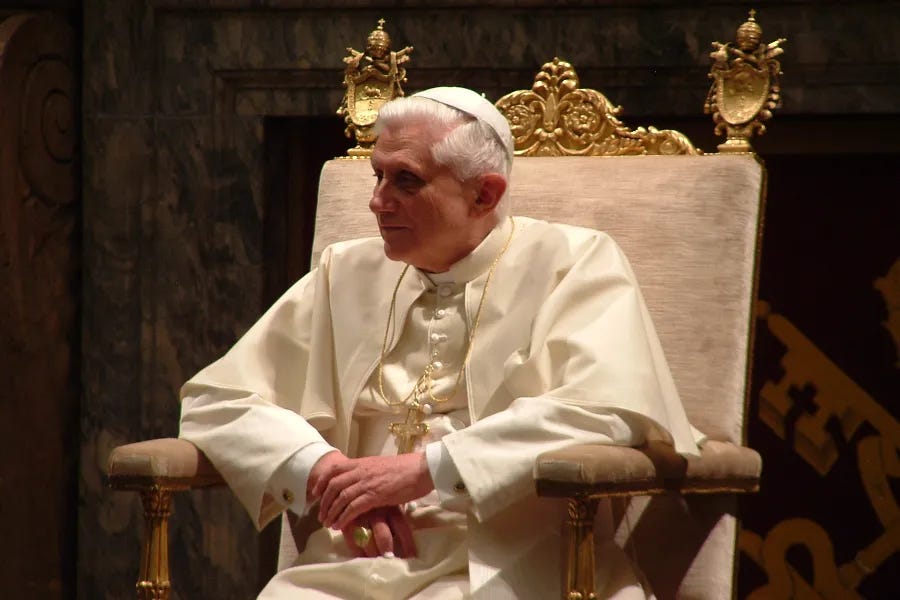
Ratzinger served as a theology professor in Germany, a peritus at the Second Vatican Council, archbishop of Munich and Freising, prefect of the Congregation for the Doctrine of the Faith, and ultimately pope. He leaves behind a body of scholarship that continues to shape theological debate today.
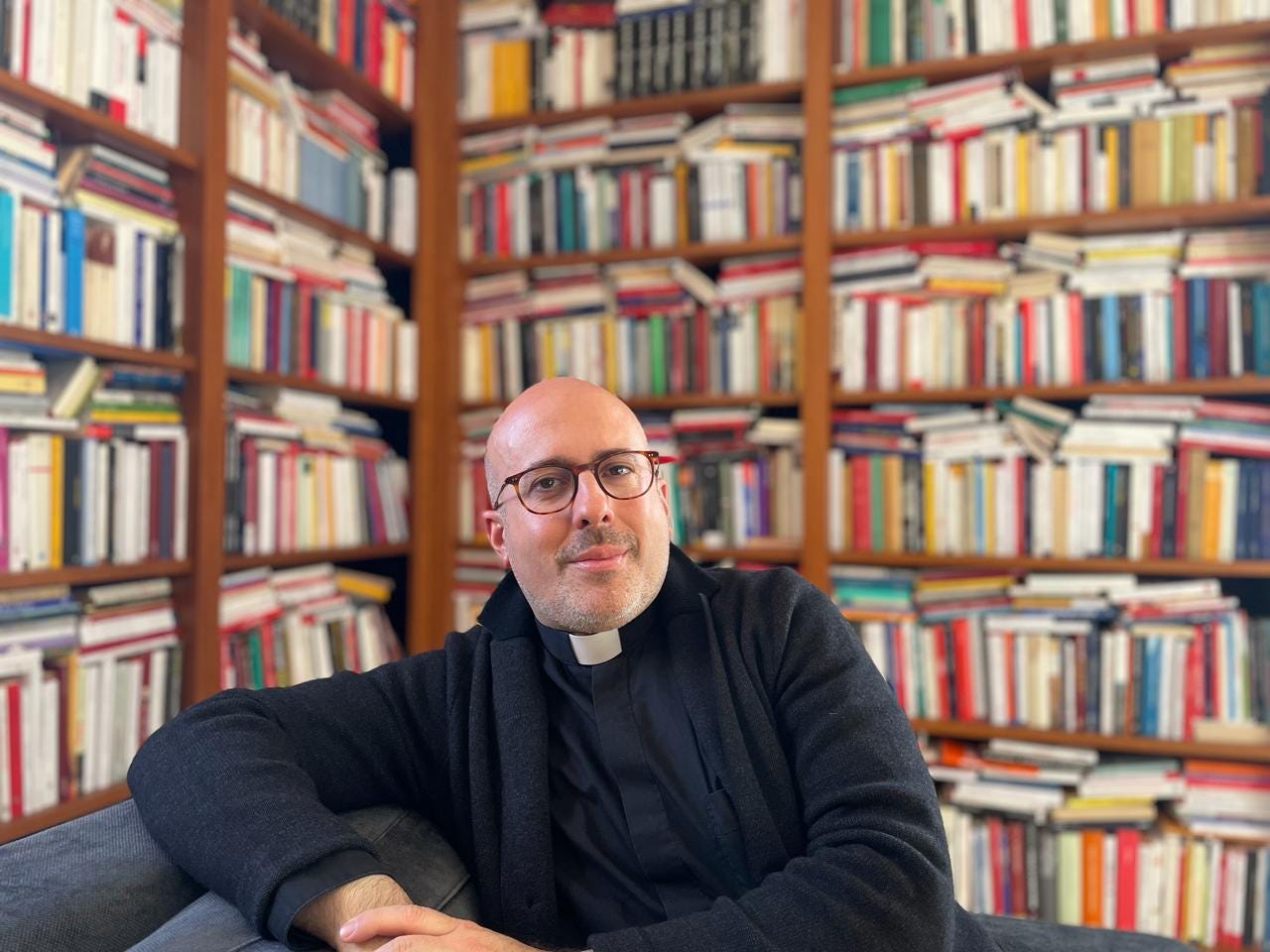
To discuss the enduring impact of his intellectual legacy, The Pillar spoke with Fr. Roberto Regoli, who in January was appointed as president of the Ratzinger Foundation.
Regoli earned his doctorate in Church history from the Pontifical Gregorian University in 2001 and has taught contemporary Church history there since 2005. He served as director of the university’s Department of Church History from 2015 to 2024 and is editor of the journal Archivum Historiae Pontificiae.
He is also the author of Beyond the Crises in the Church: The Pontificate of Benedict XVI (St. Augustine’s Press, 2024), among other works on modern and contemporary Church history.
Regoli is currently a Global Catholic Research Initiative visiting fellow at the de Nicola Center for Ethics and Culture at Notre Dame University, researching Vatican diplomacy from the French Revolution to the present.
The interview was conducted in Italian and has been edited for length and clarity.
Now that it has been nearly 100 years since Ratzinger’s birth, what do you believe is his main intellectual legacy?
It’s a very broad question, but we can narrow it down in the sense that his legacy concerns the faith, which may seem like a very trivial answer for a pope or for any Christian. But what’s so special about him? That he – as a young theologian, archbishop of Munich, cardinal prefect of the Holy Office, and pope – focused all his theological research and governing activity on presenting the figure of Christ in an immediate way to all the faithful.
Even as pope, when he wrote the three volumes on Jesus of Nazareth, this already makes us understand that his priority was to proclaim Christ and make him accessible. A Christ presented without compromise, that is, presented in a total and integral way, with his demands and with the beauty of following him. He was never a pastor or a theologian who presented a softened Jesus, a cloying Jesus.
But also not a hardened Jesus, a Jesus who stands there wanting to condemn. Ratzinger presents a complete Jesus, with his demands and with the beauty of the encounter between faith and truth. Ratzinger’s legacy, for the Church of today and for the Church of the future, is the complete proclamation of Christ.
What strikes me is that Ratzinger is still responsible for many converts who ask for baptism or who are already part of a Christian community and ask to enter the Catholic Church. They have often read Ratzinger’s works, and this makes me think that his pontificate and his intellectual work was fruitful in bringing people to the faith.
Some would describe Ratzinger’s theology as a lived experience of faith – in other words, a theology characterized by intense personal piety. How did Ratzinger’s intensely lived faith influence his theology?
Ratzinger finds a unity of life between what he teaches and what he lives, and this unity of life, at the center of which is Christ, can be well summarized with a moment when he was already pope emeritus: he was celebrating 65 years of priesthood, so it was exactly 10 years ago, and he appeared in the Apostolic Palace in front of Pope Francis and the cardinals, and he spoke at that moment about the experience of faith of the Eucharistic encounter with Christ as a transubstantiation of all reality.
Often, when we speak of this theological concept of transubstantiation, we speak of the Eucharistic bread that becomes something else, that becomes the body of Christ, but in Ratzinger’s view, transubstantiation also concerns the lives of all believers and, moreover, of the whole world.
In other words, his theological and experiential gaze led him to have this breadth of horizon, so much that a term that is often found in Ratzinger’s most popular texts is that of the “experience of Christ.” It is an experience that leads to a conversion of life and therefore to a transubstantiation of my personal reality and of the world around me.
In other words, the social, political, academic, economic commitment, every commitment of Christians, is not exempt from the experience of Christ, but is a total experience of Christ, transformed by that encounter. This is very evident in Ratzinger’s speeches and texts. There is a unity of life, it is not a proposal for a Christianity that lives in compartments that can be separated, but there is complete unity.
In the past, sometimes it seemed that orthodoxy in theology was sometimes limited to safeguarding certain doctrinal concepts, but Ratzinger seems to warn us against this. What was his vision?
Ratzinger was an atypical figure of twentieth-century Catholicism because he was the guarantor of the entire theological and magisterial tradition, but also had a personal creative ability due to his intelligence and his faith, which allowed him to propose innovative solutions.
At the time, he was often misunderstood by some traditionalist circles because he was not considered a Thomist or a neo-Thomist, but rather someone with a different type of theology and in “progressive” circles, they considered him a policeman of the faith, or God’s Rottweiler, as they called him. Also some people called him ‘the German shepherd,’ which was an insult based on the ambiguity of the term.
So he remained very misunderstood because he attempted to synthesize the old and the new, in that very Catholic way of doing theology in the contemporary era that speaks of the development of doctrine. There is no static deposit of faith, but a real deposit of faith with a clear content that is made ever clearer over the centuries.
Both as prefect of the Congregation of the Doctrine of the Faith and as pope, when he speaks to us of reform in the continuity of the Church, it is precisely to hold together what has come before us and the challenges of the present time.
What is the temptation present in Catholicism today? That we hold Catholicism as a museum, with precious and beautiful pieces from the past, but fixed in display cases only to be admired, while others want to meet the needs of the times, but want to throw away all the preciousness of the past.
Ratzinger saw that the real challenge was how to hold these dimensions together so that the Catholic tradition, that is, the content of the faith, which is nothing other than the encounter with the living Christ, could continue in subsequent generations, because the responsibility of pastors is to make Christ accessible, that is, to ensure that the community of believers is a place of experience of Christ and a place where this Christ can reach new generations.
He was very committed to this idea at a time when the Church in the 1960s, 1970s, and even 1980s was experiencing many tensions and conflicts between pastors and bishops with their priests, or lay people with their parish priests. We had moments of great tension and misunderstanding, so playing the role of the one who brought balance to the Catholic system led him to receive a lot of criticism.
But that is the price he paid for trying to keep Catholic unity together without making concessions, but saying everything that was to be believed about Christ and the faith.
In the last consistory, many cardinals spoke about evangelization as a “return to basics,” a concept emphasized repeatedly by Ratzinger in his works. How can Ratzinger’s vision help us shape the Church’s evangelical mission?
The return to our roots can be understood in two essential ways. The first is a more intellectual endeavor, that is, we must return to studying. Studying the basic texts, studying the sources. That is, all the reforms we had in the 20th century, including those of the Second Vatican Council, were possible because in past decades, even in the previous century, there had been a great deal of attention paid to the sources: the Bible, the liturgy, and the Church Fathers.
When one was able to go back to those roots, one also has the opportunity to create proposals in continuity with those sources but adapted to the new times. But what happened after Vatican II? There were people, perhaps not intellectually prepared, who, in wanting to adapt to the new times, greatly trivialized the Gospel message.
Creativity based on a solid knowledge of the roots is a creativity that allows us to continue to enrich the deposit of faith. When creativity is not rooted, it becomes a trivialization of the Christian proposal, which then becomes completely unattractive.
On an intellectual level, it is a matter of returning to the sources, returning to serious study. The other passage found in many of Ratzinger’s speeches is one that presents the community of believers as an attractive community because among themselves believers are able to follow the law of charity according to the requirement of holiness.
That is, Ratzinger often speaks of the community of believers as an experience of friendship in Christ, which then touches all areas of life. When he himself spoke of the Church as a “creative minority,” he was not referring to a truly intellectual or organizational minority. From a sociological point of view, a creative minority is an organized minority that sets goals for itself and knows how to achieve them by involving others.
But Ratzinger’s creative minority is a minority that speaks of a community of believers founded on friendship in Christ. So, if on the one hand there is a need to return to the roots, this experience of returning to the sources—and I use the term experience, as we said before, because it is a word that is dear to Ratzinger—is not simply something intellectual, but becomes a fundamental, real experience in a community of believers.
This shows us how to unite theology, doctrine, and pastoral care. We often run the risk of wanting to separate theology from pastoral care, as if theology complicated things for pastoral care or pastoral care were a trivialization of theology. In Ratzinger’s proposal, which is also the way the Church has lived for centuries, the two aspects necessarily go together.
Only if there is theology, that is, a well-rooted thought, can one make a meaningful pastoral proposal. And we see this around the world, where local Churches have this strong link with the magisterial theological and spiritual tradition of the Christian centuries, we also have more conversions. The figures are striking.
If we look at France, the Scandinavian countries, and the United States itself, where we have lively, vibrant communities, where people pray, where there is a theological proposal, we have conversions. In other words, the richness of Ratzinger’s proposal has been translated into many places around the world, because it is the only way the Church can be alive today.
You mentioned this temptation to divorce theology from pastoral care, which can often occur in the realm of moral theology.
During his life, Ratzinger defended the knowability of moral truth during a time of turbulence for the world and the Church. How can his theology help the Church to face contemporary challenges in this area?
Ratzinger was not a moral theologian, but his theological and magisterial approach also helps moral theology. And at the magisterial level, his pontificate was also very much in line with that of his predecessors Saint John Paul II – of whom Ratzinger was the theological soul of that pontificate – and Saint Paul VI.
We have seen that all these pontiffs made a proposal of great theological and magisterial transparency, even though Western society in the 1960s and 1970s was very much against this point of view. Think of the sexual revolution, condoms, the use of the pill, a new conception of the human body, of relationships.
The Christian proposal is absolutely countercultural in this framework. But why does the Church continue to propose these things in moral theology? Because it considers it something that touches the very heart and the life of the Church.
It would be much more convenient to say, “Do what you want,” but instead, the Church’s proposal is one that wants to speak of charity and chastity as a consequence of the capacity to love.
It is a proposal that cannot be resolved with a tweet or an Instagram reel, but requires intellectual, spiritual, emotional, and human formation. The Christian discourse in its truth is a demanding discourse because it speaks in an integral way, that is, to all human dimensions. No dimension is excluded.
And for this reason, the demands of Christian life in a fast-paced world, where today’s young people only have a few seconds of attention spam to watch videos, is a challenging proposition. But we are seeing that precisely in societies that have appeared more secularized, the need for spirituality is bringing many young people back to Christianity, back to Catholicism, with many baptisms and many conversions from other denominations to Catholicism, because Catholicism offers a comprehensive proposal, including all dimensions of existence, including morality.
In his lecture on the pre-political foundations of the liberal state, Ratzinger questions whether the liberal democratic state can produce on its own the moral foundations it needs to survive.
How can his insights influence the social doctrine of the Church and Catholic political-social thought?
Even when talking about political engagement, the vision of the state, and the social doctrine of the Church, we must consider the different historical and political contexts in which we find ourselves.
In Europe, there was the experience of Christian-inspired parties. In the United States, there was no such experience because there was a much clearer model of separation, but with a deeply Christian society. Many Founding Fathers said that in order to understand and put the Constitution into action, it was necessary to have the Christian society that had produced that Constitution.
The concept of the state is the result of philosophical thinking, legal thinking, but also necessarily religious thinking. In the old European continent, religion has been increasingly sidelined, but religion also produced the conceptual categories of the modern state. We cannot separate the fact that there is a religious contribution.
The secular nature of the state indicates a method, not a content. So much so that Ratzinger himself raised the question of laws concerning fundamental issues of human morality, where fundamental issues related to the truth of man cannot be left to the discretion of a majority vote, a parliament, or anything else.
What do you see in the future for the Ratzinger Foundation, especially with the centenary just around the corner?
It’s an opportunity not to be missed. This centenary also facilitates the work of the foundation because it requires us to focus on something specific. This April 16th marks the 99th anniversary of Ratzinger’s birth, which means we are entering his hundredth year.
We have various initiatives in the pipeline, some of a more intellectual and academic nature and others more popular, so we will have events organized on all continents, conferences, lectures, courses, publications, exhibitions, and even concerts.
In other words, we want to present Ratzinger not simply as a memory of the past but to show that there is a legacy that concerns the present and the future. So, it is not simply a matter of recounting Ratzinger’s thought. Rather, the work of the foundation is how Ratzinger’s thought can be a stimulus for today’s theological, philosophical, and cultural debates.
We are not interested in a museum or an archaeological park, but in the current cultural debate, and Ratzinger is a living point of reference for many intellectuals and continues to be a point of reference for many young people who, in their theological and philosophical studies, are interested in finding the Christian truth.
https://www.hprweb.com/2017/01/the-new-pagans-and-the-church/