
The Church’s future depends on “inner renewal” rather than changes to its structures and rules, Denmark’s Catholic bishop said in an interview marking his 75th birthday.
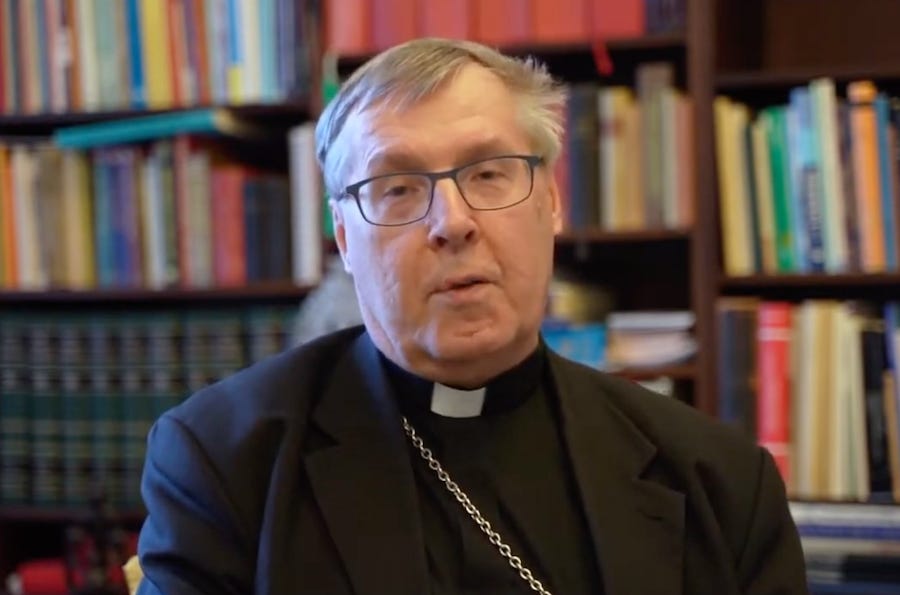
Bishop Czeslaw Kozon told Katolsk Indblik, the Diocese of Copenhagen’s magazine, that he believed neither external changes nor the preservation of traditions alone would guarantee the faith’s survival.
He said: “There may be people with lots of radical, new ideas because they see the Church losing ground and want to make it more relevant. That is fine in itself, but we should not introduce changes at any cost simply to adapt to the world.”
“That must never happen without an accompanying inner renewal. There is no point in changing structures, laws, and regulations if the substance of the faith is not preserved intact.”
He added: “People who are very attached to tradition and the traditional forms of the Church can sometimes tend to come across as elitist and perhaps even judgmental.”
“But we must remember that everyone comes to faith at their own pace and has different needs, and external forms are no guarantee in themselves.”
“They must be accompanied by an inner life, expressed through an authentic life of prayer, practical love of one’s neighbor, and respect for the sacred.”
Kozon made the remarks in an interview published on the Copenhagen diocese’s website Nov. 17, the day he turned 75, the age at which canon law requires diocesan bishops to offer their resignations to the pope.
Kozon was born in 1951 to a family with Polish roots in Falster, an island in southeastern Denmark. He has led the Copenhagen diocese, which covers Denmark, the Faroe Islands, and Greenland, since 1995, making him one of Europe’s longest-serving diocesan bishops.
Kozon noted that during his 31-year tenure, the number of priests in the diocese had declined, with several deciding to leave the priesthood.
According to the website catholic-hierarchy.org, the total number of priests fell from 99 in 1996 to 77 in 2023, while the number of Catholics rose in the same period from 34,800 to 54,000.
The diocese reportedly remains dependent on foreign priests, though it has 13 men in priestly formation. All 13 are training at the Redemptoris Mater seminary in Vedbæk and most come from other countries.
Kozon described the departure of priests from the priesthood as “probably the least pleasant aspect of being a bishop.”
“At first glance, it means losing an important resource in the Church’s pastoral work. But priesthood is a vocation and a ministry, not simply a job that someone can leave for another career — for example, a police officer deciding instead to become a gardener,” he said.
“When priests leave the priesthood, it may be perceived as a failure, because they entered their ministry with enthusiasm and the conviction that they would be priests for the rest of their lives.”
“But then something may arise that they had not anticipated. It is a little like a divorce, where two people have committed themselves to each other for life, but then face challenges and something develops that they are unable to overcome.”
Kozon said a decline in the number of religious sisters had also affected the diocese. According to catholic-hierarchy.org, there were 249 female religious in 1996 and only 78 in 2023. Several orders have scaled down their activities in Denmark or withdrawn completely.
“In many places, the sisters have played a very important role in the life of the Church, caring for the sick, teaching, preparing the church for services, and serving in many other ways,” he said.
“This has been, and continues to be, a great practical help, but it is also a witness that there is a way of serving God that is more radical than ordinary Christian life. That is an important aspect of the Church’s apostolate.”
“Therefore, the sisters should not be seen merely as a workforce that has become smaller, but also as a witness to a particular way of following Christ. They cannot simply be replaced by other people taking over certain practical tasks.”
“Conversely, the decline in the number of sisters and priests is also an invitation for the laity to become involved in new ways and to a greater extent than before.”
The Copenhagen diocese has also faced financial pressures. Its central administration recorded a deficit of 2.25 million kroner (about $330,000) in 2025, compared with a surplus of 8.6 million kroner (about $1.26 million) in 2024.
Kozon has said that if all eligible Catholics in Denmark paid the recommended church tax of 1% of their income, the diocese’s financial outlook would be different. The diocese remains dependent on support from Germany, although that is reportedly decreasing.
But the bishop said he detected renewed interest in Christian spirituality in Denmark, especially among young people.
“We see both young people who were born into Catholic families but were not brought up with faith as something central to their lives, and who are now seeking out the Church. And we see young people who are essentially starting from scratch when it comes to spirituality, discovering the Church and converting,” he commented.
He added: “God is still at work, and I am convinced that God still stands by the Church and his promises to it. But clearly, there must also be a willingness on our part to convert.”
Kozon was scheduled to celebrate his 75th birthday with a Mass at St. Ansgar’s Cathedral in Copenhagen.
He told Katolsk Indblik: “There have been many signs throughout the Church’s history that Christ continues to stand by his Church, and we still see them today — for example, in the new waves of conversions and adult baptismal candidates in countries such as France, the United States and England. We are seeing small ripples of this development here at home, too.”
“We should turn our attention to these signs of hope and not focus only on the things that are disappearing and being lost.”