Could Scottish dioceses be merged?
Scotland’s bishops have been asked to reflect on 'whether the present situation of eight dioceses is suitable.'
Scotland’s bishops announced this week that the Vatican has asked them to reflect on “whether the present situation of eight dioceses is suitable.”
The bishops said March 22 that they would be discerning between “two possible pathways.”
The first would require “deeper cooperation and the sharing of resources across dioceses within our present structures.” The second would involve “the merging of some dioceses.”
The announcement follows the news that three English dioceses could be unified under a single bishop, in what would amount to the biggest change to diocesan structures since 1980.
What’s the history of Scotland’s dioceses? How are they currently faring, in numerical terms? And what process will the Scottish bishops follow in response to the Vatican’s request for discernment?

What’s the history?
Catholicism has been present in Scotland since at least the 4th century. It suffered great upheaval during the Reformation. But in 1878, Leo XIII restored the Catholic hierarchy in Scotland, in his first major papal act.
Pope Leo established six dioceses, reviving titles from pre-Reformation sees: St. Andrews and Edinburgh, Aberdeen, Argyll and the Isles, Dunkeld, Galloway, and Glasgow. Two more dioceses were formed in 1947, Motherwell and Paisley, from Glasgow’s territory.
Scotland has two ecclesiastical provinces: St. Andrews and Edinburgh and Glasgow. St. Andrews and Edinburgh has four suffragan sees (Aberdeen, Argyll and the Isles, Dunkeld, and Galloway), while Glasgow has two (Motherwell and Paisley).
Scotland’s eight dioceses together serve around 674,800 Catholics, out of a total population of 5.5 million. Average Mass attendance is 97,796, or 14.5%, of baptized Catholics. This places Scotland at the lower end of the spectrum of Mass attendance among Catholic populations worldwide.
The Scottish bishops’ conference is led by Bishop John Keenan, the dynamic Bishop of Paisley, who was elected conference president in 2024.
How are the dioceses faring?
Scotland’s eight dioceses are strikingly varied, ranging from densely urban to remote and rural.
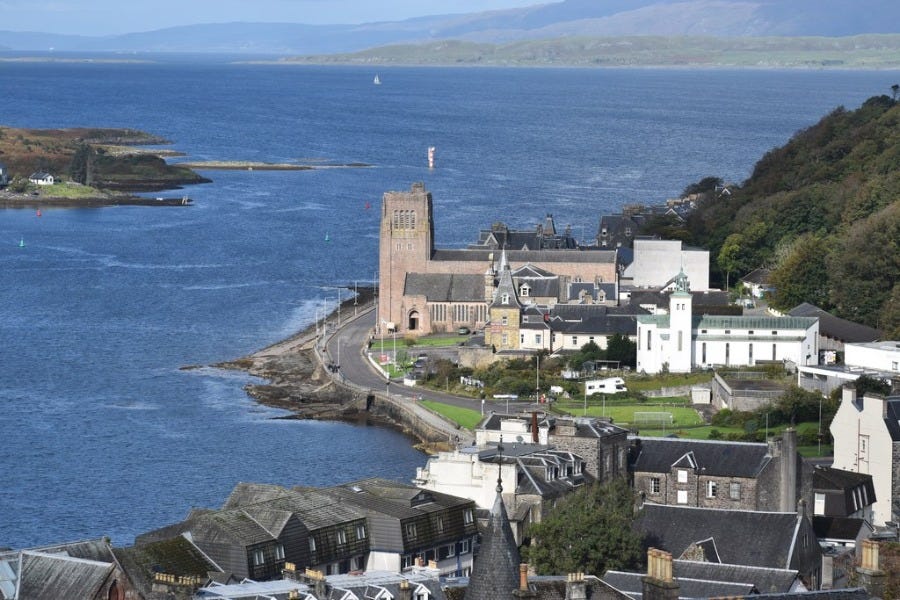
The Glasgow archdiocese is small geographically, but it is by some way the largest in terms of Catholic population. The Argyll and the Isles diocese covers a swathe of Scotland’s jagged western coastline, but serves a small number of Catholics.
But both Glasgow and Argyll and the Isles date back almost 150 years and have strong identities.
Since 1950, the Catholic population in many parts of Europe has steadily eroded. Interestingly, that’s not the case in several Scottish dioceses.
The number of Catholics fell between 1950 and 2023 in Argyll and the Isles and Glasgow. But it rose between those two dates in Aberdeen, Dunkeld, Galloway, Motherwell, Paisley, and St. Andrews and Edinburgh.
Aberdeen diocese, for example, saw a notable rise in its Catholic population in the 2010s, which can be attributed largely to an influx of migrants from Central and Eastern Europe.
Scottish dioceses have recorded an increase in adults seeking to become Catholics, a trend seen elsewhere in Europe. The country is also home to pioneering online evangelizers, such as Bishop Keenan, Brian Timmons and John Mallon of Sancta Familia Media, and Fr. James Anyaegbu.
Yet overall, the Catholic community in Scotland has shrunk in recent years. According to the national census, there were 841,053 self-identified Catholics in 2011, but only 723,322 in 2022 — a drop of 117,731, or 14%, in just over a decade.
While there are many signs of hope and vitality, declining birth rates and secularization have had a powerful erosive effect, while diocesan structures have remained essentially unaltered since 1947.
In their March 22 statement, the bishops underlined the challenges facing the local Church, including “fewer clergy, changing patterns of practice, and increasing pressures on our diocesan resources.”
What’s the process?
The reflection process will begin in the dioceses. Each bishop will invite their flocks to “pray, reflect, and contribute” to the discussion about the future organization of the Church in Scotland.
According to the bishops, a discussion paper will be shared and responses collected from each diocese. These will be included in the “initial findings” that will be presented to the Vatican in the fall.
The bishops may also seek to learn from the experiences of other Christian communities. The Presbyterian Church of Scotland, for example, is seeking to cut the number of its presbyteries (regional governing bodies) from 43 to around 12, prompting grassroots discontent.
The bishops stressed that the process would not be a cold, detached “administrative exercise.”
“It is a pastoral and missionary response to our changing landscape,” they wrote. “This process will ensure our Church in Scotland will continue to grow ever more missionary, more Christ-centred, and more collaborative in the service of God’s people.”
In the numerically small Diocese of Argyll and the Isles, Bishop Brian McGee discussed the issues with clergy after the March 25 Chrism Mass. The diocese emphasized that both priests and laity “will be properly consulted before any proposals are made.”

Think it could be noted that Leo XIII actually reestablished the historic dioceses of Scotland, which had been abolished when the country converted to Presbyterianism.