
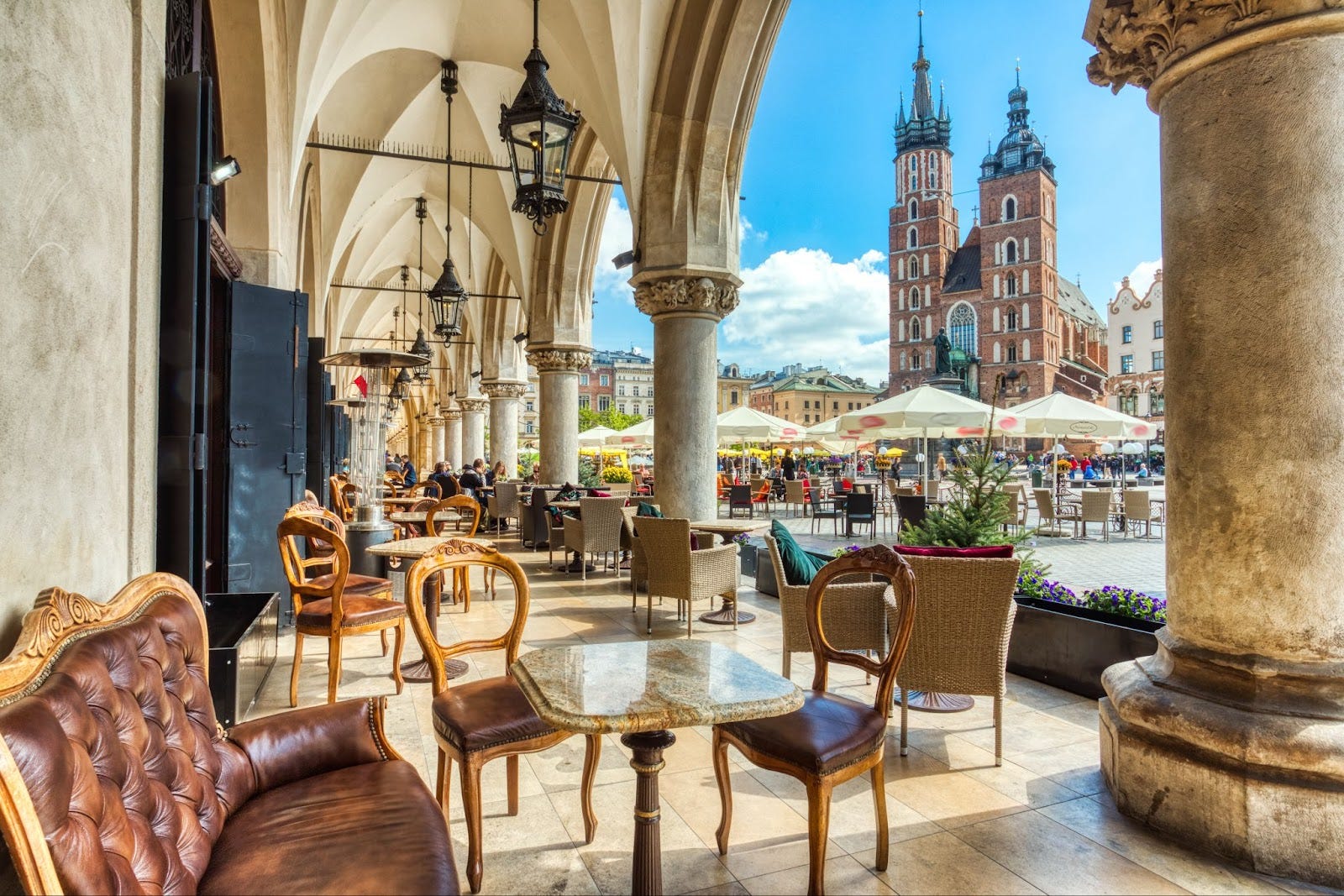
Every July, I spend a few weeks here in Poland as part of a seminar on Catholic social teaching.
There is a little place in Krakow where I like to sit in the afternoons to read or write or talk with friends. It’s not really a cafe, though the coffee is good. Nor is it really a bar, though the beer is very good. The place is a bit eclectic. One might even call it bohemian. It has a whiff of counter-culture about it. I don’t get the sense that many of the people there share my views on, say, politics. Or even, truth be told, religion.
But it is a good place, and I look forward to spending a few quiet afternoons there every year. And every year, the place is slightly different – a new bartender or a change of art on the walls. Invariably, the price of a beer is higher than it was last year.
There is one spot of which I am so fond – an alcove with a few leather chairs and a table – that I occupy with enough frequency that my Polish friends occasionally refer to it as my “office.” It’s a good place.
I’m told the owner of this little place spent some time in the Dominican Order, many years ago. I don’t know the whole story, but suffice it to say religious life was not for him, and he has since married. Nevertheless, from time to time, one will run into a Dominican brother or priest at the bar. The priory is right next door and the Order owns the building.
Krakow is one of those rare places (Rome is another) where it is completely ordinary to see priests and religious, as it were, in the wild. In Krakow’s Old Town, one encounters a dizzying array of religious habits and dress, and this despite the fact that most priests and religious in Poland will not go out to a bar or restaurant in their habit or collar. There are about a dozen churches and at least three basilicas within a five minute walk from my “office.”
Poland’s is a thoroughly Catholic culture.
Some American Catholics think of Poland, with its deeply Catholic culture, as a sort of Catholic Shangri-La. Part of this has to do with the long pontificate of Saint John Paul II, during which the fervor and charisma of the Polish pope – and the obvious enthusiasm of the Polish people for their beloved Jan Pawel II – presented to the world a particularly compelling face of Polish Catholicism. A large part of this has to do with the extraordinary witness of Polish Catholics during the successive totalitarian nightmares of the 20th Century.
But while the Polish people really are extraordinarily Catholic (particularly in comparison to the rest of Europe) and have retained their Catholic faith in a culturally meaningful way, despite the pressures of secularism, Poland is far from a Catholic Utopia.
Poland is full of people – wonderful, ordinary people – with all the proclivities and weaknesses people everywhere have. The cafe where I keep my little “office” with the leather chairs and excellent beer is, on any given day, filled with such people: People, often young people, who know plenty about Catholicism (this is Poland, afterall) but whose view of the world and themselves is largely, even predominantly, shaped by contemporary, secular culture.
These people retain a cultural attachment to Catholicism, but are not necessarily practicing.
Cultural Catholicism serves as a kind of cultural fly-wheel, providing religious “momentum,” accumulated over centuries, and helping to carry the Church through difficult times. But over time, even in Poland, that momentum can wane. Eventually, that momentum needs replenishment or the momentum is lost and the flywheel of cultural Catholicism stops turning.
When that happens, the old culture becomes a dead weight – a massive, stopped flywheel – and it requires heroic effort to get it moving again against all that inertia. What was once an advantage to the sustained vitality of the faith becomes an obstacle. We have seen this happen in other Catholic cultures around the globe. Europe is full of such examples.
We face the same dynamic, albeit with important differences, in the United States.