
Participants in the Vatican’s meeting on Amoris laetitia described a gathering focused on the need to accompany families in a wide variety of vulnerable situations, rather than on the controversial situations included in the apostolic exhortation.
“Mercy and truth are not in conflict, but rather through the gaze of Jesus, they can be the source of this accompaniment,” said Fr. Giacomo Costa, S.J., consultor of the General Secretariat of the Synod, who was responsible for the meeting’s methodology.
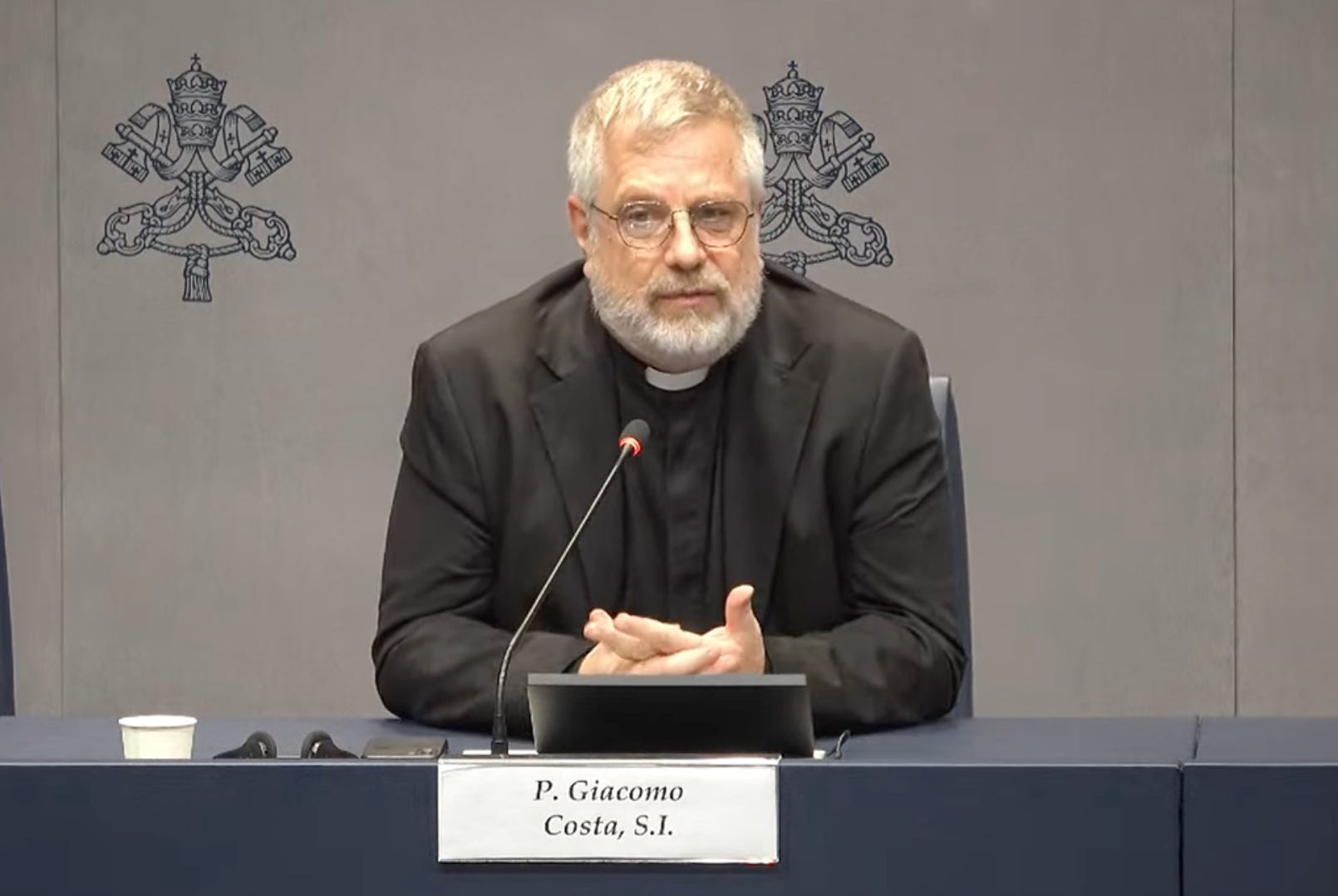
Costa spoke October 14 at a press conference concluding the week-long gathering of episcopal conferences from around the world, convened by Pope Leo XIV to reflect on the 2016 apostolic exhortation Amoris laetitia.
While questions had arisen about whether the meeting would address the controversies in the apostolic exhortation – largely related to the reception of the sacraments by divorced and remarried Catholics – participants suggested that the focus was on recognizing the many different ways in which families are in need of accompaniment.
Released by Pope Francis, Amoris laetitia was a lengthy and wide-ranging document on family life, covering topics including marriage preparation, child rearing, and the spirituality of marriage.
But the apostolic exhortation generated the most attention – and controversy – over a footnote that touched on the reception of sacraments by divorced and remarried Catholics.
The apostolic exhortation says in paragraph 305 that “a pastor cannot feel that it is enough simply to apply moral laws to those living in ‘irregular’ situations, as if they were stones to throw at people’s lives.”
The paragraph adds that “because of forms of conditioning and mitigating factors, it is possible that in an objective situation of sin – which may not be subjectively culpable, or fully such – a person can be living in God’s grace, can love and can also grow in the life of grace and charity, while receiving the Church’s help to this end.”
A footnote to the paragraph says that such help “can include the help of the sacraments” and adds that the Eucharist “is not a prize for the perfect, but a powerful medicine and nourishment for the weak.”
Later, the bishops of the Buenos Aires region in Argentina published an instruction for their priests in which they called for mutual discernment of a couple in an irregular union on whether they can receive communion and go to confession if “it is acknowledged, in a concrete case, that there are limitations that diminish responsibility and culpability.”
“Amoris laetitia opens the door to access to the sacraments of reconciliation and the Eucharist,” the bishops of Buenos Aires said.
Pope Francis later said that there was no alternative interpretation of the document, and the Dicastery for the Doctrine of the Faith said in 2023 that the pope had included the Buenos Aires bishops’ instruction in the Acta Apostolicae Sedis and it therefore was considered “authentic magisterium.”
Critics of the Buenos Aires text, and of the formulation of the footnote, argued that it appeared to run directly contrary to the Church’s sacramental discipline and teaching on marriage.
Pope Leo XIV called for this week’s global meeting at the Vatican to reflect on Amoris laetitia 10 years after it was released.
While the pope intended to play a larger role in the gathering, he ended up entering the hospital on October 12, where he has remained ever since. He underwent lung surgery and was diagnosed with lung cancer.
As a result of the pope’s hospitalization, the “synthesis report” of the Amoris laetitia was not released publicly as originally planned. The document will be presented to the pope and may be publicized at a later date.
However, the pope did have a chance to offer opening remarks to those gathered for the Amoris laetitia meeting before he entered the hospital. He did not directly address the controversies in the apostolic exhortation, but instead emphasized that the Church must find ways to accompany families in situations of fragility.
This call was echoed numerous times in the closing press conference.
Costa described “accompaniment” as the key theme of the gathering. He said the meeting was characterized by a desire to listen and understand the experiences and obstacles facing families today.
“What emerged was really the importance of receiving concrete and spiritual support to accompany these people,” he said.
Costa did not discuss the situation of divorced and remarried people. Rather, he mentioned the challenges posed by poverty, war, abandonment, migration, violence and abuse.
Msgr. Philippe Bordeyne, president of the John Paul II Pontifical Theological Institute for Marriage and Family Sciences, said that while there may be a tendency to focus on complex or complicated situations, “fragility” applies in many other circumstances as well.
Bordeyne, who coordinated the various “experts” participating at the meeting, noted that Amoris laetitia, in Italian, uses the word “fragility” 18 times. In the English translation, however, the word is used only three times, with the term “weakness” frequently being used instead.
Throughout the week, Bordeyne said, the group came to emphasize “fragility” as applying not only to people “in situations that are difficult to integrate,” but more broadly, as a common human experience.
He pointed to obstacles posed by cohabitation, domestic violence, war, and the challenges faced by couples in their early years of marriage.
Bordeyne also noted changes that had been made to some of the titles in the group’s working document.
He pointed in particular to a section on “Accompaniment in the difficulties of life,” which was changed to “Accompaniment and discernment in the difficulties of life.”
He said that there was some resistance to the notion during the meeting, and he was surprised to see that the term “discernment” was ultimately accepted for adoption into the text.
Costa said there were no clashing viewpoints during the gathering, but that participants offered “different accents.” He said the need to form consciences emerged as a topic of discussion.
He also highlighted the theme of how families are called to participate in the mission of the Church, offering a witness to the Gospel. Costa said participants discussed the idea of greater involvement of families in the formation of priests, deacons, and pastoral workers.
Fr. Stanislaus Chu Ilo, a Nigerian priest and Senior Research Professor of Theology and World Catholicism at DePaul University in Chicago, said that in his view, the meeting itself shows “a Church where listening becomes the message.”
Noting the importance of stories in African culture, he said he was reminded of the experience of sitting in an African village square, listening to other people share their stories.
“When we listen to each other’s stories, when we allow each other’s stories to become our stories,” he said, “we see a sudden convergence of multiple stories through which we can see clearly the footprints of God.”
"He said the need to form consciences emerged as a topic of discussion."
Cardinal Cupich obviously got his point across. The odds are good that he forgot to mention the need to form consciences according to the doctrine of the Church.