
The Vatican announced on Saturday the reassignment of Cardinal Mauro Gambetti, OFM Conv., who served a little more than five years as archpriest of St. Peter’s Basilica, and papal vicar general for Vatican City. Pope Leo appointed Gambetti to lead the Archdiocese of Chieti-Vasto.
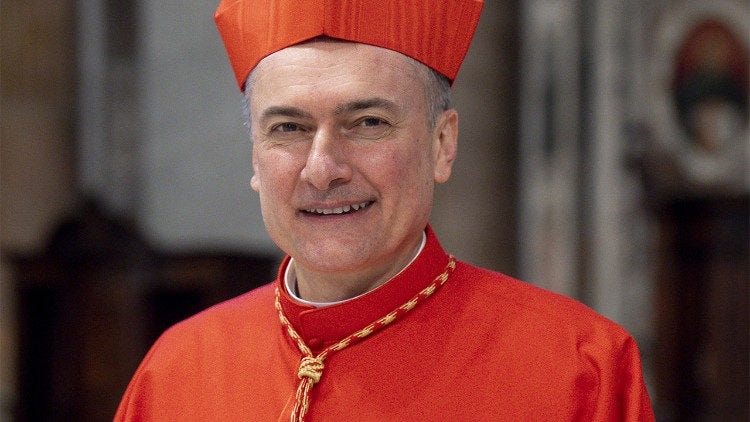
Gambetti, who was made a cardinal by Pope Francis in 2020 at the age of just 56, departs St. Peter’s after a term marked by controversy — some of his own making and some not clearly so.
The Franciscan cardinal arrives in Chieti-Vasto with no experience of diocesan or parish ministry, and succeeds Archbishop Brune Forte, 77.
Still just 60 years old, Gambetti’s departure from the Vatican scene is widely being interpreted as a statement-making personnel move from Pope Leo. While that might strike some as a little over-blown, given the relatively junior position in the Vatican hierarchy of Gambetti’s former role, the signs suggest that it does mean something — though the question is what.
—
Perhaps the most important, or at least significant, aspect of Gambetti’s reassignment is the context.
As archpriest of St. Peter’s and president of the Fabbrica, the body charged with the basilica’s practical maintenance, Gambetti oversaw some notably controversial moments and policies.
The main altar had to be rededicated in a liturgy of atonement after one of several serious security lapses led to its desecration in October last year. But even with apparent holes in the basilica’s security, Gambetti faced sustained criticism for his organization of the Vatican basilica for the Jubilee Year celebrations — with visitors, pilgrims, art historians and tour guides all discontented by crowd control barriers running the length of the church and blocking both sight lines and access to major works like Michaelangelo’s Pieta.
And throughout Gambetti’s tenure, the cardinal was dogged by accusations of administrative and financial mismanagement, and overbearing behavior towards both staff and the basilica’s chapter of canons.
But those issues paled in comparison to the criticism which stemmed from the 2021 ban on private Masses celebrated at the basilica’s side altars, with the basilica requiring instead that visiting priests concelebrate at the daily Masses offered at the Altar of the Chair of St. Peter.
That policy withdrew a centuries-long permission for visiting priests to say a Mass at the Church’s most famous basilica, and for visiting groups of pilgrims to have their own group liturgical celebration at its altars.
It also served to curtail expressions of popular devotion to saints buried under side altars in the basilica, most notably at the tomb of St. John Paul II.
All that should convey that Gambetti’s tenure at St. Peter’s was not a popular one.
In fact, his ouster from St. Peter’s was effectively telegraphed a year ago, when Leo declined to reappoint Gambetti to the Pontifical Commission for the Vatican City State.
Gambetti’s transfer to lead the Archdiocese of Chieti-Vasto is most remarkable, then, for its timing.
To a degree, Gambetti’s move to Chieti-Vasto can be seen as a natural move in this sense: Leo has been clear in his public addresses, most notably to the Italian bishops’ conference, that wants a much closer adherence to the Church’s established term limits and retirement ages, and the cardinal’s five-year term as archpriest lapsed earlier this year, while Forte turned 77 earlier this year — the age Leo previously indicated as the absolute limit for diocesan bishops absent some extraordinary circumstances.
However, it is notable that the pope has several other, somewhat larger, curial positions pending in this regard.
Cardinal Kevin Farrell is 77, and finished his second five-year term as prefect of the Dicastery for Laity, Family and Life in August. The cardinal also serves as Camerlengo, chair of the committee on reserved financial affairs, president of the Vatican’s investment advisory board, and sole czar of the Vatican pension fund.
Cardinal Marcello Semeraro, prefect of the Dicastery for the Causes of Saints, is 78 and more than a year past the end of his original five-year term while obviously too old to serve a full second term.
Beyond them there are a host of senior Vatican cardinals serving past the age of 75 and beyond their most recent five-year appointments, yet Leo has opted instead to remove — though not yet replace — one of the youngest cardinals in the college.
The background to this move is the widespread expectation in the Vatican that the pope intended to end the summer season with a slew of appointments, kicking off the autumn with a major reshuffle that would show Leo remaking the curia in his own image. That reshuffle never happened, obviously, despite reasonably credible reports of the pope using his own vacation time to brainstorm appointments and sound out candidates.
Quietly, rumors in Rome have suggested that a handful of would-be papal appointments, including a leading candidate for Gambetti’s former job, have actually cried off when asked to serve at the Vatican top table. According to some, this has caused a knock-on series of delays and rethinks among an otherwise carefully considered slate of appointments.
The names and reasons for the rumored refusals to serve vary, as do the credibility of the sources of the rumors. But however real or speculative they may be, they all point to an emerging sense that Leo is stalling, if not outright struggling, to name his own top team nearly 18 months into his reign.
But even assuming that none of it is more than the usual Roman rumor mill turning, and even if Leo has — unlikely as it would be — simply not got around to thinking about major appointments for past-due positions, that only makes the Gambetti move this past weekend stand out the more.
Leo’s decision to (re)move the archpriest of St. Peter’s, one of his youngest curial cardinals, without a successor to announce and ahead of several much older cardinals in more senior roles, has to mean something.
And whatever else may or may not be going on behind the scenes, it seems clear that shifting Gambetti out of Rome was an immediate priority for Leo, one so pressing that having no one in the job was better than keeping him in place. And that is something, whatever you make of it.
I wonder if the one to turn it down was Cardinal Makrickas, as he met with Leo back on August 21st. I do also hope this doesn't mean that Bishop Varden has declined a Roman posting. Leo needs him in Rome.
The Archdiocese of Cheiti-Vasto is certainly not one of the more well known in the Church. So I decided to put it in an American context. (Which of course is inherently foolish since Italy is different when it comes to the number of archdiocese, diocese, Cardinals, etc.)
But looking at the number of Catholics and priests, a comparison with Santa Fe or Omaha would seem to be close. But once again, Italy is different.
That seems to be a pretty big demotion. Perhaps the idea is to get his feet wet with running a relatively small diocese and then a "promotion" to something bigger ... but that just doesn't sound like Pope Leo to me. My impression is that when he appoints someone, he appoints someone.