Eddie Cotter: Spiritual maintenance after the 'mountaintop moment'
“It has to be substance over style.”
With the school year approaching, a challenge looms for Catholic teenagers across America — the dreaded post-conference spiritual crash.
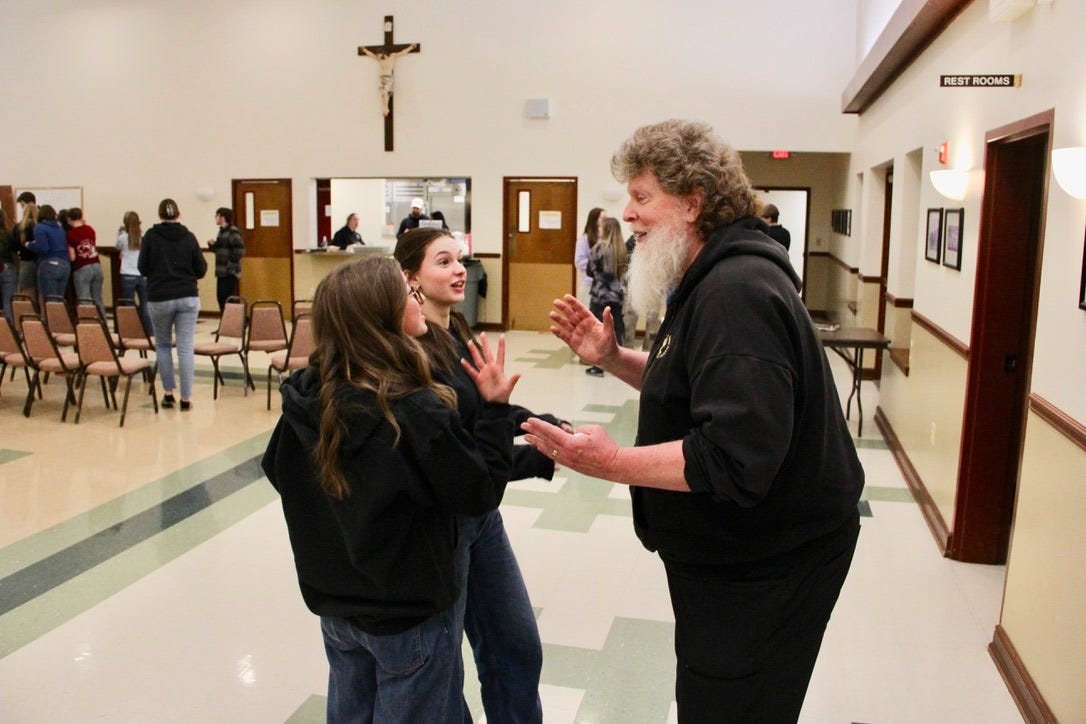
After experiencing powerful spiritual moments from jampacked summers of Steubenville Conferences, LifeTeen and summer camps, or even parish pilgrimages and mission trips to far flung locales, some teenagers find the spiritual “high” of the summer doesn’t keep up with the day-to-day grind of regular life.
Youth ministers call it the “spiritual crash,” and few of them are surprised when it happens.
But what can be done to help kids develop their spiritual lives, build for the long-term from powerful “one-shot” experiences?
Eddie Cotter is familiar with the notorious spiritual crash.
For the past 35 years, he has worked as a youth minister, attending many camps and conferences along the way. (He’s also a former rock musician, member of an Irish band and the Rockefeller Center Santa Claus.) He is the assistant director of youth ministry at St. Patrick Parish in Columbus, Ohio and the executive director of the Dead Theologians Society, an international apostolate providing youth ministers with resources to host weekly youth group events that focus on the lives of saints, Eucharistic adoration, and the rosary.
Over those years, Cotter has worked to mitigate the lasting effects of the spiritual crash — and worked to successfully integrate kids into ongoing youth groups after intense spiritual summers. Part of that work led to building and launching the Dead Theologians Society, whose meetings aim at what Cotter dubs “spiritual maintenance” — helping teens to persist along in their spiritual life.
Spiritual maintenance is essential to successfully fostering teens’ spiritual lives after intense summers, Cotter told The Pillar. And, he said, it requires intentionality, invitation, and endurance.
The following interview has been edited for length and clarity.
Eddie, there are plenty of events each summer in the Catholic landscape which leave teens with a kind of “spiritual high.”
The “conference” approach to evangelization and formation is often criticized. And yet such events do tend to be inspirational, right?
So many of them do great things and I think they are important and they serve a great purpose. They help catapult young people into real conversion, or to have some very strong spiritual highs and consolations.
Part of the reason why they’re successful is one, you have some very holy, faithful people who run them and volunteer for them. I think that’s an important ingredient.
[Such events] also provide the opportunity for young people to unplug from the world for several days, sometimes it can be for a week or more. That allows time to pray, to put distractions aside, to be able to hear the voice of God in their life, and receive those promptings.
It’s a radical departure from being so immersed in the world that it’s something that’s different, it’s unique, it’s exciting, it’s profound.
Why does this work in youth ministry?
First, at these events, young people are with their friends or it is an opportunity to meet other young people on fire for their faith, often for the first time, which I think provides a level of excitement and genuine interest.
Then, many of these camps and events are serving up many treasures of the Catholic faith with Mass, adoration, catechetical talks and some music with ime to pray.
Also, these camps and weekends are often a little more rigorous — whether it’s listening to lots of talks or something like that where the teens are investing, they’re putting skin in the game. It’s almost like they’re walking up the mountain and it can be kind of long and hard so they feel the reward more.
All these factors combined form a great buffet of Catholicism for young people where through the course of the mass and sacraments and all these things the Holy Spirit can really, really touch their hearts.
I love the analogy of climbing a mountain. Are there any dangers or temptations with these “mountaintop moments?”
For some young people that come from solidly Catholic families and they’re used to practicing their faith and they’re already solidly Catholic, these experiences can be great icing on an already solidly Catholic cake.
Then there are some who might be Catholic minimalists from Catholic minimalist families. And I think for them, taking the time to get infused with a tremendous Catholic experience is wonderful. They, though, are at a little higher risk of becoming a little disillusioned when those powerful moments are not maintained, especially when they come back to the routines, the distractions and the temptations of life.
Then there are young people who go to Catholic high schools but come from homes that are non-practicing. For some of these young people, big events might become a first time “wow!” experience, and that could be a real spiritual high — it could be even a conversion.
But if they go back home and the families, the friends, even parents, if that’s not supported, if it’s even ridiculed or mocked or undermined, I think then that can really stamp out the flame
What do teenagers experience after “mountaintop moments?”
Most people don’t have the Saul of Tarsus experience. I do know of a few radical conversions [from such events] which have lasted for decades but I think that’s more the exception rather than a rule.
Young people, afterwards, often think “Wow, that was a great experience, but was it even real?” or, “Wow, was my feeling genuine? Was it authentic? Was I just kind of riding a spiritual high?”
Even if they felt like it was real, but they go back and there’s nothing to keep the fires burning at the parish level, at the home level, at the school level — then they can start to feel a sense of guilt: “I was sincere there and now I’ve fallen back” or “maybe I’m not doing this right.”
That conflict can be a bit crushing.
Thus, there’s a critical need for spiritual maintenance, because in life we need maintenance for good things, whether it’s physical activity, mental activity, or with spiritual things.
The experiences that so many of the young people have could definitely be very genuine. But then I think it’s critical that parishes either have things like Dead Theologians Society or similar, which is why we founded the apostolate to keep the fires burning.
Parish-based youth ministry programs struggle to keep kids engaged after “mountain moments? Why do you think many young people fall away after big faith moments?
Primarily it is the influence of the world of worldly things, i.e technology, pornography, drinking, money etc.
But this challenge also shows that evil does exist.
Spiritually, evil wants to destroy your high. They want to destroy your faith. So it does anything to minimize the impact of a good Catholic experience. The world invests zillions of dollars and they never stop trying to win the souls of young people.
We’re in a spiritual war. And I think when we realize that, then we need to get the resources, spend the money, do what we have to do to help combat the negative influences that are out there.
You keep reiterating that spiritual maintenance is key. What can parishes do to promote spiritual maintenance as soon as the bus arrives back from camp, so to speak? What should be the week one strategy?
It’s great for teens to be greeted by those who support them; whether it’s their parents or family members, the youth minister, the priests at the parish, someone needs to be there to welcome them back, congratulate them, and show them that they are proud of the teens.
Over the next week, they need to have a moment to process what just happened — it could be a 15-minute or an hour, “Hey, let’s all meet in the church or something. How was your experience? Talk about it. Let’s give you some strategies to keep this going. “
The youth minister needs to give some reality checks emphasizing, “Don’t feel bad if this high you’re on starts to subside a little bit.” But encouragement is important.
What about a long-term strategy?
Every parish should have something that meets regularly, that’s grounded in total Catholic faith, it is good to have programs that aren’t just flash in the pan events.
Whether it meets once a week or twice a month at a minimum, consistency is key. Programs that meet maybe just once a month have a hard time building community and momentum.
Consistency and frequency is really important because of all the distractions, and the amount of hours in a young person’s life spent doing things that aren’t Catholic and maybe are even anti-Catholic, it’s a lot. So the more frequency we can provide for them with hours spent doing Catholic things, the better.
If you have regular meetings a young person can be connected with a solid Catholic group of friends and around great formation, then they’re more equipped when they go to college to maintain the faith.
The key is to have a faithful youth ministry team, a holy, vibrant youth minister, a holy priest who’s supportive, a core team that’s dedicated and can help provide outreach.
Successful strategies that I’ve found in my own life are the practice of going with other core team members to events that a teen is participating in.
Attend a teen’s sporting events or plays or concerts, to support them and show that you really do care.
It can be a good witness and it doesn’t have to be loud and obnoxious but it can just be a very genuine demonstration that we care about them in their life outside of the church.
We need to go to the teens’ turf and not just have them only come to our turf.
Then when they do come to our turf, let’s give them something that’s solid and inspiring and truthful.
At these conferences and camps, you’re with friends, you’re with a lot of other young teenagers, passionate about the faith, lots of flashing lights, great speakers.
Big summer conferences and camps can be flashy — highly produced liturgies, major speakers, etc. How do you make a normal Sunday youth group appealing, when you don’t have a Father Mike Schmitz type on the stage? Or any stage at all?
The key is that these conferences and retreats share a responsibility to prepare the young people for when they go back to their day-to-day lives.
They need to let them know: “Hey, what you experienced here isn’t going to last every day. But the most important thing are that you can receive the same Jesus in the Eucharist when you go home, which is the source in the summit of our life.:
Emphasizing the essentials and preparing them, that it’s not always going to be a great buffet at the end. It’s not always going to be the greatest speaker, but Jesus will still be there. That’s why it is necessary to plug them into Jesus and the Eucharist at these conferences.
Is there anything that youth ministers or group leaders can do during big retreats to help their teenagers prepare for when they return to the parish?
Before the young people go, there should be the opportunity for the youth minister to address these issues, to let them know a little bit what to expect and to encourage them by saying, “Be all in on this. And when you come back, we will be here for you. “
By doing that, you help them manage their expectations at the beginning and at the end. And when they come back, you can let them know what you experienced is real. It doesn’t happen all the time. Just like a wedding day and a reception is very real, but it’s not going to be like that every day.
—
Spiritual maintenance is a wonderful thing and it must connect people into the sacramental life of the church, but it has to be substance over style.
If youth ministry or other organizations emphasize style over substance, then the young person could become addicted to the style. And then sometimes if they liked the style — whether it was the music, the food, the comfortable chairs or whatever — then they may seek out a church with that style versus the substance. There can be a danger of some young people even leaving a Catholic church if they don’t realize what they’re leaving.
They go for the style. They want the camaraderie, the hospitality, the donuts. It is incumbent that we must, must, must plug the young people into the sacramental life of the church, that all the other things can be moments of great icing, but you have to have that solid Catholic cake.
It’s the solid food that helps them realize the non-fading beauty of the Church and the sacraments.
These conferences, these camps, these moments are beautiful, they’re profound, they’re real. Youth ministers and all those involved in these events should let teens know that when you leave from here, embrace with enthusiasm a mission. Sometimes mission can be hard, but it’s always worth it.

