England and Wales see uptick in priestly ordinations
But the rise in 2024 is expected to be followed by a dip over the next three years.
The number of priestly ordinations rose slightly in England and Wales in 2024 compared to the previous year.
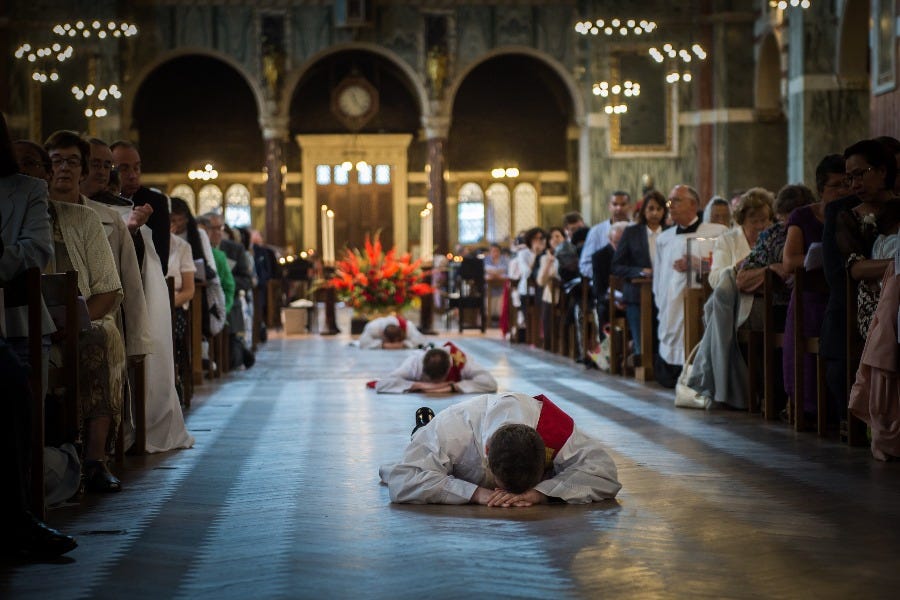
But a projection released by the National Office for Vocation in England and Wales Dec. 22 suggested the figure would fall again in 2025.
There were a total of 22 ordinations in 2024 for the 22 Catholic dioceses in England and Wales, as well as the Personal Ordinariate of Our Lady of Walsingham, up from 20 in 2023.
The 2024 figure suggests that ordinations to the diocesan priesthood may be stabilizing following a sharp drop at the end of the 1990s. In the first quarter of the 21st century, annual ordinations have hovered around the 20 mark, with occasional spikes due to influxes of former Anglican clergy.
Despite the increase to 22 in 2024, the number of ordinations is expected to fall to 14 in 2025, rise to 17 in 2026, and fall again in 2027 to 14.
The broad trend of decline in priestly vocations has prompted alarm in some dioceses.
Bishop Philip Egan of Portsmouth said in a Dec. 14 pastoral letter that “this year, 10 priests have died, yet only one was ordained, and this could be the first year ever we will not be sending any students to seminary.”
The diocese in southern England, which has an average Sunday Mass attendance of 27,550, had two priestly ordinations in 2024 and one in 2025. It is projected to have two in 2026 and two in 2027.
The leading dioceses in 2024 were the Archdiocese of Liverpool, with four ordinations, and the Archdiocese of Westminster and the Personal Ordinariate, both of which had three.
Ten of the 22 dioceses had no priestly ordinations in 2024. Five of the dioceses were also projected to have no ordinations in 2025, 2026, and 2027: Hexham and Newcastle, Menevia, Middlesbrough, Nottingham, and Wrexham.
Leo XIV accepted Dec. 22 the resignation for age reasons of Bishop Terence Drainey of Middlesbrough, northeast England. Rather than naming a successor, the pope appointed Bishop Marcus Stock of Leeds, a neighboring diocese, as the apostolic administrator of the Middlesbrough diocese.
In a Dec. 22 message to Middlesbrough Catholics, Stock appeared to hint at a possible future union of the two dioceses.
“It is the Holy Father’s wish that I explore with the clergy, lay faithful and religious of our two historic sister Dioceses of Middlesbrough and Leeds how we might journey together in mission, work in close collaboration, and gain from each other’s strengths in order to secure the future of the Church’s witness to Christ across the regions we serve,” he wrote.
In 2024, Pope Francis approved the merger of the Diocese of Menevia with the Archdiocese of Cardiff to form the Archdiocese of Cardiff-Menevia.
While the Archdiocese of Cardiff had one priestly ordination in 2024, the Welsh dioceses of Cardiff-Menevia and Wrexham are expected to have no ordinations in 2025-2027.
The National Office for Vocation also said there were 25 new entrants for priestly formation in England and Wales in 2024, the highest number since 2020, when there were 30.
In 2021, there were 18, followed by 23 in 2022, and 16 in 2023.
The average age for entry to a diocesan seminary in 2024 was 33.4, while the average for starting a propaedeutic (preliminary) year was 29.1.
The total number of men in formation for the diocesan and ordinariate priesthood in England and Wales in 2024 was 117, up from 110 the year before.
There were 24 new permanent deacons ordained for English and Welsh dioceses in 2024, up from 22 in 2023.
There were also 24 entrants to formation for the permanent diaconate in 2024, with the Birmingham archdiocese leading the way with seven candidates. There were 28 new entrants in both 2022 and 2023.
The average age for entry into formation for the permanent diaconate in 2024 was 50.8.
A total of 110 men were training to be permanent deacons in 2024, up from 97 in 2023.
The National Office for Vocation predicted there would be 26 new permanent deacons in 2025, 38 in 2026, and 22 in 2027.
Leo XIV appointed a new de facto leader of the Catholic Church in England and Wales Dec. 19. Archbishop-elect Richard Moth succeeds Cardinal Vincent Nichols as the Archbishop of Westminster, who typically serves as president of the Bishops’ Conference of England and Wales.
Moth previously led the Diocese of Arundel and Brighton, which had two priestly ordinations in 2024 and two more in 2025. But the southern diocese, which has around 182,000 Catholics, is projected to have no priestly ordinations in 2026 or 2027.
Two new priests were ordained in the Diocese of Westminster in 2025. The diocese, which serves around 450,000 Catholics, is forecast to have just one priestly ordination in 2026 and one in 2027.
