An upcoming ruling by the European Union’s top court on whether a Belgian diocese must erase baptismal register data on request could have significant implications for the Church’s autonomy and institutional freedom of religion.
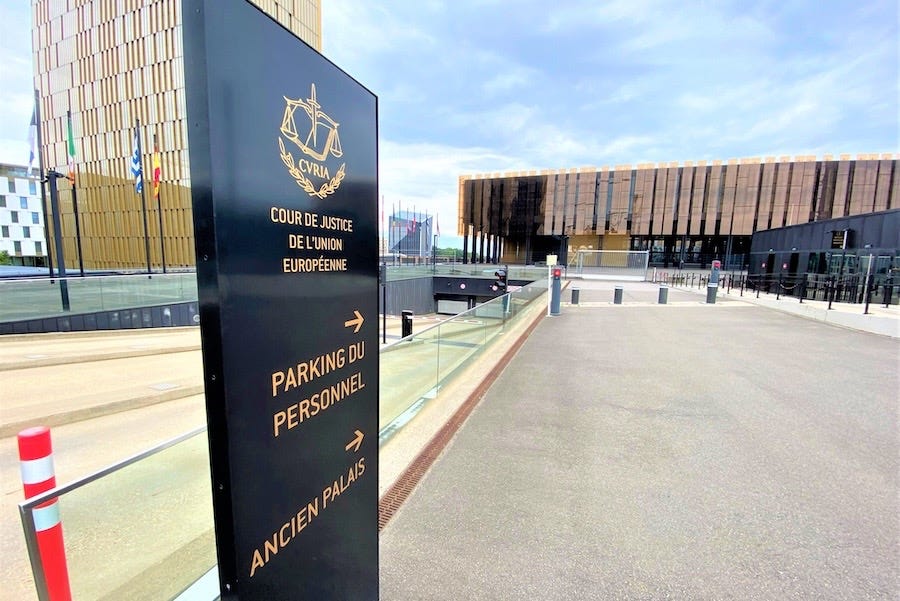
That is the contention of a position paper issued Sept. 4 by the Commission of the Bishops’ Conferences of the European Union, or COMECE.
The 15-page paper addressed a case currently before the Court of Justice of the European Union, or CJEU, concerning a dispute between the Diocese of Ghent and Belgium’s Data Protection Authority over whether the diocese must comply with an unnamed individual’s request to delete their baptismal register entry.
“The baptismal register is the fundamental basis for establishing the juridical status of the person in the internal legal order of the Church,” said the position paper, prepared at the request of COMECE’s member bishops’ conferences and dated Sept. 2.
“Requiring the Catholic Church to erase the data contained in it, thereby intervening directly in its organization, would constitute a serious infringement upon Church autonomy and institutional freedom of religion.”
The paper was published less than a month before the Advocate General, an independent legal adviser to the CJEU, is expected to issue a formal opinion on the case. The opinion will not be binding, but could give an indication of how the CJEU might resolve the case in its final judgment, which could potentially be issued in late 2026 or early 2027.
The case, known as C-12/25 Bisdom Gent, emerged from a dispute over a practice developed by Belgian dioceses of adding a note to baptismal registers rather than deleting entries when people request “debaptism.”
The Catholic Church teaches that “baptism seals the Christian with the indelible spiritual mark of his belonging to Christ.” While a person can lapse in the practice of the faith, or even renounce it altogether, it is impossible to reverse the effects of baptism.
On March 25, 2021, an individual asked the Ghent diocese to delete their data from all files, including the baptismal register, citing the General Data Protection Regulation, or GDPR, a 2018 EU data protection law.
On April 2, 2021, the Diocese of Ghent added an annotation to the baptismal register, noting that the individual “left the Church” on that date. Two diagonal lines were drawn across the entire baptismal entry.
When the diocesan authorities explained that a note had been added to the entry, the individual insisted on the deletion of their data and made a complaint to the Data Protection Authority.
On Dec. 19, 2023, the Data Protection Authority ordered the Diocese of Ghent to comply with the complainant’s request.
The data authority said that the diocese argued it was necessary to preserve baptismal records to prevent possible identity fraud, for example, if a person who was already baptized sought to receive the sacrament for a second time, in contravention of Church teaching.
The data authority recognized the Church’s concern, but argued that the complainant’s interests took precedence over those of the Church. The diocese appealed the ruling.
On Dec. 11, 2024, the Brussels Court of Appeal (Market Court) said that the case raised questions concerning EU law that should be addressed by the CJEU. It posed five questions to the Court in Luxembourg, including whether the GDPR must be interpreted in the light of the right to religious freedom and whether a note saying a person has left the Church constitutes erasure of their data.
Once the CJEU issues its ruling, the Market Court will be expected to apply the decision to the Ghent diocese dispute.
The COMECE position paper noted that the Ghent diocese’s annotation was “not ideal” and “not representative of annotations used by the Church in the other EU member states.”
The paper cautioned against treating baptismal registers as lists of Church members.
Referring to a CJEU hearing on June 30, 2026, it said: “During the hearing in the case, it was implied that baptismal registers may be seen as ‘lists of members,’ as the annotation inserted in their margin in the case (i.e. that the person had ‘left the Church’ on a certain date) seemed to entail a sense of ‘membership.’”
“However, regardless of the concrete formulation of such annotations, no conclusion can be drawn from them on the fact that in the Catholic Church baptismal registers are ‘lists of members.’”
The paper said that baptismal registers are records of historical events rather than membership lists, echoing a 2025 explanatory note issued by the Vatican’s Dicastery for Legislative Texts.
COMECE also highlighted the impact that the erasure of a baptismal entry would have on third parties. It observed that entries also contain the personal data of the minister of baptism, the child’s parents, and two godparents.
“Each of these individuals has an independent and legally protected interest in preserving the integrity of the record, as a permanent and authentic account of his or her participation in the sacramental act,” it said.
The paper also argued that the deletion of a baptismal entry could affect legal certainty regarding the validity of marriage.
It said: “Cases have been reported in which a former Catholic married in a civil ceremony with a non-Catholic, and after the breakdown of the marriage, the non-Catholic person wished to become Catholic and petitioned the Church for annulment of the previous civil marriage.”
“The absence of a baptism record would destroy relevant evidence and prejudice the person’s chances in view of having his/her rights upheld.”
The paper also noted that baptismal entries can be used in civil proceedings, giving the examples of Ireland, where a baptism certificate can be accepted as evidence of birth where records have been destroyed, and Cyprus, where baptismal registers are used as evidence to resolve family real estate claims.
In its conclusion, the paper said: “The case is not only about whether certain personal data should be retained. It also raises a deeper question. To what extent may EU data protection law require a Church to change the way in which it gives visible and juridical expression to its faith?”
“This is especially important in relation to baptism. For the Church, baptism is not simply a historical event that took place once and was later recorded. Its registration also expresses a content of faith.”
“Baptism reflects the covenant between God and the human person and the enduring faithfulness of God. The lasting character of baptism is therefore not only a matter of administration or canon law. It is rooted in the Church’s faith and sacramental understanding.”
The paper added: “An obligation to erase data from baptismal registers would therefore affect more than a system of record-keeping. It could affect the way in which the Church expresses and safeguards a central element of its sacramental faith.”
“This is not only about an administrative interest of a data controller. It concerns the institutional dimension of freedom of religion and the freedom of the Church to live, organize and express its faith.”

