
Nestled in the rolling hills of central New Jersey, Princeton University is known for its rigorous academics, striking Gothic architecture, and selective eating clubs.
But the campus is also home to a thriving Catholic presence, with the Aquinas Institute serving as the hub for Catholic campus ministry at the university.
Fr. Zachary Swantek is the Catholic chaplain and director of campus ministry at Princeton University.
Swantek spoke with The Pillar about the burgeoning Catholicism at Princeton, Catholic life on an Ivy League campus, and how he works to unite “serious intellectual formation and an unapologetically Catholic spiritual life” in his work with students.
The interview has been edited for length and clarity.
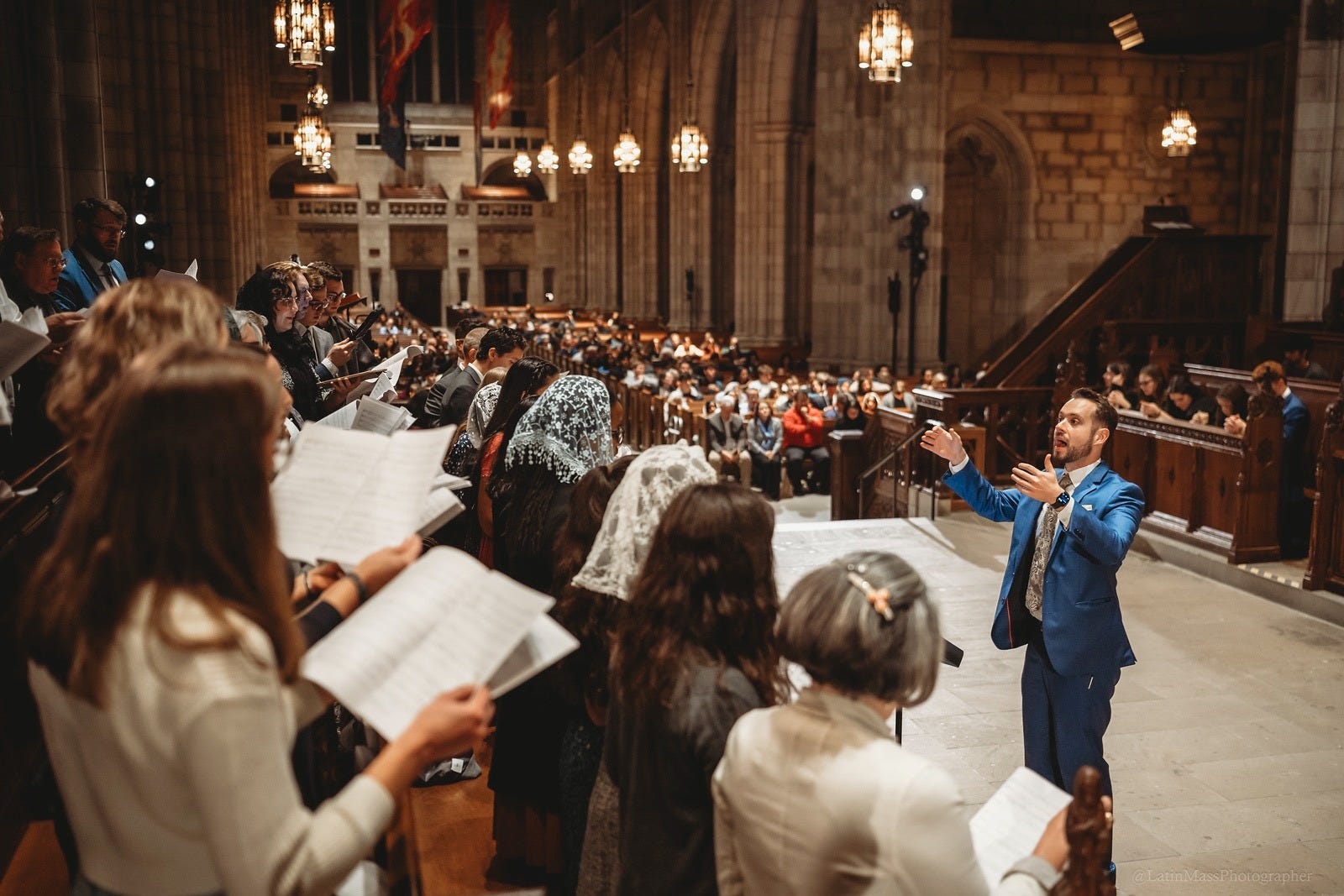
You recently held a Eucharistic procession that attracted 200 participants. How did that come about?
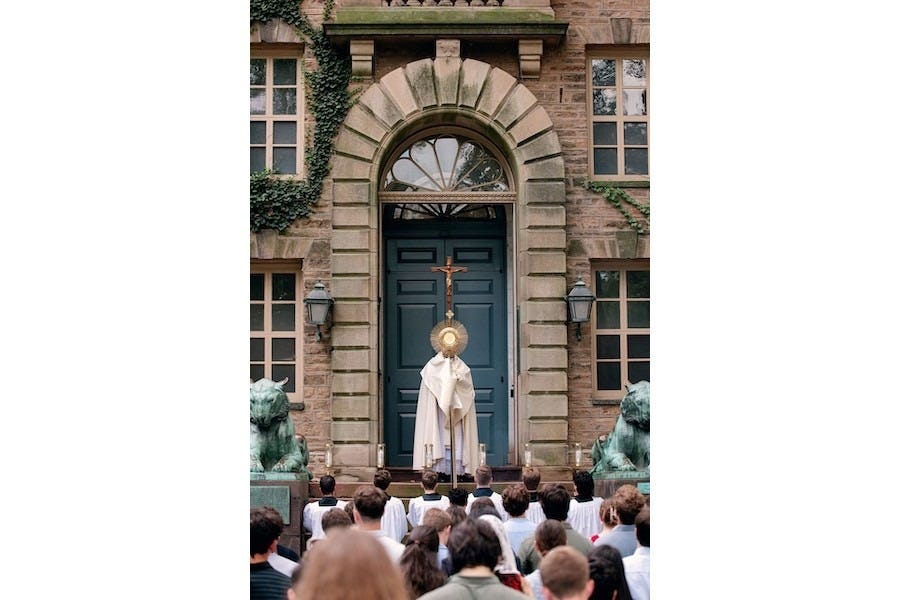
Well, we do this procession each year for the Feast of the Exaltation of the Holy Cross. And every year it just keeps growing bigger and bigger -- from about 100 students a few years ago, to 150, and now over 200. It’s a beautiful witness where the Catholics are not just this hidden group on campus, but are active and public in their worship.
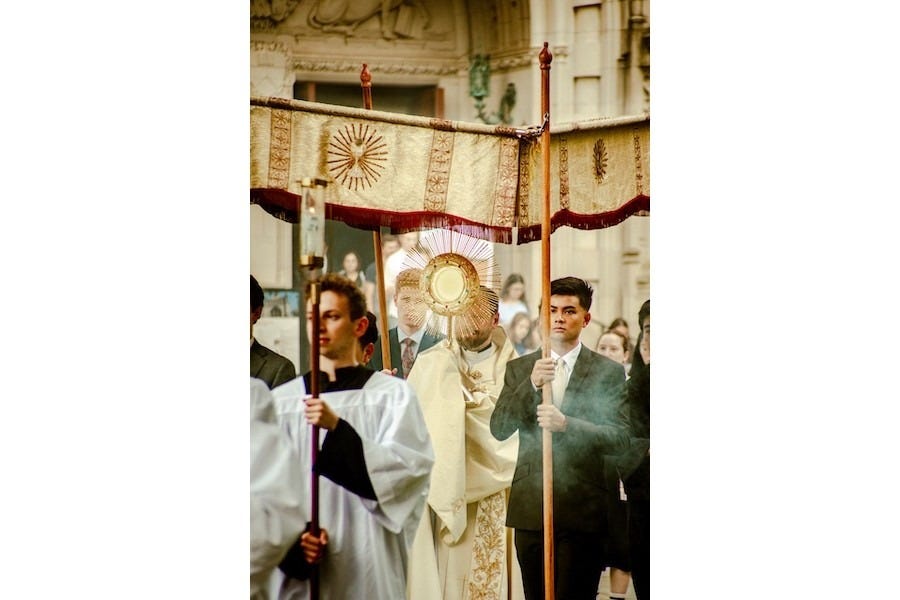
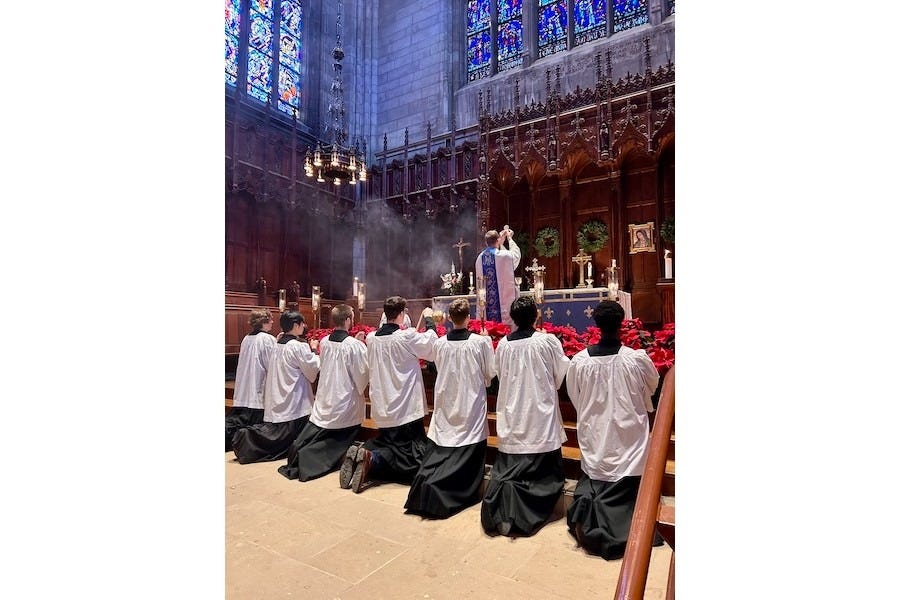
We do the procession after the 4:30 Mass on Sunday. We go out of the chapel and then we go to Nassau Hall, which holds the president’s office and the main administrative building, which is this iconic building from the 1700s on campus. We go to the lawn there, and we do a blessing. And all the students are kneeling there for the blessing and singing the Tantum Ergo. And then we go around the building and then back to the chapel.
It’s just really beautiful. We have the altar servers with candles, the crucifix, and myself with the monstrance. People see this, and they see that it’s really beautiful. They’re taking pictures or videos or even joining us and following us along, and then they end up with us in the chapel for the final blessing.
Have you seen a broader growth in Catholic life on campus as well?
Oh yes. Our numbers both for Sunday and daily Mass have doubled in recent years. In 2019, we had 40 students participating in Bible studies. Now we have 40 students leading Bible studies on campus, and more than 250 students participating in them weekly in their dorms.
Wow, that’s a tremendous amount of growth in a few years. To what do you attribute that?
In part, we’ve developed a program where the students are Bible study leaders. So it’s not just an event that students attend, but the students are actually being formed to be these intentional missionary disciples through their friendships. We give them training and formation in four areas: prayer and having an interior life, the sacramental life, having authentic Christ-centered friendships, and evangelization, just sharing their faith in normal ways with their friends.
The Bible studies focus on the Sunday Gospel. During the week, they meet to go dive deeper into that Gospel. We’re happy students are coming to Mass on Sunday. But rather than just check off the box or fulfill the obligation of going to Sunday Mass, we want them to normalize praying with the Gospel after Mass, and talking about it with their friends, and then applying it to their lives as well.
This has had a great effect, because it has helped them to really apply the Gospel and live it out in their lives. Students start challenging one another to go to Mass if they’re not going. Or perhaps encouraging one another to go to daily Mass or adoration or confession or to do service – all these different ways where they can grow in their faith and get more involved in the community.
Why did you decide to create this particular style of Bible study program? Is it only present at Princeton?
It’s something we developed ourselves. Currently, it’s just present here. But there have been other schools that are now reaching out to see if we could share with them our program.
There are some phenomenal campus ministry programs out there. When I worked at other universities, I worked with FOCUS missionaries and with St. Paul’s Outreach, and they were both wonderful. But when I came to Princeton, we didn’t have that, so I sought to evaluate what would be the best next step.
I saw that the students were extremely busy and over-programmed with all of their commitments. And so I wanted to offer Bible studies where they could just reflect on the Sunday Gospel, but then learn how to do that with friends, and share it with others.
I found this works really well for the students, because they all are overachievers. They want to do a great job and are very knowledgeable, but this way all the pressure isn’t on them to have this perfect Bible study. They don’t need to be an expert and teach so much as just be able to facilitate and lead, and most of all, through the witness of their own life.
And then we have bigger public events too. We have Eucharistic processions. We have stations of the cross. We also have large monthly gatherings -- social events to celebrate different things throughout the year, like St. Thomas Aquinas’ feast day or a Christmas party and Easter party.
The monthly social events are right on campus, so the students can see how large the Catholic community is, but also so they have something easy to invite their friends to with no commitment. That could be an entry into the community, but then from there they could go to Mass or to a Bible study or to a seminar.
As an Ivy League school, Princeton is obviously a very intellectual place. Would you say that people are drawn to the intellectual side of Catholicism? And do you offer resources with that in mind?
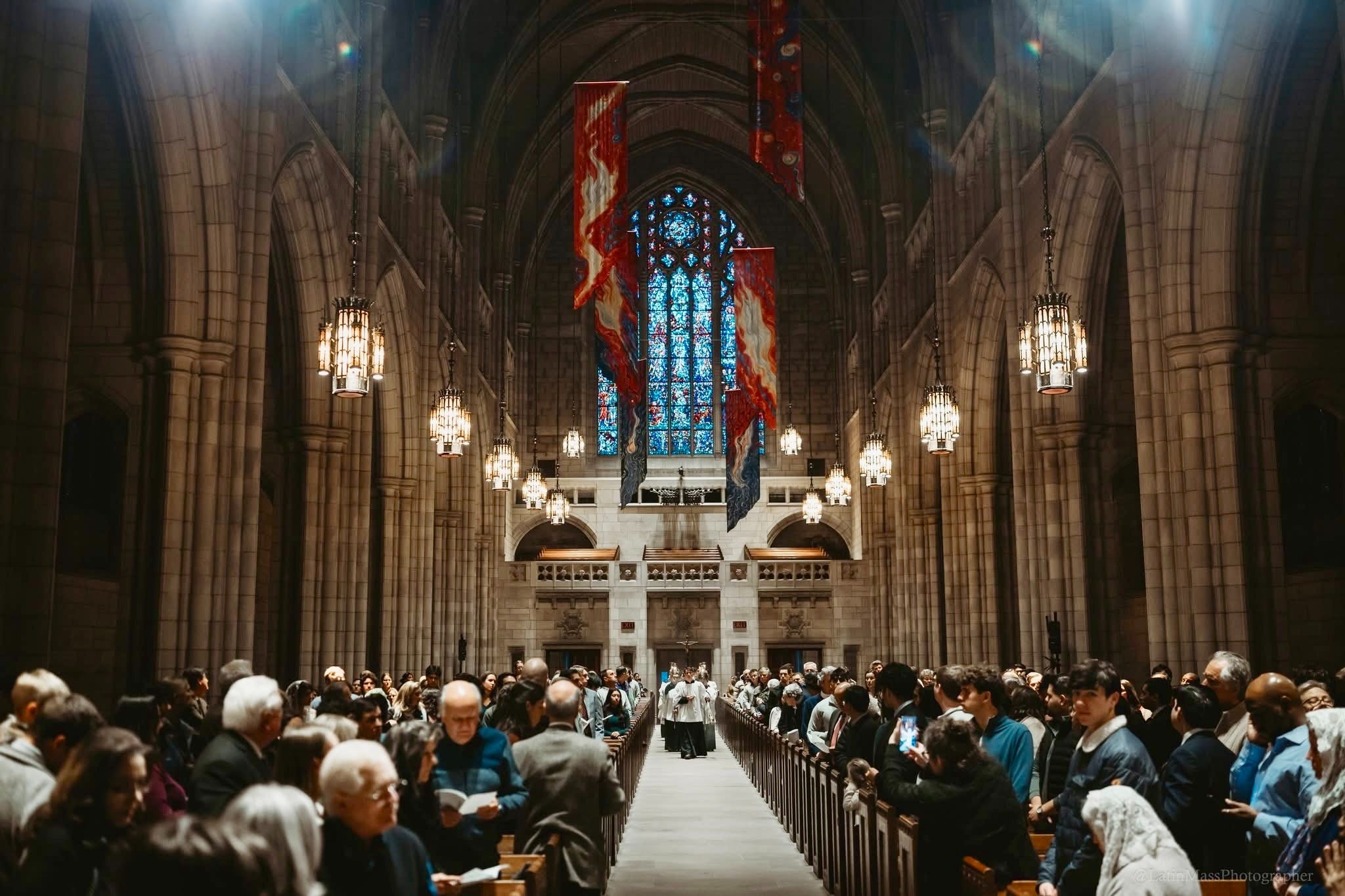
Absolutely. The students are definitely already very accustomed to asking questions in life and really pursuing answers seriously. And so it’s great that in this campus ministry, they receive both the serious intellectual formation and an unapologetically Catholic spiritual life and very reverent liturgies.
It’s kind of normal that after Mass or after adoration, you’ll find students talking and just asking these deeper theological questions of one another. Also, it’s great that at the Aquinas Institute, we have a wonderful staff including four people who have doctorates, who can really take their questions seriously.
For example, our OCIA director has a PhD from Princeton in philosophy, so he is well-equipped to answer their questions while also being a serious Catholic in the practice of his faith. That helps because students come from all different places and with all different questions. Recently, we even had two doctoral candidates from the philosophy department convert to Catholicism. So it’s great when they come to OCIA or they come to one of our seminars, they’re often met with the same intellectual rigor that they’re finding at the university.
And in order to really help them build up their faith and answer their questions, we offer seminars throughout the semester on all different topics, to have a really well-rounded faith. We have a two-year cycle that repeats, so throughout their time here as an undergrad, they would have two chances to take each of these seminars if they wanted to.
We also have guest speakers and retreats and conferences. We’ve been blessed to have guest speakers like Bishop Erik Varden, Cardinal Sarah, Cardinal Mueller, Mary Ann Glendon. It’s been really wonderful to be able to bring the great caliber of speakers they might get at the university, bringing in these great Catholic voices as well.
As far as the growth in Catholics on campus, are you seeing people who are already Catholic but are becoming more active in their faith? Or are these converts who were not previously Catholic?
It’s a real mix. There are some who are Catholic already, but then they grow tremendously in their faith. I think having community helps -- perhaps for the first time having people their own age that they’re talking to about their faith and asking questions, and then also that they’re going to Mass with or going to adoration with
But certainly also there are lots of conversions to Catholicism happening as well. All sorts -- Protestants, people from other faiths, and people with no faith at all.
The Church in the U.S. has seen a lot of infighting in recent years – arguments about liturgy, politics, etc. Do you see those tensions reflected in the Catholic community at Princeton? Have you made an effort to create a sense of unity?
Certainly, students come from all different backgrounds, so it is to be expected that they have different experiences and different opinions. But what we try to do is really give them the formation to really help them to think with the Church -- through the liturgy itself and through my preaching, but then also through the training we offer for the Bible study leaders and through the seminars. We try to help them not to see the Church with political labels of left and right, or liberal or conservative, but to try to just be orthodox within the Church and do what the Church asks of us.
I wouldn’t want anyone to feel like a certain type of Catholic isn’t welcomed. If they come to the Mass, they see that it’s very beautiful and serious and reverent, but I try to have a very merciful, pastoral approach in which I, as a priest and chaplain, am very available to them. I certainly expect and understand that they’re going to have all the normal challenges that young people and college students have, so that they don’t feel out of place or that they don’t belong somehow.
How have the university administration and staff responded to the growing Catholic presence on campus? Are they friendly to Catholic events? Do they make it difficult?
I’ve been pleasantly surprised. We’ve been very well received at the university’s Office of Religious Life. I have a monthly meeting with all of the chaplains, so they’re aware of what we’re doing, and they’re very supportive and encouraging. They’re amazed at how much Catholic life at Princeton has expanded.
The president of the university writes a lot about religious liberty, something that’s not just important to him intellectually, but also in practice at the university. So we felt very supported.
And there are also some professors who are Catholic or Catholic-friendly and have been very supportive to students in their research and in their writing on different topics for their senior thesis. Certainly Robert George has been a long-term witness on the campus and a voice for Catholic morality, and that helps too.
Are you aware of similar growth in Catholic life happening at other Ivy League schools?
Yes, and it’s great to see that it isn’t only here, but in many places. And also in the non-Ivy League schools, there has been growth. It’s been good to communicate with and connect with other chaplains, and then sometimes being able to participate in different conferences or events with other campus ministries.
I think it shows that with young people, there’s a real search for truth, and that the wonderful mix of faith and reason is giving an answer to young people’s desire for transcendence, and something that they can’t really manufacture for themselves, that they have to really enter into and participate.