A German diocesan bishop stepped down Wednesday at the age of 66, citing the “psychological strain” of office. He is the latest in a string of German prelates to offer their resignations well ahead of the customary age, suggesting the burdens of episcopal office are taking an increased toll in the country.
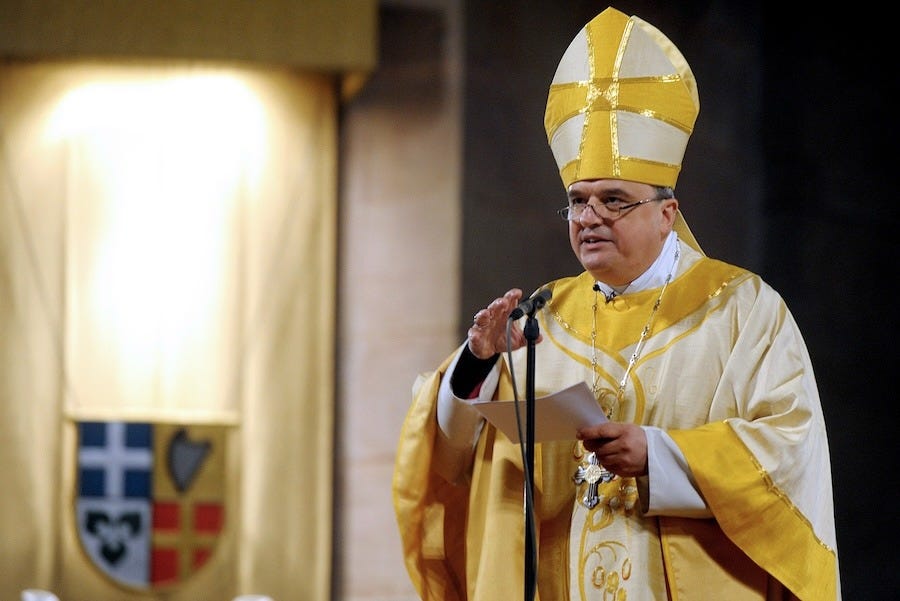
The Holy See press office announced Aug. 19 that Pope Leo XIV had accepted the resignation of Bishop Karl-Heinz Wiesemann of Speyer, southwestern Germany.
The Vatican gave no reason for the pope’s decision to accept the resignation nine years before Wiesemann turned 75, the standard retirement age for diocesan bishops. German Catholic media described the move as a surprise.
But in a candid letter to Catholics in Speyer — one of Germany’s oldest dioceses — Wiesemann recalled that he had struggled for years with depression and said he felt unable to continue serving at “half strength.”
Wiesemann, who has led the Speyer diocese for more than 18 years, explained in the Aug. 19 letter that he recognized as early as 2019 that he needed professional help. He began psychotherapy, a practice that he continues to this day.
In February 2021, the bishop entered a clinic for treatment for what doctors diagnosed as a “recurrent depressive disorder.” He took a seven-month break from active ministry that included two months at the clinic.
“The immediate trigger at that time was the situation surrounding the investigation and handling of sexual abuse in our diocese. But the deeper background goes back to the very beginning of my time as your bishop,” he wrote.
“From the outset, I experienced the great responsibility that comes with this office amid a rapidly changing world and Church — particularly against the backdrop of the many cases of abuse in our Church that came to light not long after I took office — as an enormous and, at times, overwhelming burden.”
He said the treatment enabled him to return to office, but doctors warned him that stress would continue to impair his ability to carry out his responsibilities. He noted that he was unable to work at the same capacity as before.
Wiesemann said he did his best to establish a “new pastoral and structural direction” for the diocese, an allusion to his strong support for the priorities for the German synodal way and a plan to reduce the number of parishes in Speyer from 70 to nine amid a decline in practicing Catholics.
“But I also know that I no longer have the strength to walk the entire road with you through to the complete implementation of the reform,” he wrote.
“What is needed now is someone who can once again look at the whole picture with fresh visionary eyes and — as is the task of a bishop — seek and shape these paths together with you, with wholehearted passion and trust in the Lord of the Church.”
“Today’s global crisis situation no longer permits a bishop to exercise his office at only half strength.”
Wiesemann said he wished to step aside before the Speyer diocese entered a three-year preparation period for the 1,000th anniversary celebration of the laying of the foundation stone of Speyer Cathedral, the world’s largest surviving Romanesque church and a UNESCO World Heritage site.
Wiesemann’s early resignation comes a year after Bishop Gregor Maria Hanke stepped down as the Bishop of Eichstätt in Bavaria, southern Germany, at the age of 70.
Hanke said in June 2025 that he had asked to retire five years before the customary resignation age of 75 because of “inner fatigue” caused by “the many challenges, scandals, and unresolved conflicts” that marked his term in office.
Hanke, a critic of the synodal way, said that one of the factors in his resignation was doubt that the initiative would lead to a genuine renewal of the Catholic faith in Germany.
Other German diocesan bishops have sought to retire early in recent years, but were asked to remain in office.
Archbishop Stefan Heße tendered his resignation as Archbishop of Hamburg in March 2021, after an independent report accused him of mishandling abuse cases. But Pope Francis requested that the 54-year-old continue in the role.
Cardinal Reinhard Marx submitted his resignation as Archbishop of Munich and Freising in May 2021, at the age of 67. But Pope Francis declined the offer a month later.
Cardinal Rainer Maria Woelki offered his resignation as Archbishop of Cologne in March 2022, at the age of 65, amid criticism of his handling of abuse cases. He also remains in office today.
Wiesemann is one of a handful of European bishops in recent years who have retired early while pointing to the grueling nature of episcopal ministry.
Bishop Valerio Lazzeri stepped down as the Bishop of Lugano, Switzerland, in 2022, at the age of 59, saying he suffered from “inner fatigue.”
“Over the years, the public aspects of representation, institutional governance, and financial and administrative management, which have always been far removed from anything that natural inclinations and ministry had previously led me to cultivate, have become untenable for me, despite the presence of good and competent collaborators, to whom all my gratitude goes as of now,” he said.
Also in 2022, Msgr. Ivan Brient initially accepted his nomination as an auxiliary bishop of Rennes, northwestern France, but withdrew before his episcopal ordination due to “burnout.”
Wiesemann has spoken openly before about his mental health struggles, most notably in a 120-minute podcast, recorded before a live audience at the Catholic Day event in Würzburg in May 2026.
In his letter to Speyer’s Catholics, he wrote: “I know that there is rarely an ideal time for a resignation. But in view of the challenges ahead, I have felt it my responsibility to clear the way now for a new appointment to the episcopal see of Speyer.”
“This weighs heavily on my heart, because I was a bishop in our diocese with pleasure and joy.”
With Wiesemann’s resignation, two out of Germany’s 27 dioceses are now vacant. The Diocese of Hildesheim also requires a new bishop after Pope Leo XIV named Bishop Heiner Wilmer as Bishop of Münster.

