German Church leaders defend blessing guidelines
Leading German Church figures spoke in response to critical comments from Pope Leo XIV.
Leading German Church figures have defended the country’s guidelines on the blessing of same-sex couples in response to critical comments from Pope Leo XIV.
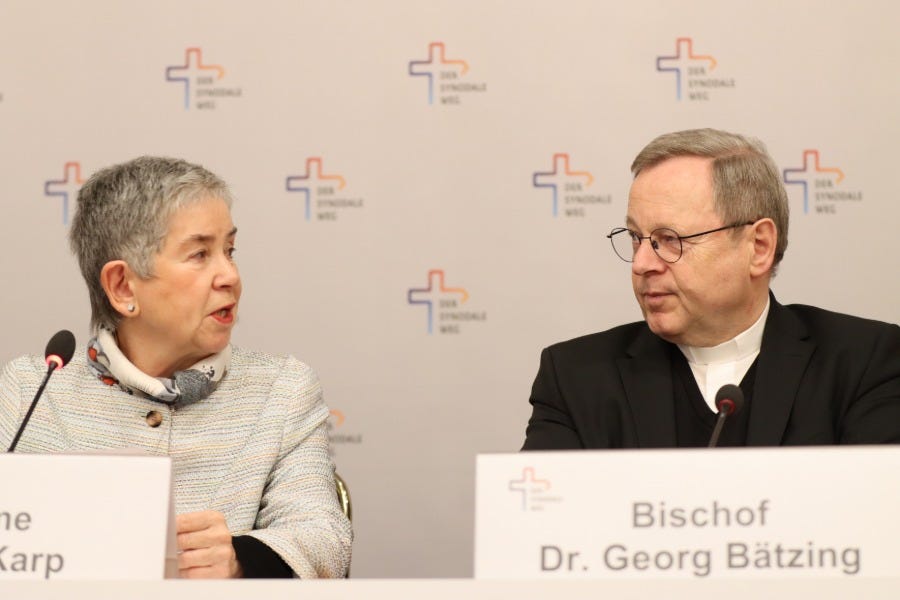
Bishop Georg Bätzing, who oversaw the guidelines’ introduction in April 2025 when serving as chairman of the German bishops’ conference, insisted that they posed no threat to Church unity.
Bätzing, who approved the guidelines for use in his Limburg diocese in July 2025, said: “Even though there are differing views on this within the universal Church, I believe this practice in the Diocese of Limburg is carried out within responsible limits. It serves the people and, in my view, does not jeopardize the unity of the Church.”
The guidelines were issued by the bishops’ conference in conjunction with the lay Central Committee of German Catholics, known by its German initials ZdK.
ZdK president Irme Stetter-Karp told German media there was no reason to withdraw the guidelines following Pope Leo’s remarks.
She said the document was aimed at encouraging the provision of blessing ceremonies “for couples who do not wish to enter into a sacramental church marriage or for whom such a marriage is not an option.”
“No more and no less. There is no possibility of confusing it with the sacrament of marriage,” she said.
Renewed debate over the guidelines was triggered by an April 10 letter from Cardinal Reinhard Marx to priests and lay pastoral workers in his Munich and Freising archdiocese.
Marx, who also serves as the coordinator of the Vatican’s Council for the Economy, reportedly called for blessings to be provided in the archdiocese in accordance with the guidelines.
The Catholic weekly newspaper Die Tagespost reported April 20 that the archdiocese would offer training courses to full-time pastoral staff on how to conduct blessing ceremonies. Any workers who do not wish to preside at the ceremonies would be expected to refer those seeking a blessing to a colleague or the local dean.
Following the report’s publication, a spokesperson for Munich and Freising archdiocese described the letter as “an internal memo.”
The spokesperson said there were no plans to publish the guidelines in the archdiocese’s official gazette — a step that would publicly commit the archdiocese to enacting the document’s provisions.
The dioceses of Limburg, Osnabrück, and Aachen have published the guidelines in their official gazettes. According to German Catholic media, 13 of Germany’s 27 dioceses have recommended or intend to recommend the guidelines in some form. The Cologne, Augsburg, Eichstätt, Passau, and Regensburg dioceses have rejected the document, arguing that it goes beyond the provisions of the Fiducia supplicans, the 2023 Vatican instruction on blessings approved by Pope Francis.
A German journalist asked Pope Leo XIV during an April 23 press conference on the flight back from his trip to Africa how he assessed Marx’s decision to permit the blessing of same-sex couples in his archdiocese.
The pope said: “The Holy See has made it clear that we do not agree with the formalized blessing of couples, in this case, homosexual couples, as you asked, or couples in irregular situations, beyond what was specifically, if you will, allowed for by Pope Francis in saying all people receive blessings.”
“When a priest gives a blessing at the end of Mass, when the Pope gives a blessing at the end of a large celebration like the one we had today, they are blessings for all people. Francis’ well-known expression ‘Tutti, tutti, tutti’ is an expression of the Church’s belief that all are welcome; all are invited; all are invited to follow Jesus, and all are invited to look for conversion in their lives.”
“To go beyond that today, I think that the topic can cause more disunity than unity, and that we should look for ways to build our unity upon Jesus Christ and what Jesus Christ teaches.”
The German bishops’ conference and Marx reportedly declined to comment on the pope’s remarks.
Years before the publication of Fiducia supplicans, parishes in parts of Germany offered blessing ceremonies for unmarried and same-sex couples.
Same-sex blessings were one of the dominant topics at Germany’s “synodal way,” a multi-year initiative that brought together the country’s bishops and select lay people to discuss far-reaching changes to Catholic teaching and practice.
In 2023, synodal way participants adopted a resolution on “blessing ceremonies for couples who love each other,” which called for the official introduction of blessing ceremonies in all German parishes.
The bishops conference and the ZdK approved guidelines on blessings via a body known as the Joint Conference on April 4, 2025.
The text was presented in an official press release as a recommendation from the Joint Conference “that the diocesan bishops proceed in accordance with the guidelines,” rather than as a binding document.
The press release was dated April 23, 2025, two days after the death of Pope Francis, prompting accusations that the document’s release was timed to coincide with the papal interregnum.
The bishops’ conference rejected the suggestion, highlighting that the document was dated April 4, 2025, when Pope Francis had returned from hospital to the Vatican.
The guidelines said that “no approved liturgical celebrations or prayers are provided for the blessings.” But the German Catholic group New Beginning argued that the overall tenor of the document encouraged “a ritual practice,” while “Fiducia supplicans explicitly called for a non-ritual practice.”
German media reported in May 2025 that feedback from Vatican doctrinal prefect Cardinal Víctor Manuel Fernández had been incorporated into the text.
In an interview published in September 2025, Pope Leo XIV made his first public comments on same-sex blessing since his election.
He said: “In Northern Europe, they are already publishing rituals of blessing ‘people who love one another,’ is the way they express it, which goes specifically against the document that Pope Francis approved, Fiducia supplicans, which basically says, of course we can bless all people, but it doesn’t look for a way of ritualizing some kind of blessing because that’s not what the Church teaches.”
In response to the pope’s interview, Bishop Bätzing insisted the guidelines were developed “transparently with the Dicastery for the Doctrine of the Faith.”
But Cardinal Fernández told The Pillar in October 2025 that the Dicastery for the Doctrine of the Faith had not endorsed the document.
He explained that “the DDF didn’t approve anything, and wrote a letter some time ago reminding [the German bishops] that [Fiducia supplicans] excluded any form of ritualization, just as the pope has said.”
Following the pope’s latest comments on blessings, ZdK vice-president Thomas Söding argued that the guidelines were in line with Rome’s wishes.
“In Germany, what should and can happen with same-sex couples is agreed upon with Rome, and that will not change,” he commented.
The pope’s latest remarks have generated mixed reactions among German Catholics.
Speaking at the meeting of the State Committee of Catholics in Bavaria, the highest lay body in the southern German state, Catholic journalist Peter Frey said he was disturbed by the papal intervention.
“Refusing to bless people who live in same-sex relationships because of their sexual orientation, or verbally discriminating against them, is, in my view, inconsistent with the message of a God who loves everyone just as he created them,” he said.
The theologian Martin Brüske suggested the pope’s comments vindicated dioceses that rejected the guidelines.
“They alone are in agreement with Rome. All other claims turn out to be empty rhetoric. This alone will fundamentally change the course of the debate. A conflict that has been dragging on for over half a decade has taken what may be a decisive turn,” he wrote on the website of the New Beginning group.
Bätzing was succeeded as chairman of the German bishops’ conference by Bishop Heiner Wilmer in February.
Wilmer had his first private audience with Pope Leo XIV as head of the bishops’ conference in March. The two leaders discussed “the proclamation of the Gospel — and, in this context, the situation of the Church in Germany.”
It is not known whether they addressed the blessing guidelines. Wilmer does not appear to have responded publicly to Leo XIV’s in-flight comments.
Meanwhile, scholars are currently working on the first new liturgical book of blessings for German-speaking countries since 1978.
Fr. Johannes Feierabend, O.S.B., head of the international working group preparing the volume, has expressed hopes that it will include a blessing for “loving couples.”
In an April 9 interview with katholisch.de, the German Church’s official news site, he said: “We believe that a form is needed for this as well. When we were finalizing the blessing forms — that is, the list we submitted to Rome — this was the only point that immediately stood out.”
“Bishop Stephan Ackermann, who is responsible for liturgy in the German bishops’ conference, then suggested that officials in Rome develop a form. However, we in the working group believe that we should develop one ourselves and then see how it is received in Rome.”

"She said the document was aimed at encouraging the provision of blessing ceremonies 'for couples who do not wish to enter into a sacramental church marriage or for whom such a marriage is not an option.'"
Wasn’t the whole point of Fiducia Supplicans that there not be ceremonial blessings of irregular couples? Maybe the German Church needs a synod on FS.
“‘Refusing to bless people who live in same-sex relationships because of their sexual orientation, or verbally discriminating against them, is, in my view, inconsistent with the message of a God who loves everyone just as he created them,’ he said.”
Well, that sort of gives the whole game away.