
German bishops’ conference chairman Bishop Heiner Wilmer said Monday that he hoped the Vatican would respond to a request to approve a new national body known as the synodal conference by the end of 2026.
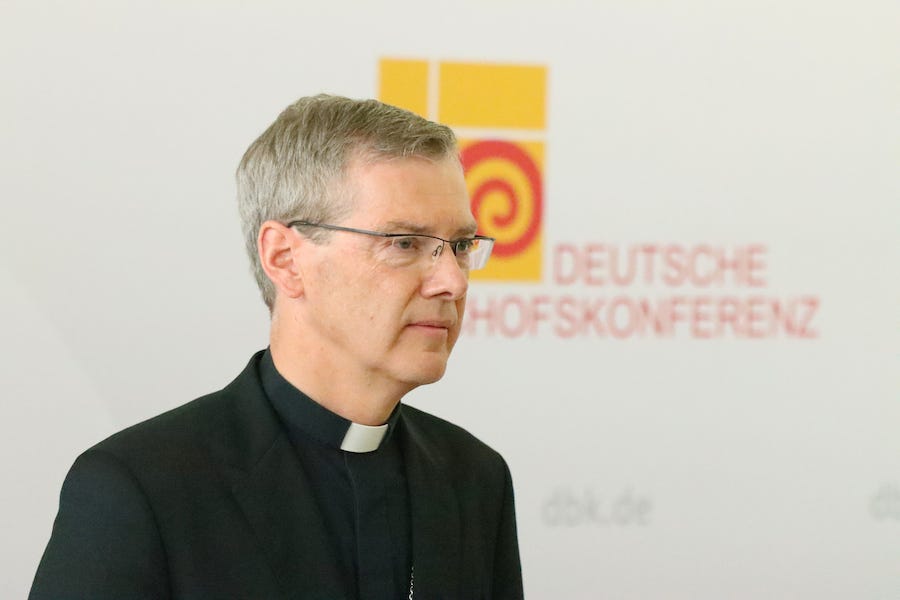
Wilmer made the remark on the opening day of the bishops’ Sept. 28- Oct. 1 plenary meeting in Fulda.
He told German media: “There is currently no news regarding the synodal conference. We are waiting for the recognitio [Vatican approval] for the draft statutes. I have mentioned this before, and I hope you will receive a response by the end of this year.”
Wilmer personally submitted the synodal conference statutes to the Vatican on March 31, 2026. A photograph showed him placing the document in the hands of Archbishop Filippo Iannone, prefect of the Dicastery for Bishops.

What is the synodal conference? What’s happening to its statutes? And is the apparent delay surprising?
What’s the synodal conference?
The proposal for a new, permanent national synodal body in Germany emerged from the synodal way, an initiative that brought together bishops and select lay people between 2020 and 2023 to discuss sweeping changes to Catholic teaching and practice.
The initiative produced 150 pages of resolutions calling, among other things, for women deacons, a re-examination of priestly celibacy, lay preaching at Masses, greater lay involvement in selecting bishops, and a revision of the Catechism of the Catholic Church on homosexuality.
But arguably the most controversial resolution, passed in September 2022, proposed a permanent “advisory and decision-making body” composed of bishops and select lay people.
The new body would “take fundamental decisions of supradiocesan significance on pastoral planning, future perspectives of the Church, and financial and budgetary matters of the Church that are not decided at diocesan level.”
It would replace an institution known as the Joint Conference, a consultative body that has brought together representatives of the bishops’ conference and the ZdK roughly twice a year since 1976.
The resolution said the new permanent body should be established “by March 2026 at the latest.”
In November 2025, an interim body called the synodal committee finalized the statutes of the permanent body, to be known as the synodal conference. Members of the lay Central Committee of German Catholics, or ZdK, approved the statutes days later.
The German bishops endorsed the text at their plenary assembly in February 2026, the final step before the document was submitted to Rome for recognitio ad experimentum — approval on an experimental basis for a fixed period.
The draft statutes adopted in November 2025 defined the synodal conference as “a synodal body in which bishops and other members of the faithful, in accordance with their common baptismal dignity and their respective vocations, deliberate together and take decisions in order to fulfil the Church’s mission.”
The draft added that the new body “respects the constitutionally established order of the Church and safeguards the rights of diocesan bishops and of the German bishops’ conference, as well as the diocesan procedures and bodies.”
That statement was an attempt to reassure Vatican officials alarmed that the proposed body could potentially usurp the authority of the bishops’ conference and undermine the episcopal office as expressed in the documents of Vatican Council II.
Only a third of the synodal conference’s members are bishops. Another third are ZdK members. The final third were elected by participants in the synodal way’s sixth and final plenary assembly, held in Stuttgart in January 2026. The statutes say that decisions require a two-thirds majority of votes to be passed. This means that a decision could be adopted without any bishops voting for it.
Synodal way organizers announced in November 2025 that the synodal conference’s first meeting would take place on Nov. 6-7, 2026, in Stuttgart, followed by a second meeting on April 16-17, 2027, in Würzburg, subject to Vatican approval.
What’s happening with the statutes?
When Pope Leo XIV was asked about the synodal conference during an inflight press conference in November 2025, he replied, somewhat enigmatically: “We shall see.”
But the Vatican has made no public comment on the statutes since it received them in March 2026, creating an air of uncertainty around the document.
As the text was handed to Archbishop Iannone, the Dicastery for Bishops seems to be the Vatican office primarily responsible for assessing the statutes. Cardinal Mario Grech, the secretary general of the Vatican’s Synod of Bishops, appeared to confirm this in a recent interview.
Bishop Wilmer first hinted in May 2026 that the Vatican’s recognitio would not be granted before the synodal conference’s first scheduled meeting in November 2026.
In an August 2026 interview, Wilmer said: “The statutes are currently being reviewed in Rome. I’ve been told by the people in charge there that it will take a little more time. I’m confident that we’ll make progress on this.”
At the end of August, the ZdK confirmed the inaugural meeting had been postponed.
Archbishop Hubertus van Megen, the new apostolic nuncio to Germany, said in a Sept. 23 interview that he planned to visit Rome to inquire about the status of the synodal conference.
“As far as I know, the statutes are currently being studied by various dicasteries. To be honest, however, I can’t say much yet about where things currently stand,” he commented.
“I hope to be able to travel to Rome at the end of October. One of the main reasons for doing so is to listen and get a sense of where we are in this discussion and how the curia views the matter.”
Ja, aber?
Most German Church figures seem to believe that Rome will approve the statutes, rather than reject them.
Bishop Stefan Oster, for example, is an avowed critic of the synodal way who refused to join the interim synodal committee that paved the way for the synodal conference. But in March 2026, he said he believed Vatican approval would be forthcoming.
“Rome also has an interest in ensuring that nobody comes out of this looking like they’ve lost face,” he said.
In September 2026, Oster said a Vatican response would probably not arrive before spring 2027.
In a Sept. 18 article for the German version of the theological journal Communio, the theologian Jan-Heiner Tück predicted that the Vatican’s response would be “Ja, aber” (“Yes, but”).
“A complete veto from Rome would be understood in Germany as a defeat for the synodal way as a whole. It could strengthen those forces that already accuse Rome of being insufficiently willing to pursue reform. For Pope Leo XIV, who, out of concern for the unity of the Church, has to contain tensions, this would be politically and pastorally unhelpful,” Tück wrote.
“An unqualified approval, on the other hand, would also be difficult. It could create the impression that Rome accepts a new national decision-making structure whose relationship to the episcopal office has not been sufficiently clarified. A ‘yes, but’ could avoid both dangers.”
Tück outlined what a “yes, but” might look like, suggesting that Rome could insist on diocesan bishops’ freedom to reject synodal conference decisions, require episcopal approval for specific types of decisions, make it clear that the synodal conference does not have oversight of bishops, clarify the nature of the body’s financial powers, and better define the relationship between the synodal conference, the bishops’ conference, and individual bishops.
Yet not everyone in Germany is confident that the Vatican will approve the request for recognitio ad experimentum.
The canon lawyer Heribert Hallermann argued that the statutes don’t meet the formal requirements for approval. He suggested, for example, that they should have been drafted by the German bishops’ conference — a body formally recognized in Church law — rather than the synodal committee.
Hallermann also claimed that the statutes failed to address Rome’s fundamental concern, about the undermining of episcopal authority.
He said: “It is objectively untrue that all of the curia’s comments were incorporated into the draft statutes; for example, the concerns that the synodal conference might take precedence over the bishops’ conference were not addressed — quite the contrary!”
Meanwhile, frustration is growing among German lay groups that enthusiastically supported the synodal way.
In a Sept. 23 joint statement, the German Catholic Women’s Association, the Catholic Women’s Association of Germany, and We Are Church Germany said: “Rome’s continued failure to recognize the statutes for the planned synodal conference is more than disappointing.”
“However, this must not be used as a pretext to slow down the reform process in Germany. The synodal assembly has passed resolutions. Now the German bishops must demonstrate that these joint resolutions are more to them than non-binding declarations of intent by consistently implementing the resolutions in their respective dioceses and thus continuing to bring about a synodal Church.”
Is the perception that Rome is slow-walking the synodal conference statutes valid? Perhaps it looks that way if your measure is the November 2026 date set for the synodal conference’s inaugural meeting.
But the notion that Rome could issue a decision within 220 days of receiving the draft statutes was somewhat unrealistic. While the Vatican can take quick decisions when it judges them necessary, it tends to take its time when granting recognitio. The more complex the document, the longer the process generally takes.
The synodal conference statutes touch on deep and, in some respects, unresolved issues of episcopal authority and lay responsibility. While the Dicastery for Bishops appears to be overseeing the process, other offices are likely to be involved, perhaps including the Dicastery for the Doctrine of the Faith and the Secretariat of State, adding further complexity.
How long should we expect the process to take? Consider the case of Australia. The decrees of the country’s Fifth Plenary Council were submitted to the Vatican for recognitio in 2022. Four years later, they still haven’t been approved.
The rising impatience in Germany suggests a lack of understanding of Vatican procedures. Perhaps this isn’t surprising given that speed was of the essence during the German synodal way. It was sheer velocity that allowed the organizers to race past the Vatican’s many “stop signs” and cross the finishing line in 2023. But this may have created a false perception that the Vatican too can be made to work according to an externally imposed timetable.
Perhaps Bishop Wilmer has reasons to be confident that Rome will respond by the end of 2026. But if it’s merely a wish, he risks adding to the growing restlessness in Germany if there is no decision forthcoming.
It is clear by now that while the synodal conference’s architects think in months, Rome still thinks in centuries.
"The rising impatience in Germany suggests a lack of understanding of Vatican procedures."
Unsurprising given that the majority of the synodal suggestions lack an understanding of the Catholic faith.