German women’s group’s abortion stance ‘not Catholic,’ says bishop
Bishop Algermissen called a new policy adopted by the Catholic Women’s Association of Germany 'completely unacceptable and downright intolerable.'
A German bishop has sharply criticized a leading Catholic women’s association’s call for Catholic hospitals in the country to perform abortions.
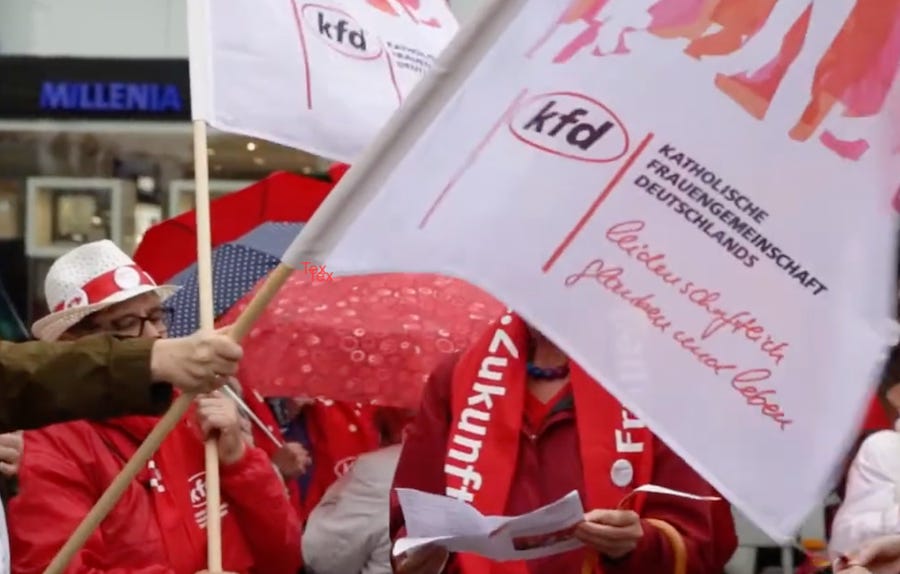
Bishop Heinz Josef Algermissen said June 11 that a new policy paper on abortion adopted by the Catholic Women’s Association of Germany was “not Catholic.”
“That a Catholic organization is seriously demanding that the killing of children before birth ‘must also be possible in Catholic hospitals’ is completely unacceptable and downright intolerable,” said Algermissen, the emeritus bishop of Fulda and chairman of the pro-life group Seelsorge für das Leben.
Members of the Catholic Women’s Association of Germany ― known by its German initials kfd ― adopted the policy paper by a large majority at the organization’s June 4-6 national assembly in Mainz.
The text argued that there were significant regional variations in the provision of abortion across Germany and that the gaps “must be urgently closed.”
It said: “Catholic-run hospitals are subject to Catholic labor law, a special ecclesiastical law that allows for deviations from state law when Church principles are at stake. Doctors in Catholic hospitals are not permitted to perform abortions. This includes abortions performed for medical reasons. The exception is an acute threat to the mother’s life. The kfd demands that abortions must also be possible in Catholic hospitals.”
It added: “Clear political and institutional framework conditions are needed to ensure nationwide medical provision for abortion, and to reduce discrimination and stigmatization within the healthcare system. Equally important is the assurance that health insurance will cover the costs of abortions.”
Algermissen, who retired as Bishop of Fulda in 2018 at the age of 75, said: “The killing of an innocent and defenseless child in the womb does not constitute a medical service. Nor is an unwanted pregnancy an illness. Attempting to shift the costs of the killing of children before birth onto the community of insured individuals trivializes and undermines the prohibition against killing.”
The kfd, which traces its origins back to 1856, is a private association of the faithful subject to the oversight of the German bishops’ conference.
The group, which describes itself as Germany’s largest Catholic women’s organization, with around 265,000 members, adopted the policy paper amid a nationwide debate over Section 218 of the German Criminal Code, which generally criminalizes abortion, except in specified circumstances.
Abortion in the first 12 weeks of pregnancy is permitted, provided a woman undergoes mandatory counseling, observes the required waiting period, and the abortion is performed by a physician.
In 2024, a cross-party group introduced a bill in the German parliament seeking to remove abortions in the first 12 weeks from the scope of Section 218, making them lawful, rather than simply exempt from punishment. The bill failed to advance.
It was against this background that the kfd adopted the text entitled “Between the Protection of Life and Self-Determination: The kfd’s Positions and Perspectives on Section 218 of the German Criminal Code.”
The policy paper acknowledged that life begins at conception. But it argued that the unborn child’s right to life “stands in tension with a woman’s right to self-determination.”
As well as calling for Catholic hospitals to provide abortions, the paper advocated free access to contraceptives, “early and continuous” sex education, and the appointment in every diocese of “a contact person for sexual education.”
The document also criticized prominent German pro-life initiatives, arguing that they were associated with far-right networks.
It said: “At gatherings of the ‘pro-life’ movement, not only are anti-feminist, authoritarian, and Christian fundamentalist views and positions disseminated, but they are also at times ethno-nationalist, racist, homophobic, and transphobic, or they relativize the Holocaust.”
In his critique of the kfd paper, Bishop Algermissen highlighted the document’s reference to conscience as a possible justification for opting for abortion.
He said: “If conscience were to offer such advice, it would merely reveal that the conscience in question has not been sufficiently formed. A properly formed conscience will regard the teaching of the Catholic Church, both on this and on other matters, as binding and personally obligatory.”
The bishop cited Pope Leo XIV’s June 8 address to the Spanish parliament, in which he said that human life must be safeguarded from conception to natural death, and a nation’s moral greatness is shown “in its capacity to accompany, protect, and love those lives that are most fragile.”
Algermissen commented: “A Catholic organization that distances itself from this concept distances itself from the Church as the mystical Body of Christ — and thus from Christ himself.”
Cornelia Kaminski, the national chairwoman of Action Right to Life for All, said the kfd paper was marred by “a glaring lack of knowledge.”
She said: “The claims made in the position paper on the German pro-life movement are completely absurd. Not only do the language and tone lack any sense of solidarity, but they also exude precisely the kind of aggression that the pro-life movement is accused of.”

Lord, have mercy on us and may the Sacred Heart of your Son inflame our hearts to follow You alone. Open the hearts of the German Church to return to You.