German youth body keeps More as patron, despite ‘polemical’ opposition to Reformation
The Katholische Junge Gemeinde voted to retain St. Thomas as its patron despite 'his rigid adherence to Church structures.'
A German Catholic youth organization has voted to retain St. Thomas More as its patron after a two-year review of his suitability.
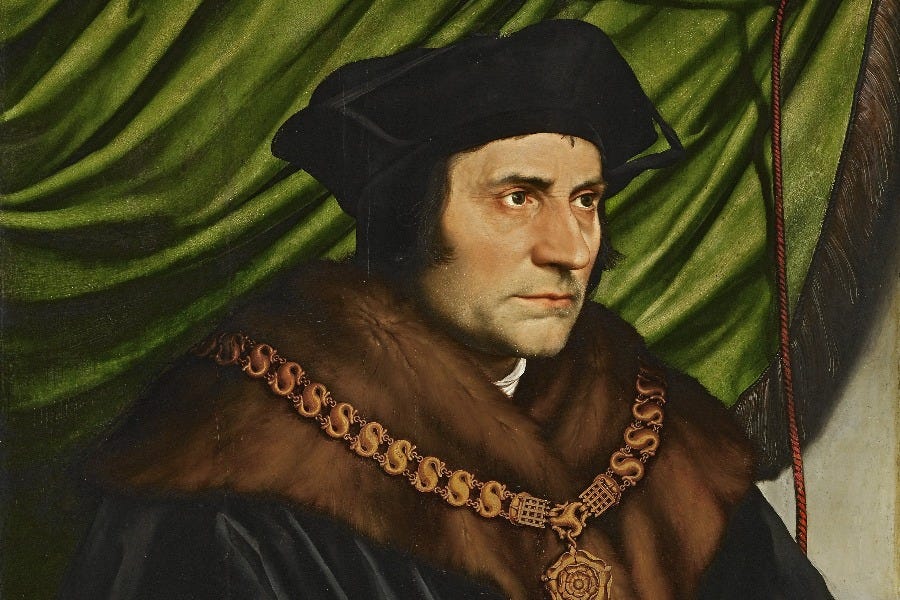
The Katholische Junge Gemeinde adopted a resolution at its May 27-31 annual national assembly keeping the 16th-century English martyr as its patron, “while also acknowledging and critically assessing problematic aspects of his life.”
More served as Lord Chancellor, England’s top judicial officer, from 1529 to 1532. He opposed Henry VIII’s break with Rome and was executed in 1535 for refusing to swear an oath recognizing the king as head of the Church in England.
More was canonized in 1935 and proclaimed the patron saint of statesmen and politicians in 2000. He was portrayed as a hero of conscience in the 1960 play “A Man for All Seasons,” but presented as a harsh fanatic in the 2009 novel “Wolf Hall.”
The KjG, which was founded in 1970 and has around 50,000 members, said that More’s negative features included “his disparaging and polemical attitude toward the concerns and aspirations of the Reformation.”
The resolution also argued that More engaged in “the persecution of so-called heretics — that is, people whose views were deemed contrary to Catholic doctrine — including executions and burnings at the stake during his time in government.”
It also criticized “his rigid adherence to Church structures that he himself recognized as needing reform.”
But the resolution praised More for his “fidelity to conscience,” his humanist ideals, “including education for all genders,” his sense of humor, and the influence of his 1516 work “Utopia.”
The vote came at the end of an internal review process that began after the KjG’s branch in the Diocese of Münster passed a resolution in February 2024 distancing itself from More.
The resolution, adopted by 42 votes to 1, with 1 abstention, was entitled Thomas Morus - ein nicht so nicer Dude! (“Thomas More — not such a nice guy!”). It called for More’s patronage of the KjG to be reviewed at the national level.
The resolution noted that during an educational trip to London, England, in October 2022, members became aware of “critical issues” regarding More, which, it said, conflicted with the KjG’s values. These included his treatment of supporters of the Reformation and his stand for “the traditional values of the Catholic Church.”
In May 2024, the KjG’s annual national assembly voted, by 65 to 2, with 3 abstentions, to form a committee to consider whether More was an appropriate patron saint.
The committee reported back at the KjG’s 2026 national assembly. The resolution approved by members said that during the review “it became clear that there are difficulties in finding a contemporary approach to saints and patronages.”
It said: “Both the traditional perspective and the concept of ‘holiness’ present challenges, arising both from theological considerations and from the personal ways in which members relate to Thomas More.”
“For this reason, we reaffirm our established practice within the association of presenting diverse images of God, role models, and saints — especially in spiritual settings — to enable a variety of paths to faith.”
The resolution explained that the review’s findings would be posted on the KjG website and shared on social media.
It said: “We want to provide members of the KjG at all levels with opportunities to engage more deeply with Thomas More as the association’s patron saint, so that they can develop their own view of the historical figure and their own possible relationship to St. Thomas More.”
A profile of More on the KjG’s website says that the saint serves as a role model for members, encouraging them to think critically, act responsibly, listen to their consciences, and retain a sense of humor.
“Thomas More makes it clear that ‘merely going along with the crowd’ and ‘endless debate’ — without a willingness to make decisions and take action — offer no prospect of success,” it says.
“In many ways, we as young Christians are called upon to make decisions. For example, we must decide how to live out our faith and shape our lives in a way that is relevant to today’s world. The life of the Christian Thomas More can serve as a guide for us in this endeavor.”
The body’s criticism of More, even while voting to retain him as patron, is likely to strike many as surprising.
Apart from his veneration as a saint and martyr in the Catholic Church, and his being treated as an iconic figure in English Catholic history, he is held in high esteem among English Protestants, too.
The Church of England commemorates More as a “martyr of the Reformation,” and the Anglo-Irish essayist and Anglican clergyman Jonathan Swift described him as “a person of the greatest virtue this kingdom ever produced.”
At the time he was declared patron of statesmen and politicians, Pope St. John Paul II noted that in his own lifetime More was “highly esteemed by everyone for his unfailing moral integrity, sharpness of mind, his open and humorous character, and his extraordinary learning.”
“In fidelity to his principles, he concentrated on promoting justice and restraining the harmful influence of those who advanced their own interests at the expense of the weak,” said the pope, while noting the saint’s “inflexible firmness in rejecting any compromise with his own conscience.”
Noting the modern importance of More’s example, St. John Paul said that More answered the “need felt by the world of politics and public administration for credible role models able to indicate the path of truth at a time in history when difficult challenges and crucial responsibilities are increasing.”
“His life teaches us that government is above all an exercise of virtue. Unwavering in this rigorous moral stance, this English statesman placed his own public activity at the service of the person, especially if that person was weak or poor; he dealt with social controversies with a superb sense of fairness; he was vigorously committed to favoring and defending the family; he supported the all-round education of the young,” said the pope.
“His profound detachment from honours and wealth, his serene and joyful humility, his balanced knowledge of human nature and of the vanity of success, his certainty of judgement rooted in faith: these all gave him that confident inner strength that sustained him in adversity and in the face of death. His sanctity shone forth in his martyrdom, but it had been prepared by an entire life of work devoted to God and neighbor.”


I think St Thomas More should withdraw HIS patronage of the group!
Harumph! 😤
Sounds like the "problematic" aspects they identified of St. Thomas More are indeed his most wholesome and Christlike qualities.