‘God gave the growth’: Mar Srampickal on 10 years of Britain’s Syro-Malabar eparchy
“The Syro-Malabar Eparchy of Great Britain ... can play a significant role in the revival of the Catholic Church.”
Ten years ago this week, Pope Francis created a diocese for Syro-Malabar Catholics in Great Britain.
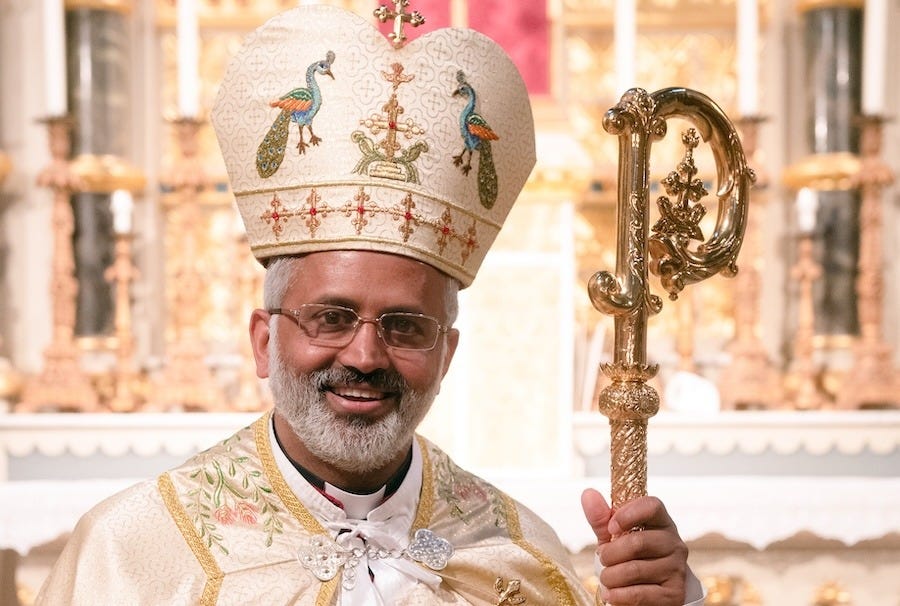
On July 28, 2016, the Argentine pope named Fr. Joseph Srampickal as the first bishop of the Syro-Malabar Eparchy of Great Britain, based in Preston, a city with a deep Catholic history in northwestern England.
Srampickal, who was then vice-rector of Rome’s Pontifical Urban College for the Propagation of the Faith, was consecrated as a bishop Oct. 9 at the Preston North End soccer stadium at a ceremony attended by almost 10,000 people.
In the decade that followed, he sought to establish the eparchy on a firm footing, founding parishes, missions, and proposed missions (communities in formation) across Britain, to serve Syro-Malabar Catholics who migrated from India and the British-born generations that followed.
With their own eparchy, Syro-Malabar Catholics have gained a new prominence within the wider Catholic community. In a country where Catholic gatherings are often relatively small, they have turned up in their thousands on pilgrimages to the national Marian shrine of Walsingham and at Handhoosa, the annual Syro-Malabar youth gathering.
In an email interview with The Pillar, Srampickal described the eparchy’s birth and evolution, the joys and challenges of its first 10 years, and how Syro-Malabar Catholics can help to evangelize Britain.
This interview has been edited for clarity and length.
The Syro-Malabar eparchy of Great Britain celebrated its 10th anniversary July 28. Could you explain the background to its creation, and why Church authorities decided the time was right to establish it?
For several decades, Syro-Malabar Catholics have migrated to Great Britain, with migration increasing significantly over the past 20 years. Before the eparchy’s establishment, our faithful were welcomed with great generosity into their local Latin Catholic parishes, for which we remain deeply grateful. They received generous pastoral care and were able to participate fully in the sacramental life of the Church.
However, as the Syro-Malabar community continued to grow, it gradually became apparent that this arrangement, though pastorally generous, was not enough to preserve the distinct identity and heritage of our Church. Many, especially those of the second generation, were growing up with little awareness of their Eastern Catholic heritage, the richness of the East Syriac tradition, and the unique identity of the Syro-Malabar Church.
During this period, the pastoral care of the faithful was provided in various ways. Syro-Malabar priests studying in Great Britain, priests serving primarily in Latin dioceses, and a small number of priests dedicated to the Syro-Malabar communities regularly traveled across the country to celebrate the Holy Qurbana (Mass) and administer the sacraments. Their generosity and sacrifice laid the foundations for the growth of the community. Nevertheless, as you can imagine, within this arrangement it was not possible to provide comprehensive pastoral care or to establish stable parish communities.
The Catholic Church has consistently taught that the Eastern Catholic Churches have both the right and the duty to preserve their own liturgical, spiritual, theological, and canonical traditions. The Second Vatican Council expressed this clearly in [the 1964 decree] Orientalium ecclesiarum 6: “All members of the Eastern rites should know and be convinced that they can and should always preserve their legitimate liturgical rite and their established way of life, [...] Besides, they should attain to an ever greater knowledge and a more exact use of them, and, if in their regard they have fallen short owing to contingencies of times and persons, they should take steps to return to their ancestral traditions.”
The Dicastery for the Eastern Churches discerned the need for a dedicated ecclesiastical structure to care for the growing Syro-Malabar community in Great Britain. The eparchy’s establishment was therefore not simply an administrative decision; it was a pastoral response to ensure that our faithful could live, celebrate, and hand on their own ecclesial tradition while remaining fully integrated within the communion of the universal Catholic Church.
This vision was beautifully articulated by Cardinal Leonardo Sandri, the then Prefect of the Dicastery for the Eastern Churches, in a [March 9, 2020] letter to me: “The mind of the Church when erecting an ecclesiastical circumscription outside the traditional territory is to assist the Eastern Catholic faithful belonging to their respective eparchy to grow in their sense of identification with their sui iuris [autonomous] Church by participating in their proper ecclesial life. This is the mission entrusted to you by Pope Francis for the Syro-Malabar faithful, so that their precious liturgical, theological, spiritual, disciplinary, and cultural heritage may flourish also in Great Britain.”
This statement captures the very purpose of the eparchy. Its mission is not simply to provide the Holy Qurbana in another language, but to foster a living Syro-Malabar Church in Great Britain: one in which the faithful can worship according to their own liturgical tradition, grow in their ecclesial identity, and pass on the rich spiritual, theological, canonical, and cultural heritage of their Church to future generations. In doing so, the eparchy also enriches the wider Catholic Church through the distinctive gifts of the East Syriac tradition.

What are your strongest memories of your consecration as the eparchy’s first bishop, and what vision did you have for the new eparchy?
What struck me most was the sheer number of people who had gathered in the stadium — nearly 10,000, as I was later told. Seeing so many people waiting with such eager anticipation brought to mind the words of Mt 9:36: “When he saw the crowds, he had compassion on them, because they were harassed and helpless, like sheep without a shepherd.”
Two memories from that day remain especially vivid. The first was the rain — which I have since realized is something of a hallmark of Great Britain. The second was the sight of two doves circling above the stadium during the ordination. At the time, I could not help but see them as a symbol of God’s blessing upon the sacred event taking place.
I was deeply moved by the devotion of the Syro-Malabar faithful, who had traveled from across Great Britain and endured the cold, the wind, and the rain in order to be present for the ordination.
That day also strengthened my own vision of the priesthood: to be a shepherd for the people entrusted to my care and to help them live out their identity as Syro-Malabar Catholics in a Western context. That, after all, is precisely why I was sent and what I believe to be the will of the universal Church.
How has the eparchy developed over its first decade?
The eparchy’s development over the past decade has been guided by two successive five-year pastoral plans. The first, implemented during the initial five years, focused on building our community and gathering our faithful into one vibrant and functional ecclesial body. To achieve this, each year was dedicated to a particular group within the Church: children, youth, married couples, family units, and parishes.
The second five-year pastoral plan sought to help the eparchy and its faithful discover, appreciate, and live the Syro-Malabar heritage in a more concrete way. Accordingly, each year was devoted to a different dimension of our tradition, enabling our faithful to experience the richness of their heritage through the study and practice of the liturgy, theology, spirituality, discipline, and culture.
Over the past decade, we have also witnessed remarkable structural growth, made possible by the grace and guidance of Isho M’shiha [Jesus Christ in Syriac]. Seven new parishes have been erected, together with 72 missions and 31 proposed missions.
Today, more than 80 priests minister to our communities stretching from Inverness to Plymouth.
We have also established a pastoral house at Maryvale and a retreat center at Darlington, providing places where the entire eparchy can gather for formation, fellowship, and worship. In addition, a number of dedicated apostolates now serve the diverse needs of our faithful, including youth, altar servers, catechists, liturgy, and other pastoral ministries.
Looking back over these 10 years, what gives me the greatest joy is the profound impact the eparchy has had on our young people. The vast majority of our missions now have active chapters of the Syro-Malabar Youth Movement. Through these local units, together with regional and eparchial gatherings, we are able to provide our young people with a close-knit community that strengthens their faith through the witness and friendship of their peers.
I firmly believe that catechesis alone is not enough. Young people also need opportunities to form holy friendships that will support and sustain them in a culture increasingly hostile to Christian values.
My greatest joy is seeing the eparchy bear lasting spiritual fruit in the lives of its youth. The number of vocations with which Isho M’shiha has blessed the eparchy over the past decade speaks eloquently of the work He is accomplishing among our young people. I have had the privilege of ordaining two priests. We currently have five seminarians, one professed to the consecrated religious life, and four others in formation. These are clear signs of God’s abundant blessing upon our eparchy.
By God’s grace, we have also been able to provide pastoral care even to relatively small and remote communities, including those in Inverness, Scotland, and on the Isle of Wight. Knowing that we are able to help Syro-Malabar Catholics grow in their Oriental Catholic tradition through the regular celebration of the Holy Qurbana (Holy Mass) and catechesis, regardless of the size of their community, fills me with profound gratitude to the Lord.
Nevertheless, the eparchy has faced considerable challenges, particularly during its early years. One of the greatest obstacles has been the lack of permanent infrastructure where our communities could gather and celebrate the Holy Qurbana. This has inevitably limited the eparchy’s growth and its ability to provide comprehensive pastoral care to its faithful.
Language has presented another significant challenge. While many first-generation migrants naturally prefer Malayalam, the native language of Kerala, in the liturgy, the second generation is generally more comfortable worshiping in English.
Recognizing this pastoral reality, the eparchy has sought to implement a gradual transition toward greater use of English in the liturgy, while continuing to respect the linguistic heritage of the first generation. We are convinced that this approach will better serve future generations and enable them to participate more fully in the liturgical life of the Church.

How has the eparchy helped families preserve their Syro-Malabar identity while also becoming part of the local Church and wider British society?
Through commissions such as the Bible Apostolate and Catechism, we have been able to pass on the traditions, teachings and values of the Syro-Malabar Church to the younger generation, ensuring that their faith remains strong across generations.
This is achieved through almost all parishes, missions and proposed missions, which run regular Sunday School programs. Children from Year 1 to Year 12 [Grades 1-12] take part in a sophisticated catechetical program that supports families in sharing their faith.
In addition, every year the eparchy holds the Bible Kalotsavam (Bible Festival), where children, youth and adults participate in numerous faith-centered events including the Suvara Bible Quiz. Competitions range from painting and sketching to Margam Kali, a traditional dance form that originated among the Nazranis of Kerala. Participants compete at the local mission level before progressing to the regional and eparchial levels, where crowds of around 5,000 gather.
Syriac hymn competitions held under the leadership of the Women’s Forum help our women to learn the ancient and liturgical hymns.
Since 2023, the eparchy has also held an annual Urha (The Way) Quiz, which follows a similar format and further supports families in understanding the hallmarks of belonging to the Syro-Malabar Church.
At the same time, we have tried our very best to maintain the collaboration with the wider Catholic community through initiatives such as WeBelieve and Adoremus, helping Syro-Malabar Catholics to connect with the local Church and contribute to the mission of the Body of Christ. The collaborative efforts of the Catholic Bishops’ Conference of England and Wales, and similarly in Scotland, have allowed our families to feel at home away from home.
The witness of our families has been one of the greatest means of integrating into British society. I take great joy in visiting many homes during my pastoral visits and sharing in their profound faith. Many of our migrants have contributed immensely to the healthcare sector, strengthening the NHS and wider society while demonstrating their commitment to serving others. I am confident that our second-generation migrants will continue to enter a wider range of professions and remain steadfast in their faith.

How have the Handhoosa events helped to engage young Syro-Malabar Catholics, and what have you learned from them about the faith of the younger generation?
Handhoosa, meaning “Happiness,” is our annual youth gathering that has helped engage young Syro-Malabar Catholics across Great Britain by bringing them together to grow in their liturgical identity and build a strong sense of community.
Many who begin their faith journey through Catechism continue by joining the Youth Apostolate. From these events, I have learned that young people value authentic relationships and opportunities to actively live out their faith. Through participation in unit-, regional- and eparchial-level activities, they have embraced the scope and breadth of the eparchy. They form meaningful friendships across the eparchy, consequently enabling them to live out and share their faith boldly in schools, universities and workplaces.
The establishment of more than 90 local Syro-Malabar Youth Movement units has been a remarkable blessing for the eparchy. By inviting young people to organize prayer meetings, lead the choir, and take on various other responsibilities, they are not simply participating in parish life. They are becoming missionary disciples.
As St. Paul reminds us, “For just as the body is one and has many members, and all the members of the body, though many, are one body, so it is with Christ” (1 Cor 12:12). This spirit of unity and participation helps young people recognize that each has a unique role to play in building up the Body of M’shiha.
Have there been any pastoral needs that have proved especially difficult to meet?
One of the greatest pastoral challenges I have encountered has been the eparchy’s geographical spread. While having a pastoral center in a central location such as Birmingham has been a great blessing, I am also mindful of the challenges faced by families and communities living at the furthest ends of the country. For some, distance can make it difficult to access regular pastoral support, participate in parish activities and feel fully connected to the wider eparchy.
As the eparchy continues to grow, I recognize the increasing need for more dedicated places of worship. Many communities are currently dependent on shared spaces or rented facilities, where limitations on availability, timing and resources can sometimes restrict their ability to gather freely and develop a strong parish life. Having churches and suitable places of worship of their own would provide communities with a greater sense of belonging and create a stable environment where faith, fellowship and pastoral care can flourish.
Another important pastoral need is the availability of more full-time parish priests who can journey closely with our communities. As Pope Francis reminds us, “a good shepherd smells like the sheep.” This calls us to ensure that our priests are not only ministers of the sacraments but also companions who know the joys, struggles and everyday realities of the faithful entrusted to their care. Having priests who are fully present within communities would greatly strengthen pastoral outreach, nurture families in their faith and help the eparchy respond more effectively to the needs of its growing faithful.
Despite these challenges, I remain filled with hope and gratitude for the dedication of our priests, religious, families and communities. These challenges also present opportunities for us to deepen our commitment to one another and continue building a vibrant Syro-Malabar Church in Great Britain.

In what ways has the eparchy enriched the wider Catholic Church in Great Britain over the past decade? And do you think the eparchy has a role to play in the evangelization of the country as a whole?
Over the past decade, the eparchy has enriched the Catholic Church in Great Britain through the reverent celebration of the Holy Qurbana, the faithful proclamation of the Word of God, and by fostering life-changing encounters with M’shiha. By the grace of Almighty God, the eparchy has nurtured communities that are first evangelized and then sent forth as missionary disciples to evangelize others.
The witness of our faithful, especially those serving in the health sector, has become a living proclamation of the Gospel. Through their care for the sick and vulnerable, they reveal the healing presence of M’shiha and bear witness to His love in places where hope is most needed.
I firmly believe that the eparchy has a vital role to play in the evangelization of Great Britain. By sharing the richness of our liturgical tradition, our missionary spirit, and our joyful witness to M’shiha, we can help renew faith, inspire vocations, strengthen families, and build vibrant Christian communities. As we continue to look to the future, I pray that the Ruha d’Qudsha – [Holy Spirit] will use our witness to bring many more people to know, love, and follow M’shiha.

Do you still encounter misunderstandings among Latin Catholics about the Syro-Malabar Church or the role of the eparchy?
My experience has been that the vast majority of Latin Catholics are welcoming, generous, and open to the Syro-Malabar Church. Their hospitality reflects the catholicity of the Church, where different traditions enrich one another in communion.
Where misunderstandings do arise, they are usually not due to reluctance but to a lack of awareness. Some are unfamiliar with the nature of the Syro-Malabar Church as a sui iuris Church and may not fully understand its traditions, structures, or the canonical role of the Eparchy. At times, this can lead to practices that do not fully respect the rights and discipline of the Eastern Catholic Churches.
As Orientalium ecclesiarum 6 reminds us, those engaged in ministry should be formed in the knowledge, respect, and appreciation of the rites, discipline, history, and spirituality of the Eastern Churches. Continued dialogue, collaboration, and mutual learning will strengthen communion and help us witness more fully to the richness of the universal Church.

What are your priorities and hopes for the eparchy over the next decade?
I strongly believe that the Syro-Malabar Eparchy of Great Britain, by fulfilling the mission entrusted to us by Isho M’shiha through His vicar in Rome, can play a significant role in the revival of the Catholic Church in Great Britain.
Unlike many ethnic communities within the Catholic Church in Great Britain, our eparchy enables its faithful to belong to a particular Church with its own liturgy, theology, spirituality and canonical discipline. By witnessing to the richness of our Eastern Christian tradition, we have the potential to contribute to a new evangelization and offer a distinctive spiritual witness to the Church in Great Britain.
To achieve this, the Syro-Malabar Church in Great Britain must gradually move beyond an exclusively Malayalam-speaking identity. Our aim is to make English the principal language of the liturgy, catechesis and the wider pastoral life of the eparchy, while remaining fully faithful to our Syro-Malabar heritage. The fostering of abundant local vocations will be essential to achieving this vision.
One of our principal priorities for the coming years will be to address the infrastructural challenges facing our eparchy, particularly the lack of churches and parish halls owned by our community. Dependence on shared facilities limits our ability to flourish and to live out our ecclesial heritage fully. The establishment of our own parishes and churches will greatly strengthen our mission and enable us to fulfill more effectively the purpose for which this eparchy was established.
Our catechetical program, which provides a structured 12-year formation for children and young people up to the age of 17, has served our community well. Likewise, our pastoral organizations have successfully encouraged the active participation of the laity in the life and mission of the eparchy, ensuring that their gifts and voices contribute to the growth of our Church.
In the years ahead, I hope to embrace the motto, “Evangelized to evangelize.” Having received the gift of faith, we must now become its joyful witnesses. We will encourage every member of the Syro-Malabar faithful to share the Gospel confidently in their families, workplaces, schools and every sphere of daily life, so that our eparchy may not only preserve the faith but also become an instrument of its growth throughout Great Britain.
The best way I can summarize the past decade in the life of the eparchy is with the words of 1 Cor 3:6: “I planted, Apollos watered, but God gave the growth.” Over these years, the eparchy and its faithful have worked tirelessly to fulfill the mission entrusted to us. Yet, as St. Paul reminds us elsewhere, “Yet not I, but the grace of God that was with me” (1 Cor 15:10). Whatever has been achieved during this past decade has ultimately been the work of God’s grace, guiding and sustaining our efforts.

