How Catholics are caught in the Cambodia-Thailand conflict
Despite its small size, the local Church is offering substantial help to the displaced.
Neither Cambodia nor its neighbor Thailand is strongly associated with the Catholic Church.
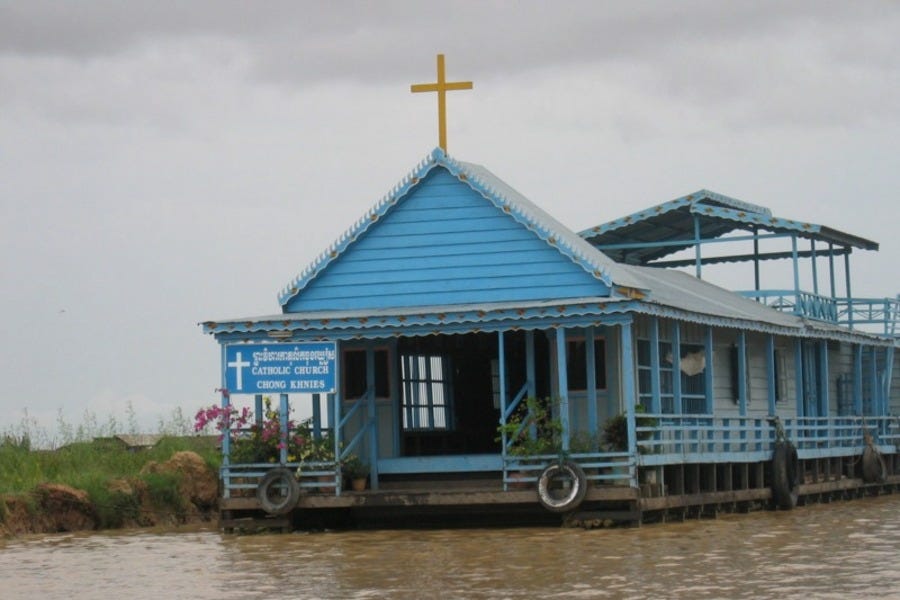
Nevertheless, Catholics on both sides of the border are caught in the latest flare-up of the Cambodia-Thailand conflict.
Who are the Catholics of Cambodia and Thailand? What is currently happening to them? And what are their prospects for the future?
The Pillar takes a look.
What’s the context?
Cambodia is a Southeast Asian nation of around 18 million people that borders Laos, Vietnam, and, of course, Thailand. The population is 97% Buddhist, mainly following the Theravada school, which predates the larger but newer Mahayana school. Buddhism is the state religion.
A 2019 census found that just 0.3% of Cambodians are Christian. Estimates of the number of Catholics vary widely, from around 20,000 to 75,000.
The Catholic presence in Cambodia dates back to the 16th century, when the Dominican missionary Fr. Gaspar da Cruz arrived from Portugal. He made little headway with the local population, as did his successors, even when Cambodia was a French protectorate from 1863 to 1953. The first Cambodian priest was only ordained in 1957.
Catholics were driven underground when the communist Khmer Rouge seized power in 1975, led by dictator Pol Pot. Many died in labor camps, including Bishop Joseph Chhmar Salas, the Vicar Apostolic of Phnom Penh, whose beatification cause opened in 2015. Others, such as the priest Paul Tep Im Sotha, were summarily executed.
That Cambodia is still something of a mission territory is indicated by the absence of any dioceses. There are only three jurisdictions: the Apostolic Vicariate of Phnom Penh, the Apostolic Prefecture of Kampong Cham, and the Apostolic Prefecture of Battambang.
The Apostolic Prefecture of Battambang, which runs along the Thai border, covers around 30,000 square miles — a territory roughly the size of Scotland — but serves fewer than 6,000 Catholics.
Thailand, a country of around 71 million people bordering Laos, Malaysia, and Myanmar as well as Cambodia, is approximately 93% Buddhist, largely also of the Theravada school. Christianity accounts for little more than 1% of the population.
There are fewer than 400,000 Catholics, who can also trace their history back to a 16th-century mission, led in this case by a French Franciscan called Bonferre. He was no more successful than Cruz in Cambodia. But later missionaries persevered, despite often sharp reversals, in the goal of evangelizing the Kingdom of Siam, the precursor of modern-day Thailand.
In favorable times, Catholics built up institutions such as schools, orphanages, and hospitals. In unfavorable times, they suffered persecution, such as the seven Martyrs of Songkhon, who were killed in 1940 on suspicion of spying for France and beatified in 1989.
The Catholic Church in Thailand is organized into 11 dioceses, suggesting it is more developed than in Cambodia. The Diocese of Ubon Ratchathani covers the main provinces that border Cambodia. It serves around 25,000 Catholics.
What’s happening?
Cambodia and Thailand have been locked in a territorial dispute since Cambodia gained independence from France in 1953. The main flashpoint was initially the ancient Preah Vihear temple, located on a mountain range that provides a natural border between the two countries.
The International Court of Justice in the Hague has twice ruled that the temple is in Cambodia, in 1962 and 2013. But the border dispute, rooted in the French colonial era, has never been settled by joint demarcation by Cambodia and Thailand.
The disagreement erupted into an armed conflict in 2008 and reached a peak in 2011. The situation remained tense until July 2025, when renewed fighting broke out. Both Cambodia and Thailand blamed each other for initiating hostilities and each claimed it was responding in self-defense.
U.S. President Donald Trump intervened, demanding an immediate ceasefire, which came into effect days later. A comprehensive peace agreement was signed in October 2025 in Kuala Lumpur, Malaysia.
But a series of border incidents escalated in early December 2025 into another armed confrontation, with shelling, air strikes, and drone attacks.
The fighting has had a heavy impact on civilians on both sides of the border. Hundreds of thousands of people have been displaced. Infrastructure, including hospitals, has been destroyed. Reports indicate that Cambodians working in Thailand have faced threats, while Thais have been assaulted by Cambodians in South Korea.
Meanwhile, the Catholic Church has strived to help the local population on both sides of the border.
Divine Mercy Parish in Khnach Romeas, northwestern Cambodia, is providing food and temporary shelter to families fleeing the renewed fighting. Fr. Damo Chour, the priest-in-charge, is also seeking to integrate displaced children into the local school system.
In Thailand, the dioceses of Ubon Ratchathani, Nakhon Ratchasima, and Chanthaburi are offering urgent assistance to evacuees.
The Catholic Bishops’ Conference of Thailand has asked “all dioceses, religious orders, Catholic organizations, and all benevolent Christians to show love and compassion to our brothers and sisters who are suffering through donations according to their ability via Caritas Thailand.”
Caritas Thailand was well-prepared for the latest outbreak of fighting because it had responded to the earlier clashes by designating areas of Catholic churches in the border region as initial evacuation centers and strengthening its ties with local government agencies.
Across the border in Cambodia, Bishop Olivier Schmitthaeusler, the Vicar Apostolic of Phnom Penh, has asked parishes to organize Masses and prayer services imploring peace.
What’s next?
In the short term, President Trump’s renewed involvement in the crisis could bring about another ceasefire. But in the long term, the underlying issues are likely to remain unresolved.
The latest clashes will have eroded whatever trust remained between the Thai and Cambodian authorities. Neither side appears ready to make the compromises that would be necessary to achieve joint demarcation of the border.
Pope Leo XIV appealed at his Dec. 10 general audience for a swift resolution to the crisis.
“I am deeply saddened by the news of the renewed conflict along the border between Thailand and Cambodia, which has claimed civilian lives and forced thousands of people to flee their homes,” he said.
“I express my closeness in prayer to these dear peoples, and I call on the parties to immediately cease fire and resume dialogue.”
His words are unlikely to have much clout given Catholicism’s marginal status in both countries. But the Catholic communities in Cambodia and Thailand will keep providing support to the conflict’s victims at a level disproportionate to their small size for as long as it’s needed.


Lovely to see a picture of the floating church on the Tonle Sap lake, which I have visited a number of times. The Catholic Church in Cambodia is indeed very small, but punches well above its weight in terms of its contribution to society - in education, healthcare, and particularly support for people with disabilities. I am planning to make my fifth visit to Cambodia at the end of January - my parish is twinned with parishes in the NW of Cambodia, in the Apostolic Prefecture of Battambang. I know that the conflict with Thailand is having a serious effect on the many people in that part of Cambodia who go to work in Thailand. Either they have to return home, where there may be no work, or they are stuck in Thailand and cannot get back to visit their families. Note on Paul Tep Im Sotha, whom you mention, murdered by the Khmer Rouge. He was actually the first Apostolic Prefect of Battambang, so similar to a bishop, but in a missionary area that has not yet been raised to a diocese.